EUR/USD pulls back to 1.1330 on Dollar's short covering ahead of US inflation data
- EUR/USD trims gains as the US Dollar finds support ahead of the PCE inflation data release.
- A US federal court reversed the previous day's sentence blocking tariffs and sent the US Dollar tumbling on Thursday.
- In Europe, the focus will be on the German CPI due later today.

EUR/USD extends its reversal, and is trading near 1.1330 at the time of writing as investors trim their Dollar shorts, ahead of the release of April's US Personal Consumer Expenditures (PCE) Price Index numbers. The pair jumped on Thursday, after a US federal court reversed the block on US President Donald Trump’s tariffs, triggering a sharp US Dollar (USD) sell-off.
Investors’ concerns about Trump's trade policy, coupled with growing fears about US fiscal stability, heightened by a tax-slashing bill that is expected to add trillions of Dollars to an already high US debt, have been fuelling the “Sell America” trade and undermining the USD over the last two months.
In the macroeconomic front, Thursday's US data did little to improve markets' mood, with weekly Initial Jobless Claims rising beyond expectations and the Gross Domestic Product (GDP) confirming that the economy contracted in the first quarter.
In Europe, German Retail Sales data have failed to support the Euro (EUR), increasing concerns about the health of the Eurozone’s major economy, although the impact has been minimal. Investors’ focus is on the German Consumer Prices Index figures, due later in the day.
Euro PRICE Today
The table below shows the percentage change of Euro (EUR) against listed major currencies today. Euro was the strongest against the New Zealand Dollar.
| USD | EUR | GBP | JPY | CAD | AUD | NZD | CHF | |
|---|---|---|---|---|---|---|---|---|
| USD | 0.32% | 0.12% | -0.12% | 0.00% | 0.35% | 0.10% | 0.16% | |
| EUR | -0.32% | -0.17% | -0.47% | -0.31% | 0.06% | 0.10% | -0.16% | |
| GBP | -0.12% | 0.17% | -0.27% | -0.12% | 0.25% | 0.11% | 0.03% | |
| JPY | 0.12% | 0.47% | 0.27% | 0.15% | 0.58% | 0.39% | 0.36% | |
| CAD | -0.01% | 0.31% | 0.12% | -0.15% | 0.43% | 0.22% | 0.16% | |
| AUD | -0.35% | -0.06% | -0.25% | -0.58% | -0.43% | 0.04% | -0.20% | |
| NZD | -0.10% | -0.10% | -0.11% | -0.39% | -0.22% | -0.04% | -0.25% | |
| CHF | -0.16% | 0.16% | -0.03% | -0.36% | -0.16% | 0.20% | 0.25% |
The heat map shows percentage changes of major currencies against each other. The base currency is picked from the left column, while the quote currency is picked from the top row. For example, if you pick the Euro from the left column and move along the horizontal line to the US Dollar, the percentage change displayed in the box will represent EUR (base)/USD (quote).
Daily digest market movers: US Dollar finds support ahead of the PCE report
- The US Dollar dropped sharply after the US Court of Appeals paused the previous day’s ruling of the Court for International Trade, which blocked most of the levies introduced on April 2. The decision brought global trade uncertainty back to the table and increased pressure on all US assets. However, the Greenback found some footing on Friday, with investors bracing for the release of the US Personal Consumer Expenditures (PCE) Price Index, due later in the day.
- US PCE inflation is expected to have ticked up by 0.1% in April, after a flat reading in March, with the yearly rate easing to 2.2% from the previous 2.3% reading. The core figure, of higher relevance to the Federal Reserve (Fed), is expected to show the same monthly performance, with the yearly inflation down to 2.5% from 2.6% in March.
- Data released on Thursday revealed that the US Weekly Jobless Claims increased by 240K last week, well above the 230K expected. The previous week’s reading was revised down to 226K from the previously estimated 227K.
- Apart from that, the first quarter’s US GDP confirmed that the economy contracted, although at a slower-than-expected rate, -0.2% instead of the -0.3% previously reported.
- Furthermore, US consumer spending slowed down against expectations. The core Personal Consumption Expenditures eased to 3.4% in the first quarter, against the 3.5% expected, all in all increasing fears about the economic momentum.
- In the Euro Area, German Retail Sales have shown an unexpected decline in April. Retail consumption fell by 1.1% against expectations of a 0.2% increase, which reveals the soft momentum of the country’s economy.
- Italian GDP has confirmed a 0.3% growth in the first quarter, while the monthly CPI has stalled in May, and eased to 1.7% year on year, from the previous 1.9%, according to preliminary data from the Italian statistics office.
- The highlight today is on the German CPI , which is expected to show some moderation in April, with the yearly CPI steady at 2.1% and the core index easing to 2% from the previous 2.2%. These figures add to the case for further European Central Bank (ECB) easing in June and might hurt the Euro.
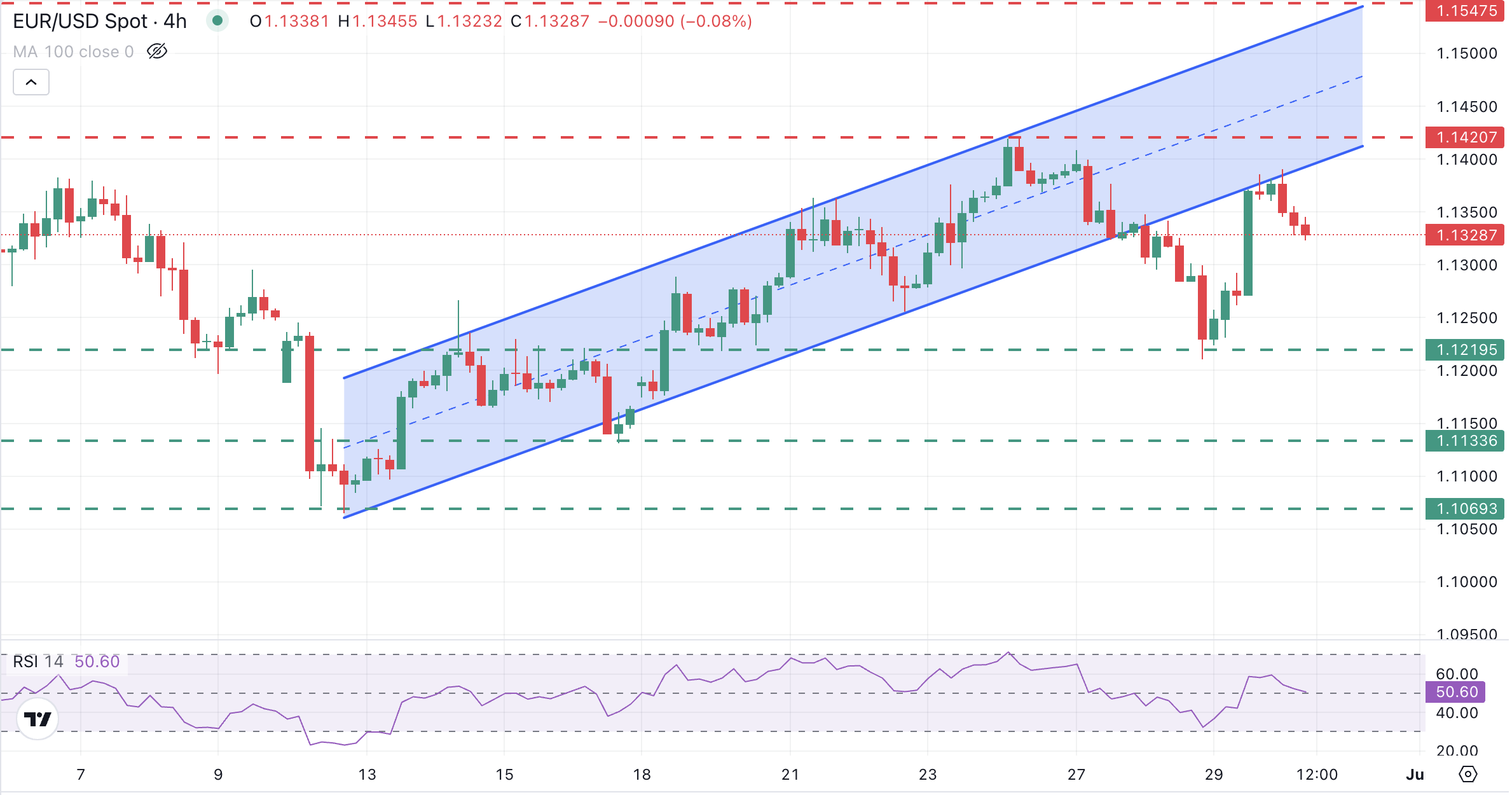
Technical analysis: EUR/USD remains capped by the reverse trendline at the 1.1390 area
EUR/USD bounced sharply on Thursday, printing a bullish engulfing candle on the daily chart. This is a positive sign, but it needs to be confirmed by further appreciation above a previous trendline support, now turned resistance, at 1.1390, and also above the weekly high, at 1.1420.
A confirmation above those two levels would shift the focus towards the April 22 high, near 1.1545.
On the contrary, failure to extend beyond 1.1420 might put bears back in control, and increase pressure towards the 1.1220 support zone ahead of the 1.1135 (May 16 low) and 1.1070 (May 12 low) levels.
EUR/USD 4-Hour Chart
Inflation FAQs
Inflation measures the rise in the price of a representative basket of goods and services. Headline inflation is usually expressed as a percentage change on a month-on-month (MoM) and year-on-year (YoY) basis. Core inflation excludes more volatile elements such as food and fuel which can fluctuate because of geopolitical and seasonal factors. Core inflation is the figure economists focus on and is the level targeted by central banks, which are mandated to keep inflation at a manageable level, usually around 2%.
The Consumer Price Index (CPI) measures the change in prices of a basket of goods and services over a period of time. It is usually expressed as a percentage change on a month-on-month (MoM) and year-on-year (YoY) basis. Core CPI is the figure targeted by central banks as it excludes volatile food and fuel inputs. When Core CPI rises above 2% it usually results in higher interest rates and vice versa when it falls below 2%. Since higher interest rates are positive for a currency, higher inflation usually results in a stronger currency. The opposite is true when inflation falls.
Although it may seem counter-intuitive, high inflation in a country pushes up the value of its currency and vice versa for lower inflation. This is because the central bank will normally raise interest rates to combat the higher inflation, which attract more global capital inflows from investors looking for a lucrative place to park their money.
Formerly, Gold was the asset investors turned to in times of high inflation because it preserved its value, and whilst investors will often still buy Gold for its safe-haven properties in times of extreme market turmoil, this is not the case most of the time. This is because when inflation is high, central banks will put up interest rates to combat it. Higher interest rates are negative for Gold because they increase the opportunity-cost of holding Gold vis-a-vis an interest-bearing asset or placing the money in a cash deposit account. On the flipside, lower inflation tends to be positive for Gold as it brings interest rates down, making the bright metal a more viable investment alternative.
Author

Guillermo Alcala
FXStreet
Graduated in Communication Sciences at the Universidad del Pais Vasco and Universiteit van Amsterdam, Guillermo has been working as financial news editor and copywriter in diverse Forex-related firms, like FXStreet and Kantox.