EUR/USD treads water awaiting the outcome of Fed's meeting
- EUR/USD picks up to the 1.1640 area after hitting weekly lows at 1.1615.
- The US Dollar trims some of its recent gains with traders positioning for the Fed's monetary policy decision.
- The pair is trading below a previous trendline support, now at the 1.1665 area.

EUR/USD has given away most of the gains taken on Wednesday's early European session and trades at the 1.1630 area, after rejection at session highs near 1.1660. Investors are looking from the sidelines, awaiting the US Federal Reserve's (Fed) monetary policy decision due later in the day.
The market has practically discounted a 25-basis-points Fed interest rate cut later this Wednesday, with the monetary policy committee likely to show the wider divergence in years. In this context, the central bank's rate cut projections, the so-called "dot plot," and the tone of Chairman Jerome Powell's ensuing press conference will be the main market movers.
On the macroeconomic data front, the release of the delayed US JOLTS Job Openings figures from September and October provided a positive surprise, which, together with the sticky PCE inflation numbers seen last week, adds to the case of a "hawkish cut" by the Fed.
US President Donald Trump, however, invited himself to the party on Tuesday, renewing his pressure for sharply lower interest rates, in an interview with Politico, although the impact on the US Dollar was minimal.
Euro Price Today
The table below shows the percentage change of Euro (EUR) against listed major currencies today. Euro was the strongest against the Canadian Dollar.
| USD | EUR | GBP | JPY | CAD | AUD | NZD | CHF | |
|---|---|---|---|---|---|---|---|---|
| USD | -0.05% | -0.06% | -0.11% | 0.03% | -0.10% | -0.04% | -0.09% | |
| EUR | 0.05% | -0.01% | -0.09% | 0.08% | -0.05% | 0.00% | -0.04% | |
| GBP | 0.06% | 0.00% | -0.06% | 0.08% | -0.04% | 0.01% | -0.03% | |
| JPY | 0.11% | 0.09% | 0.06% | 0.15% | 0.02% | 0.07% | 0.03% | |
| CAD | -0.03% | -0.08% | -0.08% | -0.15% | -0.13% | -0.08% | -0.11% | |
| AUD | 0.10% | 0.05% | 0.04% | -0.02% | 0.13% | 0.05% | 0.00% | |
| NZD | 0.04% | -0.01% | -0.01% | -0.07% | 0.08% | -0.05% | -0.05% | |
| CHF | 0.09% | 0.04% | 0.03% | -0.03% | 0.11% | -0.01% | 0.05% |
The heat map shows percentage changes of major currencies against each other. The base currency is picked from the left column, while the quote currency is picked from the top row. For example, if you pick the Euro from the left column and move along the horizontal line to the US Dollar, the percentage change displayed in the box will represent EUR (base)/USD (quote).
Daily Digest Market Movers: Rangebound trading ahead of the Fed
- The US Dollar (USD) is ticking lower on Wednesday, after having appreciated over the previous two days. Price action, however, remains contained within recent ranges, with traders awaiting the outcome of the Federal Reserve's monetary policy meeting to make investment decisions.
- The Fed is widely expected to trim its Repo Rate by 25 basis points to the 3.50-3.75% band, but Chairman Jerome Powell might signal a monetary easing pause in the coming months and warn about upside risks to inflation.
- Investors will also be attentive to the bank's interest rate projection, which will be contrasted with the market expectations of two or three more rate cuts in 2026.
- US President Trump added pressure on the Fed in an interview with Politico published on Tuesday, calling Powell "not a smart person" for not lowering borrowing costs faster, and assured that the support for "immediately slashing interest rates" will be a litmus test for the election of the next Fed chair.
- White House economist Kevin Hassett, who is also the best-positioned candidate to replace Powell at the Fed, affirmed that there is "plenty of room" to ease monetary policy further, although he acknowledged that the situation might change if inflationary pressures rise.
- Meanwhile, the delayed figures by the US Labor Department revealed that job openings rose to 7.658 million in September and to 7.67 million in October, from 7.227 million in August, beating market expectations of a slight decline to 7.2 million.
- In Europe, the European Central Bank (ECB) President, Christine Lagarde, stuck to her usual rhetoric, reiterating that the bank's monetary policy remains in good shape and suggested that they might lift the region's growth forecasts again, adding to evidence that the easing cycle has reached its end.
Technical Analysis: EUR/USD remains capped below a previous trendline support
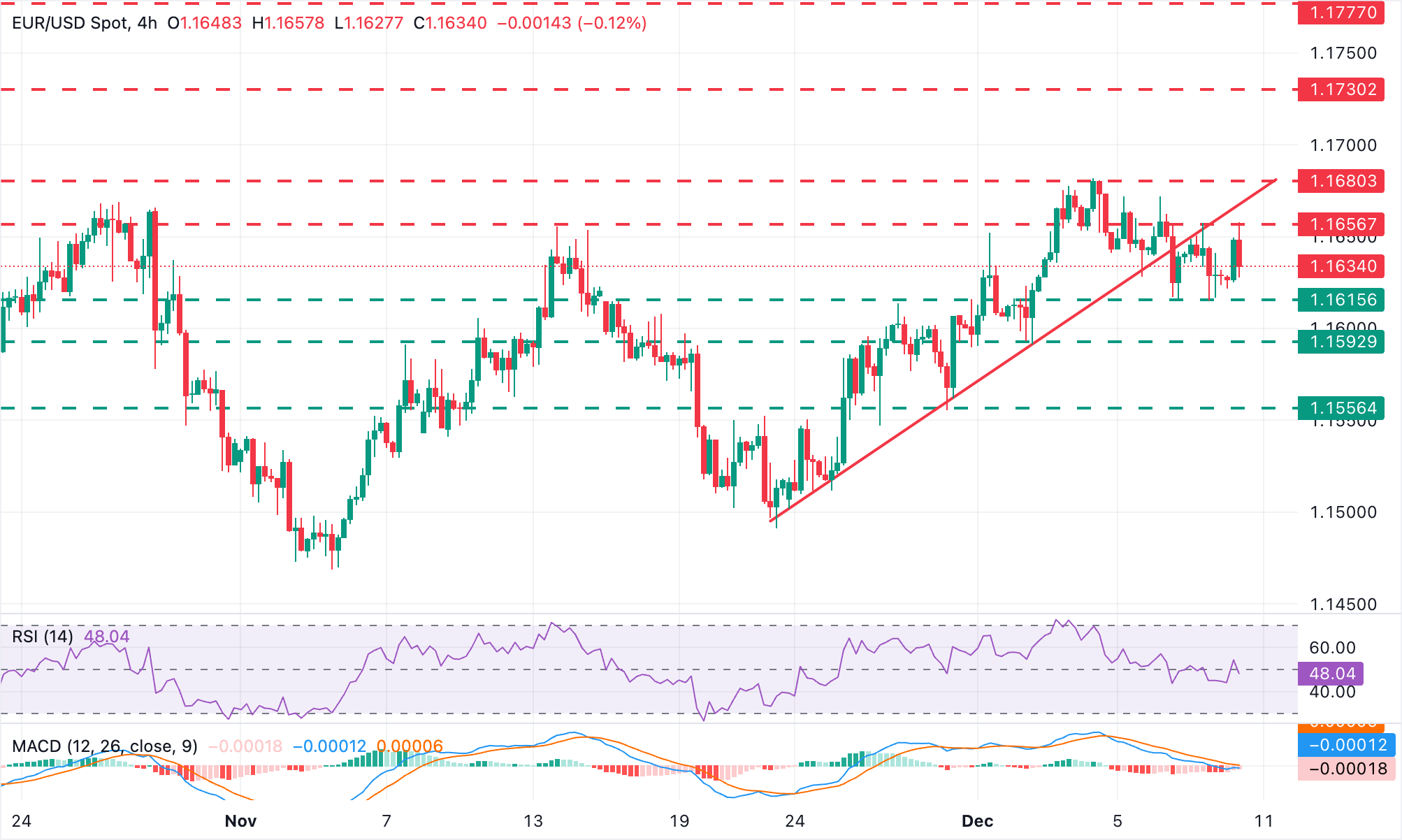
Technically, the EUR/USD broke below the ascending trendline from the November 20 lows and remains unable to return above it, which is a bearish signal. Oscillators are also pointing lower. The 4-hour Moving Average Convergence Divergence (MACD) remains below zero, highlighting a mild bearish momentum, although the 4-hour Relative Strength Index (RSI) has returned to levels right above the 50 line.
Bulls remain capped below Tuesday's high, at 1.1657, and the reverse trendline, now at 1.1665 area, which is closing the path to last week's high, at 1.1682, and the October 17 high, near 1.1730. To the downside, immediate support is at Tuesday's low of 1.1615, ahead of the December 1 and 2 lows around 1.1590 and the November 26 and 28 lows in the 1.1550-1.1555 area.
Economic Indicator
Fed Interest Rate Decision
The Federal Reserve (Fed) deliberates on monetary policy and makes a decision on interest rates at eight pre-scheduled meetings per year. It has two mandates: to keep inflation at 2%, and to maintain full employment. Its main tool for achieving this is by setting interest rates – both at which it lends to banks and banks lend to each other. If it decides to hike rates, the US Dollar (USD) tends to strengthen as it attracts more foreign capital inflows. If it cuts rates, it tends to weaken the USD as capital drains out to countries offering higher returns. If rates are left unchanged, attention turns to the tone of the Federal Open Market Committee (FOMC) statement, and whether it is hawkish (expectant of higher future interest rates), or dovish (expectant of lower future rates).
Read more.Next release: Wed Dec 10, 2025 19:00
Frequency: Irregular
Consensus: 3.75%
Previous: 4%
Source: Federal Reserve
Economic Indicator
Interest Rate Projections - 1st year
At four of its eight scheduled meetings, the Federal Reserve (Fed) releases a Summary of Economic Projections, or ‘dot-plot’. This shows each member of the Federal Open Market Committee’s (FOMC) forecast for where they expect the federal funds rate (the interest rate at which banks lend to each other) will go in the future. It can have a major impact on the US Dollar (USD), particularly if members change their forecasts. It is widely used as a guide to figure out the terminal rate and the possible timing of a policy pivot.
Read more.Next release: Wed Dec 10, 2025 19:00
Frequency: Irregular
Consensus: -
Previous: 3.4%
Source: Federal Reserve
Author

Guillermo Alcala
FXStreet
Graduated in Communication Sciences at the Universidad del Pais Vasco and Universiteit van Amsterdam, Guillermo has been working as financial news editor and copywriter in diverse Forex-related firms, like FXStreet and Kantox.


![How Wall Street rigs the game [Video]](https://editorial.fxsstatic.com/images/i/market-chaos-01.jpg)