EUR/USD corrects as US Dollar rebounds despite moderate US Inflation growth
- EUR/USD drops to near 1.0890 after the release of the soft US CPI data for February.
- US Commerce Secretary Lutnick sees President Trump’s policies as worthwhile despite they may lead to a recession.
- The Euro capitalizes on hopes of Ukraine’s ceasefire for 30 days and German debt restructuring plans.

EUR/USD corrects to near 1.0890 in North American trading hours on Wednesday after the release of the United States (US) Consumer Price Index (CPI) report for February, which showed that inflationary pressures grew at a slower-than-expected pace. The major currency pair drops as the US Dollar (USD) gains despite the lower-than-anticipated increase in US inflation, which is expected to boost market expectations that the Federal Reserve (Fed) will cut interest rates in the May policy meeting.
Year-over-year headline inflation data decelerated at a faster pace to 2.8% from the estimates of 2.9% and a 3% increase seen in January. In the same period, the core CPI – which excludes volatile food and energy prices – rose by 3.1%, slower than expectations of 3.2% and the prior release of 3.3%. The month-on-month headline and core CPI grew at a moderate pace of 0.2%, compared to estimates of 0.3%.
The US Dollar Index (DXY), which tracks the Greenback’s value against six major currencies, rises to near 103.75 from the four-month low of 103.20 posted on Tuesday.
The US Dollar (USD) had been underperforming for the past few weeks as US President Donald Trump’s tariff agenda has dampened the economic outlook. Market participants expect Trump’s “America First” policies to boost inflationary pressures, eventually diminishing the purchasing power of households already battling high inflation.
On Tuesday, fears of a US recession escalated after comments from US Commerce Secretary Howard Lutnick in a CBS interview indicated that policies by the President are worthwhile despite the prompted fears of a recession. Lutnick said, “These policies are the most important thing America has ever had, and they are worth it” after being asked whether it would be worth executing Trump’s policies even if they led to a recession.
Daily digest market movers: EUR/USD remains broadly firm on German defense spending deal, Ukraine ceasefire
- EUR/USD has been advancing for over a week as the Euro (EUR) is outperforming on optimism over the German defense spending deal. Hopes for a clearance to German debt restructuring to boost defense spending accelerated after Franziska Brantner-led-German Green Party agreed to negotiate with likely next Chancellor Friedrich Merz and Social Democratic Party’s (SDP) co-leader Lars Klingbeil in a scheduled meeting on Thursday.
- Market participants expect that widening the German “debt brake” could be a game-changer for the Eurozone economy, assuming that the monetary stimulus will stimulate economic growth. Such a scenario would also force the European Central Bank (ECB) officials to reassess their monetary policy path. The ECB had been guiding that the interest rate path is clearly on the downside.
- Additionally, the acceleration in optimism over peace in Ukraine has increased the Euro’s appeal. On Tuesday, Ukraine agreed to an immediate 30-day ceasefire in a meeting with US officials in Saudi Arabia. US Secretary of State Marco Rubio said he would now take the offer to the Russians, Reuters report. During European trading hours on Wednesday, the Kremlin said that "we need to hear" from US National Security Advisor Mike Waltz and Secretary of State Rubio before commenting on the "acceptability of a ceasefire for Russia".
- Meanwhile, tariff policies by US President Trump continue to be a nightmare for the Euro. Trump’s tariff policies keep him in a dominant position while negotiating deals with his trading partners. On Tuesday, Canada’s Ontario Premier, Doug Ford, rolled back the 25% surcharge levied on electricity exported to the US after Trump threatened to increase levies on steel and aluminum imports from Canada to 50%.
Technical Analysis: EUR/USD stabilize above 1.0900
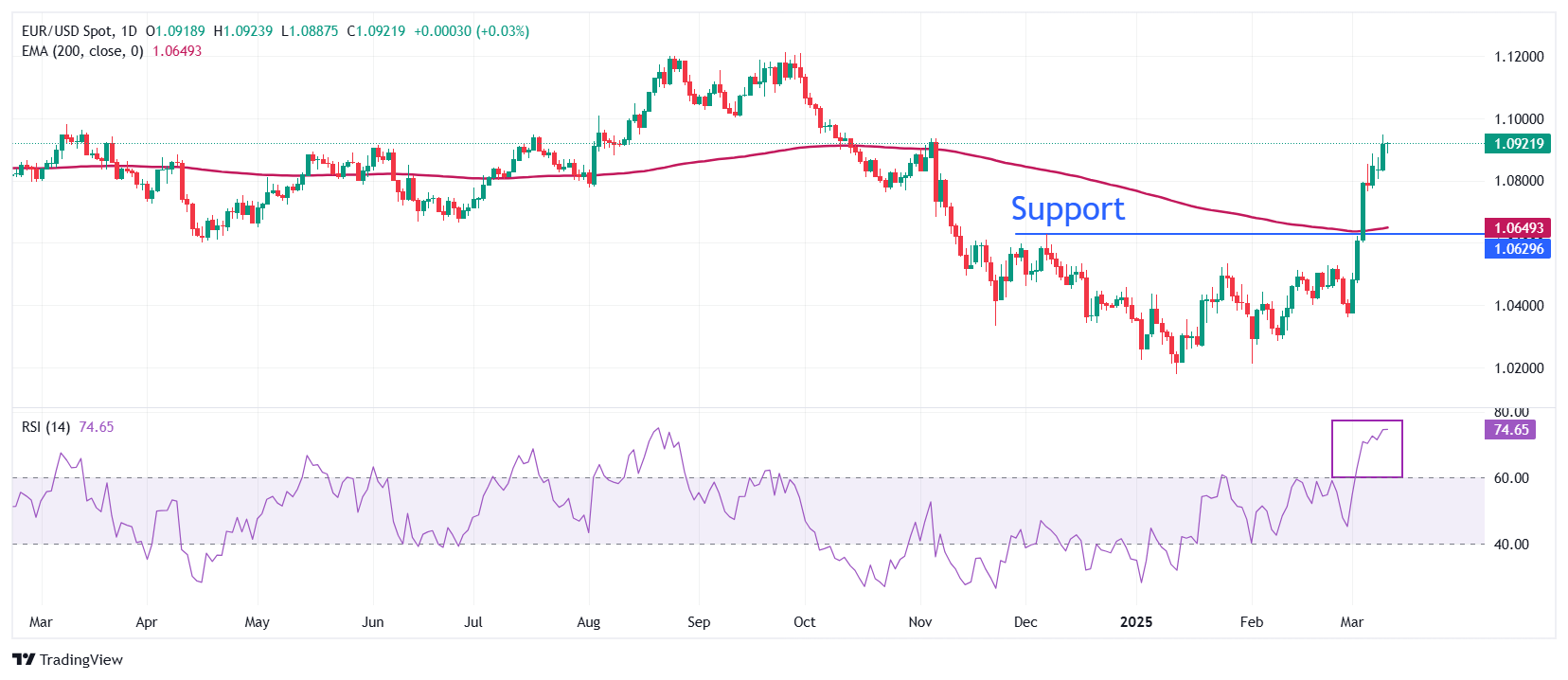
EUR/USD drops to near 1.0890 in Wednesday's North American session from the five-month low of 1.0920 posted on Tuesday. The long-term outlook of the major currency pair is bullish as it holds above the 200-day Exponential Moving Average (EMA), which trades around 1.0650. Last week, the major currency pair showed a strong upside move after a decisive breakout above the December 6 high of 1.0630.
The 14-day Relative Strength Index (RSI) holds to near 70.00, indicating a strong bullish momentum.
Looking down, the December 6 high of 1.0630 will act as the major support zone for the pair. Conversely, the psychological level of 1.1000 will be the key barrier for the Euro bulls.
Economic Indicator
Consumer Price Index (YoY)
Inflationary or deflationary tendencies are measured by periodically summing the prices of a basket of representative goods and services and presenting the data as The Consumer Price Index (CPI). CPI data is compiled on a monthly basis and released by the US Department of Labor Statistics. The YoY reading compares the prices of goods in the reference month to the same month a year earlier.The CPI is a key indicator to measure inflation and changes in purchasing trends. Generally speaking, a high reading is seen as bullish for the US Dollar (USD), while a low reading is seen as bearish.
Read more.Last release: Wed Mar 12, 2025 12:30
Frequency: Monthly
Actual: 2.8%
Consensus: 2.9%
Previous: 3%
Source: US Bureau of Labor Statistics
The US Federal Reserve has a dual mandate of maintaining price stability and maximum employment. According to such mandate, inflation should be at around 2% YoY and has become the weakest pillar of the central bank’s directive ever since the world suffered a pandemic, which extends to these days. Price pressures keep rising amid supply-chain issues and bottlenecks, with the Consumer Price Index (CPI) hanging at multi-decade highs. The Fed has already taken measures to tame inflation and is expected to maintain an aggressive stance in the foreseeable future.
Author

Sagar Dua
FXStreet
Sagar Dua is associated with the financial markets from his college days. Along with pursuing post-graduation in Commerce in 2014, he started his markets training with chart analysis.