EUR/USD declines as hotter-than-expected US CPI lifts US Dollar
- EUR/USD tumbles to near 1.0320 as hot US CPI report strengthens the US Dollar.
- European Commission President Ursula von der Leyen has threatened to take countermeasures against US President Trump’s 25% levy on steel and aluminum imports.
- The ECB is expected to cut interest rates three times more this year.

EUR/USD dives vertically to near 1.0320 in Wednesday’s North American session after failing to revisit the key resistance of 1.0400. The major currency pair weakens after the release of the hotter-than-expected United States (US) Consumer Price Index (CPI) data for January. The US Dollar (USD) strengthens after the inflation data, with the US Dollar Index (DXY) surging to near 108.50.
The US CPI report showed that annual core CPI inflation – which excludes volatile food and energy prices – rose at a faster pace of 3.3%, compared to a 3.2% increase in December. Economists expected the underlying inflation to have risen at a slower pace of 3.1%. In the same period, headline CPI inflation accelerated to 3% from the estimates and the former release of 2.9%. On month, headline and core CPI rose by 0.5% and 0.4%, respectively, faster than estimates of 0.3%.
A faster-than-expected growth in the inflation data has prompted market expectations that the Federal Reserve (Fed) will keep interest rates in the current range of 4.25-4.50% for longer.
After the stubborn inflation report, the probability for the Fed to cut interest rates in the June meeting has eased to almost 35% from 49%, recorded on Tuesday, according to the CME FedWatch tool.
Contrary to market expectations, US President Donald Trump said just before the CPI data release that interest rates "should be lowered", adding that they would "go hand in hand" with upcoming tariffs.
On Tuesday, Fed Chair Jerome Powell reiterated on the first day of a two-day testimony at Capitol Hill that the central bank is in “no rush to cut interest rates” as the economy is “strong overall”, with a lower unemployment rate and inflation staying well above the 2% target. Powell added, "We know that reducing policy restraint too fast or too much could hinder progress on inflation."
This week, investors will also focus on the US Producer Price Index (PPI) and the Retail Sales data for January, which will be released on Thursday and Friday, respectively.
Daily digest market movers: EUR/USD weakens as US Dollar strengthens
- EUR/USD tumbles amid strength in the US Dollar. While the Euro (EUR) outperforms other major peers, even though risks of a trade war between the US and the Eurozone have deepened. European Commission President Ursula von der Leyen warned on Tuesday that 25% tariffs on imports of steel and aluminum into the US by President Donald Trump “will not go unanswered”. Von der Leyen added that the EU would act to “safeguard its economic interests” and is ready for “proportionate countermeasures.”
- President Donald Trump signed executive orders imposing 25% tariffs on steel and aluminum imports into the US without exemptions or exclusions in a way to boost local production. Trump is also poised to impose reciprocal tariffs on nations with whom he sees unfair trade practices.
- Market participants expect the Eurozone to face significant pressure from reciprocal tariffs. The 27-nation bloc charges 10% tariffs on automobile imports from the US and pays 2.5% import duty for domestic autos supplied to them.
- In Wednesday's European session, European Central Bank (ECB) policymaker and Bank of France head Francois Villeroy de Galhau said that US President Donald Trump’s trade policies would most likely have a "negative impact on the economy." Villeroy added, "Protectionism is a seductive short-term policy, but in the long-term, it is a losing strategy.”
- On the monetary policy front, traders are confident that the European Central Bank (ECB) will announce three more interest rate cuts this year amid risks of inflation undershooting the central bank’s target of 2%. The ECB already reduced its Deposit Facility Rate by 25 basis points (bps) to 2.75% in the first policy meeting of the year in January.
- Going forward, investors will focus on economic growth forecasts, which will be released by the European Commission (EC) on Thursday.
Euro PRICE Today
The table below shows the percentage change of Euro (EUR) against listed major currencies today. Euro was the strongest against the Japanese Yen.
| USD | EUR | GBP | JPY | CAD | AUD | NZD | CHF | |
|---|---|---|---|---|---|---|---|---|
| USD | 0.34% | 0.53% | 1.20% | 0.36% | 0.96% | 0.98% | 0.17% | |
| EUR | -0.34% | 0.20% | 0.86% | 0.02% | 0.61% | 0.64% | -0.17% | |
| GBP | -0.53% | -0.20% | 0.65% | -0.17% | 0.41% | 0.44% | -0.36% | |
| JPY | -1.20% | -0.86% | -0.65% | -0.85% | -0.26% | -0.25% | -1.04% | |
| CAD | -0.36% | -0.02% | 0.17% | 0.85% | 0.60% | 0.61% | -0.19% | |
| AUD | -0.96% | -0.61% | -0.41% | 0.26% | -0.60% | 0.03% | -0.78% | |
| NZD | -0.98% | -0.64% | -0.44% | 0.25% | -0.61% | -0.03% | -0.80% | |
| CHF | -0.17% | 0.17% | 0.36% | 1.04% | 0.19% | 0.78% | 0.80% |
The heat map shows percentage changes of major currencies against each other. The base currency is picked from the left column, while the quote currency is picked from the top row. For example, if you pick the Euro from the left column and move along the horizontal line to the US Dollar, the percentage change displayed in the box will represent EUR (base)/USD (quote).
Technical Analysis: EUR/USD declines to near 1.0320
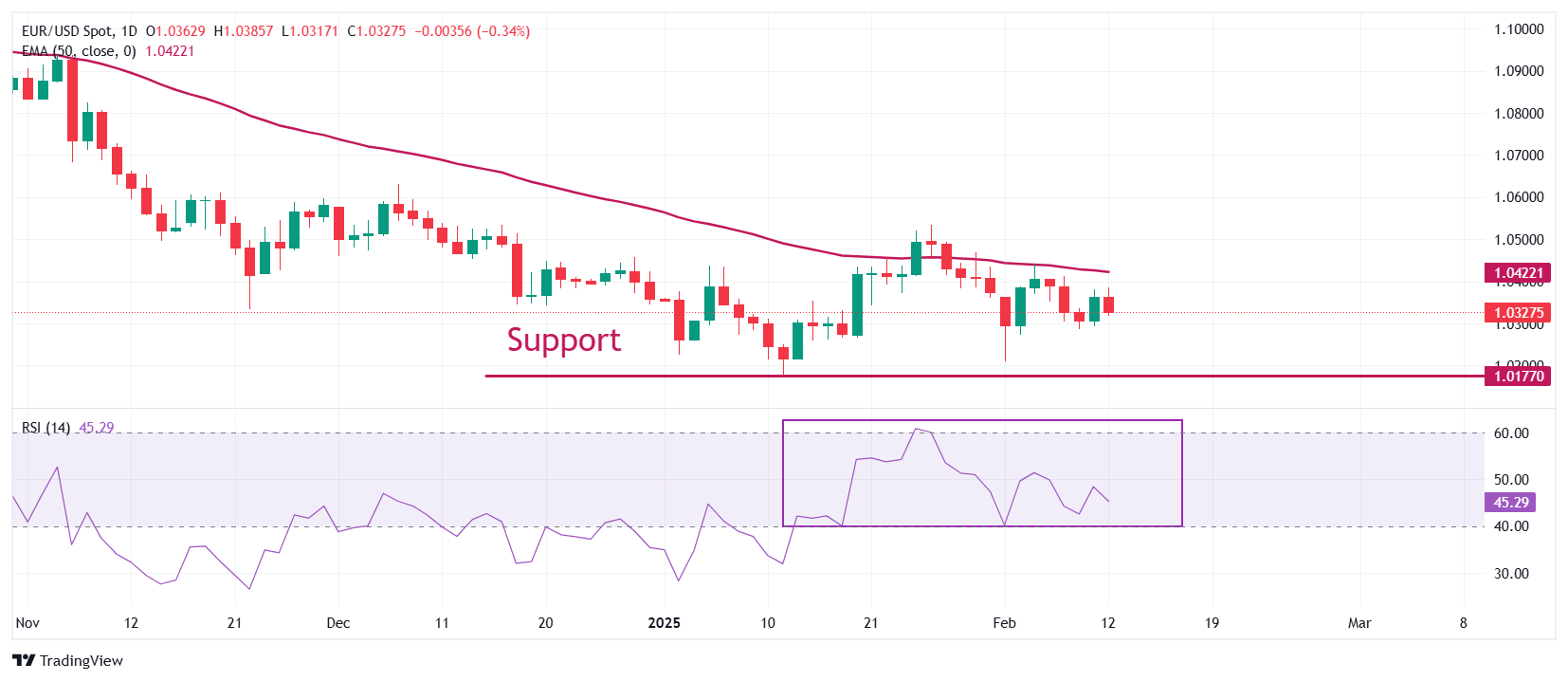
EUR/USD falls sharply to near 1.0320 in North American trading hours on Wednesday after facing selling pressure near 1.0380. The outlook of the major currency pair was already bearish as the 50-day Exponential Moving Average (EMA) around 1.0423 continues to be a major barricade for the Euro bulls.
The 14-day Relative Strength Index (RSI) oscillates in the 40.00-60.00 range, indicating a sideways trend.
Looking down, the January 13 low of 1.0177 and the round-level support of 1.0100 will act as major support zones for the pair. Conversely, the psychological resistance of 1.0500 will be the key barrier for the Euro bulls.
Inflation FAQs
Inflation measures the rise in the price of a representative basket of goods and services. Headline inflation is usually expressed as a percentage change on a month-on-month (MoM) and year-on-year (YoY) basis. Core inflation excludes more volatile elements such as food and fuel which can fluctuate because of geopolitical and seasonal factors. Core inflation is the figure economists focus on and is the level targeted by central banks, which are mandated to keep inflation at a manageable level, usually around 2%.
The Consumer Price Index (CPI) measures the change in prices of a basket of goods and services over a period of time. It is usually expressed as a percentage change on a month-on-month (MoM) and year-on-year (YoY) basis. Core CPI is the figure targeted by central banks as it excludes volatile food and fuel inputs. When Core CPI rises above 2% it usually results in higher interest rates and vice versa when it falls below 2%. Since higher interest rates are positive for a currency, higher inflation usually results in a stronger currency. The opposite is true when inflation falls.
Although it may seem counter-intuitive, high inflation in a country pushes up the value of its currency and vice versa for lower inflation. This is because the central bank will normally raise interest rates to combat the higher inflation, which attract more global capital inflows from investors looking for a lucrative place to park their money.
Formerly, Gold was the asset investors turned to in times of high inflation because it preserved its value, and whilst investors will often still buy Gold for its safe-haven properties in times of extreme market turmoil, this is not the case most of the time. This is because when inflation is high, central banks will put up interest rates to combat it. Higher interest rates are negative for Gold because they increase the opportunity-cost of holding Gold vis-a-vis an interest-bearing asset or placing the money in a cash deposit account. On the flipside, lower inflation tends to be positive for Gold as it brings interest rates down, making the bright metal a more viable investment alternative.
Author

Sagar Dua
FXStreet
Sagar Dua is associated with the financial markets from his college days. Along with pursuing post-graduation in Commerce in 2014, he started his markets training with chart analysis.