EUR/USD drifts away from multi-month highs with Fed speakers on focus
- EUR/USD eases below 1.1730 from the two-month high at 1.1762 posted on Thursday.
- The increasing monetary policy divergence between the ECB and the Fed keeps the US Dollar on its back foot.
- Technical indicators suggest that Euro bulls are starting to lose steam following the rally of the last two days.

EUR/USD is going through a moderate correction, trading at levels near 1.1720 on Friday after pulling back from more than two-and-a-half months' highs at 1.1762. The pair, broader trend, however, remains bullish with the increasing monetary policy divergence between the European Central Bank (ECB) and the US Federal Reserve (Fed) limiting the US Dollar's (USD) rallies.
The Fed cut rates this week and pointed to one more rate cut in 2026. Investors, however, still expect that the US central bank will ease monetary policy at least two times, considering that Chairman Jerome Powell will likely be replaced by the more dovish-leaning Kevin Hassett. Hasset is the White House economic adviser and has repeatedly shown his inclination for significantly lower borrowing costs.
On the macroeconomic front, German consumer inflation data confirmed that price pressures accelerated in November, although the monthly inflation contracted. In the US, a batch of Fed policymakers will take the stage and might give further insight into the central bank's monetary policy.
Euro Price Today
The table below shows the percentage change of Euro (EUR) against listed major currencies today. Euro was the strongest against the Japanese Yen.
| USD | EUR | GBP | JPY | CAD | AUD | NZD | CHF | |
|---|---|---|---|---|---|---|---|---|
| USD | 0.08% | 0.12% | 0.20% | -0.06% | -0.13% | -0.07% | 0.02% | |
| EUR | -0.08% | 0.03% | 0.13% | -0.14% | -0.22% | -0.16% | -0.06% | |
| GBP | -0.12% | -0.03% | 0.08% | -0.17% | -0.25% | -0.19% | -0.10% | |
| JPY | -0.20% | -0.13% | -0.08% | -0.24% | -0.32% | -0.28% | -0.17% | |
| CAD | 0.06% | 0.14% | 0.17% | 0.24% | -0.08% | -0.04% | 0.08% | |
| AUD | 0.13% | 0.22% | 0.25% | 0.32% | 0.08% | 0.05% | 0.15% | |
| NZD | 0.07% | 0.16% | 0.19% | 0.28% | 0.04% | -0.05% | 0.10% | |
| CHF | -0.02% | 0.06% | 0.10% | 0.17% | -0.08% | -0.15% | -0.10% |
The heat map shows percentage changes of major currencies against each other. The base currency is picked from the left column, while the quote currency is picked from the top row. For example, if you pick the Euro from the left column and move along the horizontal line to the US Dollar, the percentage change displayed in the box will represent EUR (base)/USD (quote).
Daily Digest Market Movers: US Dollar's weakness keeps Euro dips limited
- The Euro (EUR) continues drawing support from broad-based US Dollar weakness. The USD Index, which measures the value of the Greenback against a basket of six majors, has been trading at two-month lows near 98.00, as investors keep pricing further Fed cuts, while most major central banks are at the end of their easing cycles.
- Data from Germany released on Friday revealed that the Harmonized Index of Consumer Prices (HICP) accelerated to 2.6% in the year to November, from 2.3% in the previous month, while prices fell by 0.5% on the month. These figures confirm the preliminary numbers and, therefore, the impact on the Euro has been minimal.
- In the US, Jobless Claims data released on Thursday showed that first-time applications for unemployment benefits rose by 44,000 in the first week of December, to 236,000. This is the largest increase in more than four years and backs the idea that the Fed will be forced to lower interest rates further to support a deteriorating labour market.
- Later in the day, the focus will shift to Philadelphia Fed President, Anna Paulson, the Cleveland Fed President, Beth Hammack, the Chicago Fed President, Austan Goolsbee, and Kansas City Fed President, Jeff Schmid, who will make public comments during the American trading hours.
Technical Analysis: EUR/USD pulls back from overbought levels
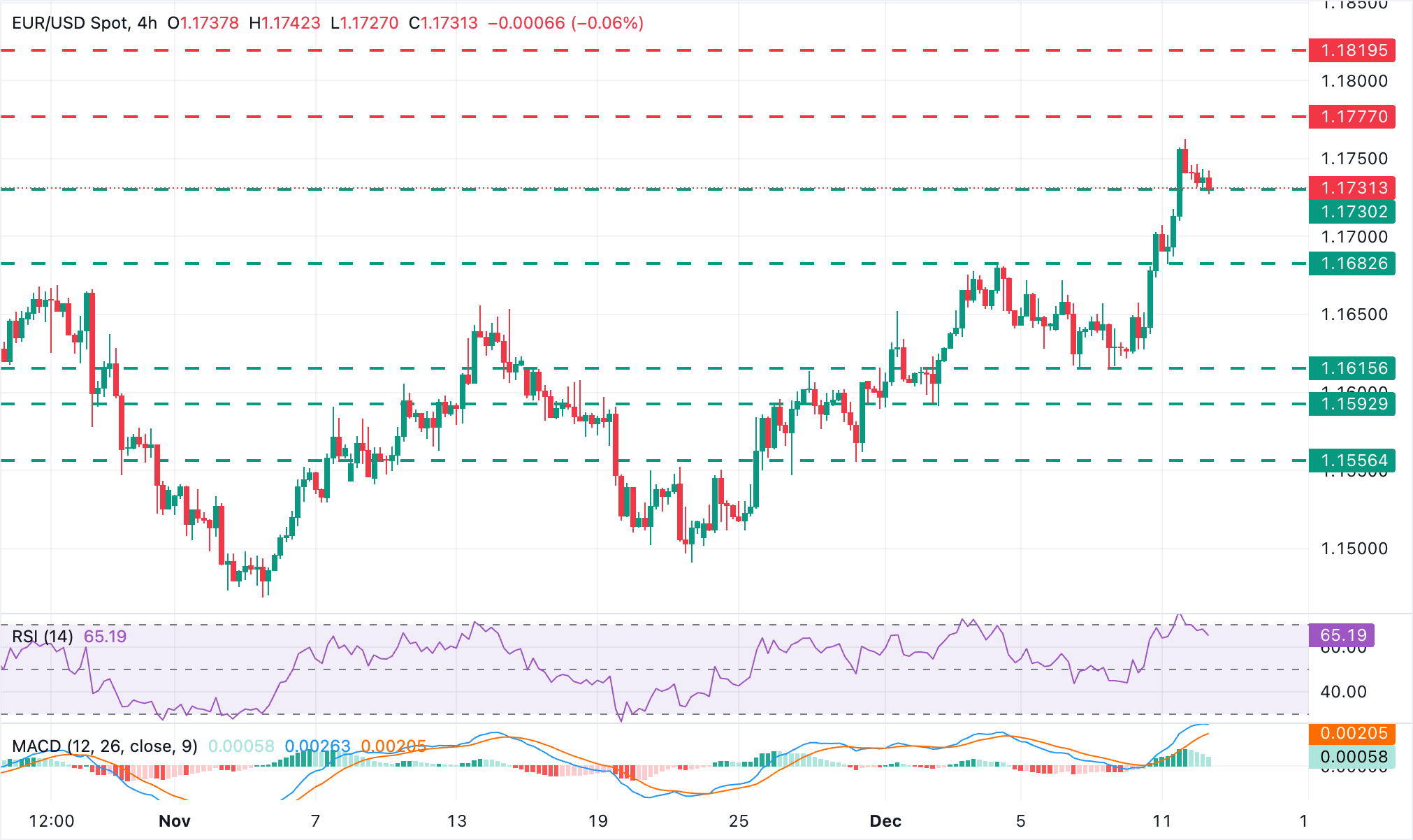
The EUR/USD is correcting lower following a nearly 1.2% rally over the last two days that had pushed technical indicators into overbought levels. The 4-Hour Relative Strength Index (RSI) is at 63 after having hit highs past 70, and the Moving Average Convergence Divergence (MACD) indicator has turned flat, indicating a weaker bullish momentum.
Bears are now testing support at the October 17 high near 1.1730. Beyond here, Thursday's low, at the 1.1680 area, and the December 9 low at 1.1615 will come into focus. To the upside, Thursday's high at 1.1762 and the October 1 high at around 1.1780 are likely to challenge bulls. Further up, the target is the September 23 and 24 highs near 1.1820.
Economic Indicator
Fed's Paulson speech
Anna Paulson is the president of Federal Reserve Bank of Philadelphia. In this role, Paulson represents the Third Federal Reserve District on the Federal Open Market Committee (FOMC) in the formulation of US monetary policy.
Read more.Next release: Fri Dec 12, 2025 13:00
Frequency: Irregular
Consensus: -
Previous: -
Source: Federal Reserve
Economic Indicator
Fed's Schmid speech
Jeff Schmid is president and chief executive officer of the Federal Reserve Bank of Kansas City, representing the Tenth Federal Reserve District on the Federal Open Market Committee. Schmid participates in each FOMC meeting and will be a voting member in 2025.
Read more.Next release: Fri Dec 12, 2025 13:30
Frequency: Irregular
Consensus: -
Previous: -
Economic Indicator
Fed's Goolsbee speech
Austan D. Goolsbee took office on January 9, 2023, as the 10th president and chief executive officer of the Seventh District, Federal Reserve Bank of Chicago. In 2023, he serves as a voting member of the Federal Open Market Committee.
Read more.Next release: Fri Dec 12, 2025 15:30
Frequency: Irregular
Consensus: -
Previous: -
Source: Federal Reserve Bank of Chicago
Author

Guillermo Alcala
FXStreet
Graduated in Communication Sciences at the Universidad del Pais Vasco and Universiteit van Amsterdam, Guillermo has been working as financial news editor and copywriter in diverse Forex-related firms, like FXStreet and Kantox.

















