EUR/USD gives up gains as US Dollar rebounds ahead of Fed policy decision
- EUR/USD drops from 1.0950 ahead of the vote on German debt restructuring and peace talks between Russia and the US.
- A significant relaxation in German borrowing rules could boost economic growth and employment.
- The Fed is certain to keep interest rates steady on Wednesday amid uncertainty over President Trump’s economic policies.

EUR/USD surrenders intraday gains after posting a fresh five-month high near 1.0955 in Tuesday’s North American session. The major currency pair falls back as the US Dollar (USD) attracts bids ahead of the Federal Reserve’s (Fed) interest rate decision, which will be announced on Wednesday. The US Dollar Index (DXY), which tracks the Greenback’s value against six major currencies, rebounds from the five-month low of 103.20.
According to the CME FedWatch tool, the Fed is almost certain to keep borrowing rates steady in the range of 4.25%-4.50% on Wednesday. This would be the second straight policy meeting in which the Fed will leave interest rates unchanged.
Traders have remained increasingly confident about the Fed maintaining a status quo on Wednesday as officials have been arguing in favor of a “wait and see” approach amid uncertainty over the economic outlook under the leadership of US President Trump. He has been threatening to introduce reciprocal tariffs, a situation in which the US will impose similar levies charged by other nations on the same products.
Market participants expect that Trump's tariffs could be inflationary and lead to economic turbulence. A slew of US officials, including the President, have not ruled out that Trump’s economic policies could lead the economy to a recession.
Increased geopolitical uncertainty from Trump’s tariff agenda has forced global organizations to slice US Gross Domestic Product (GDP) growth forecasts. On Monday, the Organization for Economic Cooperation and Development (OECD) stated that the US economic growth could decelerate to 2.2% in 2025 and 1.6% in 2026 after expanding at a robust pace of 2.8% in 2024. The agency also warned that higher and broader increases in trade barriers would hit growth and boost inflation growth globally.
Daily digest market movers: EUR/USD surrenders intraday gains ahead of German debt vote
- EUR/USD retreats from five-month high ahead of voting on the German debt restructuring deal in the Bundestag lower house of Parliament. German leaders will vote on passing an infrastructure fund worth 500 billion Euros (EUR) and ease borrowing limit to boost defense spending.
- The German debt deal is highly likely to get majority votes as Franziska Brantner-led-Greens agreed last week to support likely chancellor Frederich Merz-led-Christian Democratic Union (CDU) and the Social Democratic Party (SDP) for bringing an end to German’s fiscal conservatism, which it adopted after the 2008 sub-prime crisis.
- Market participants expect that the massive surge in the German borrowing limit will accelerate economic growth and inflation. Such a scenario is favorable for the Euro, given that Germany is the Eurozone’s locomotive. The positive impact of the German debt increase plan is already visible in the Euro, which has performed strongly in the last weeks.
- Firm optimism over the German debt deal has also lifted expectations that the European Central Bank (ECB) could pause the monetary easing cycle after reducing interest rates six times since June 2024. ECB policymaker and Austrian Central Bank Governor Robert Holzmann said on Friday that the central bank could keep interest rates steady in the April policy meeting as United States (US) President Donald Trump’s tariff agenda and defense spending have prompted risks of a resurgence in inflationary pressures.
- Ahead of voting on German debt deal, German ZEW Economic Sentiment Index increased significantly to 51.6 in March from 26.0 in February, beats estimates of 48.1. The Current Situation Index improved to -87.6 from -88.5 seen last month but missed expectations of -80.5. The Eurozone ZEW Economic Sentiment Index came in marginally higher at 39.8 than expectations at 39.6 in March and significantly higher than 24.2 in February.
- In Tuesday’s session, investors will also focus on the US- Russia talks for a ceasefire in Ukraine. Last week, Ukraine agreed to a 30-day ceasefire plan after discussions with US officials in Saudi Arabia. On Monday, the European Union (EU) Foreign policy chief Kaja Kallas said the conditions demanded by Russia to agree to a ceasefire showed Moscow does not really want peace, Reuters report.
Technical Analysis: EUR/USD struggles around 1.0950
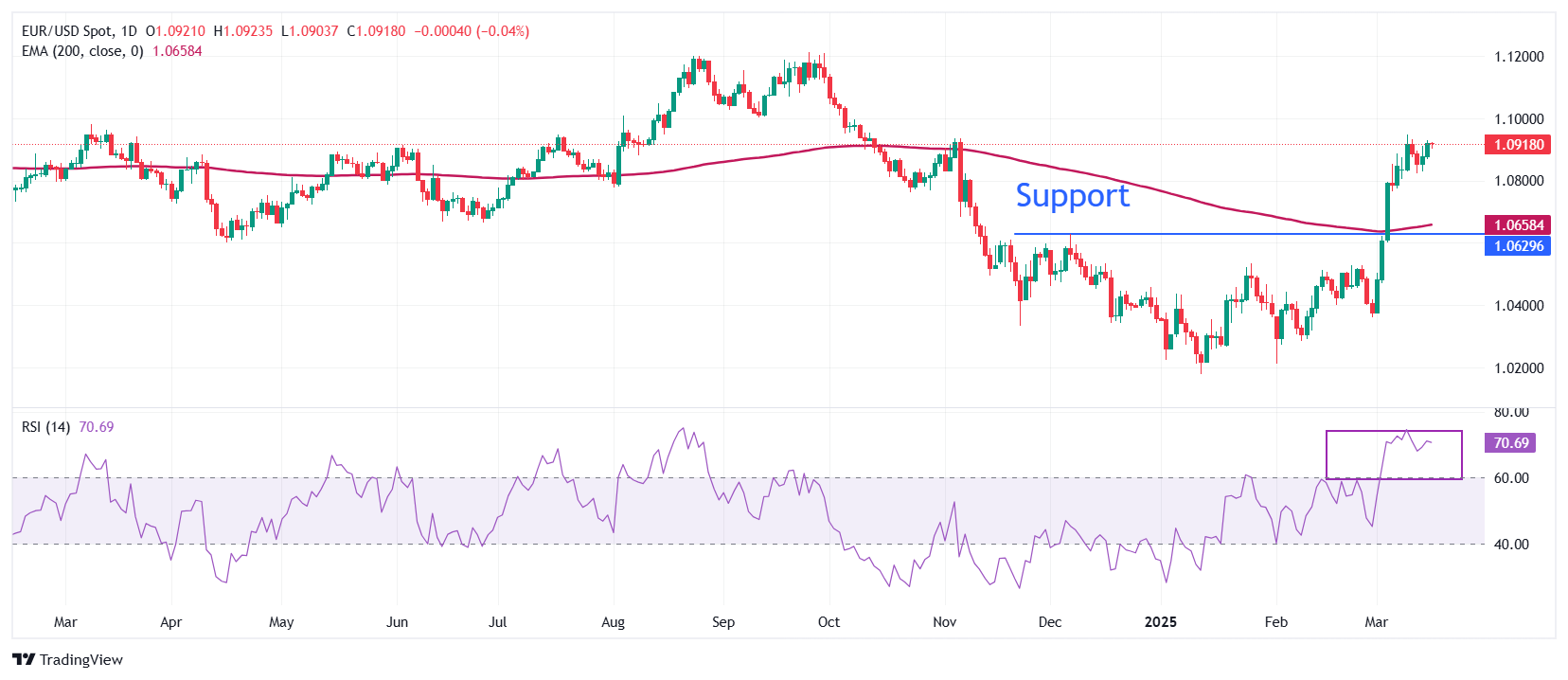
EUR/USD struggles to extend its upside above 1.0950 on Tuesday. The long-term outlook of the major currency pair remains firm as it holds above the 200-day Exponential Moving Average (EMA), which trades around 1.0655.
The pair strengthened after a decisive breakout above the December 6 high of 1.0630 on March 5.
The 14-day Relative Strength Index (RSI) wobbles near 70.00, suggesting that a strong bullish momentum is intact.
Looking down, the December 6 high of 1.0630 will act as the major support zone for the pair. Conversely, the psychological level of 1.1000 will be the key barrier for the Euro bulls.
Interest rates FAQs
Interest rates are charged by financial institutions on loans to borrowers and are paid as interest to savers and depositors. They are influenced by base lending rates, which are set by central banks in response to changes in the economy. Central banks normally have a mandate to ensure price stability, which in most cases means targeting a core inflation rate of around 2%. If inflation falls below target the central bank may cut base lending rates, with a view to stimulating lending and boosting the economy. If inflation rises substantially above 2% it normally results in the central bank raising base lending rates in an attempt to lower inflation.
Higher interest rates generally help strengthen a country’s currency as they make it a more attractive place for global investors to park their money.
Higher interest rates overall weigh on the price of Gold because they increase the opportunity cost of holding Gold instead of investing in an interest-bearing asset or placing cash in the bank. If interest rates are high that usually pushes up the price of the US Dollar (USD), and since Gold is priced in Dollars, this has the effect of lowering the price of Gold.
The Fed funds rate is the overnight rate at which US banks lend to each other. It is the oft-quoted headline rate set by the Federal Reserve at its FOMC meetings. It is set as a range, for example 4.75%-5.00%, though the upper limit (in that case 5.00%) is the quoted figure. Market expectations for future Fed funds rate are tracked by the CME FedWatch tool, which shapes how many financial markets behave in anticipation of future Federal Reserve monetary policy decisions.
Author

Sagar Dua
FXStreet
Sagar Dua is associated with the financial markets from his college days. Along with pursuing post-graduation in Commerce in 2014, he started his markets training with chart analysis.