EUR/USD gives up majority of initial gains as US Dollar rebounds
- EUR/USD surrenders some of its early gains as the US Dollar recoups its initial losses.
- Trump’s erratic policy announcements have renewed concerns over the USD’s credibility.
- According to revised estimates, the German economy rose at a robust pace of 0.4% in the first quarter of the year.

EUR/USD gives back significant intraday gains and drops to near 1.1380 during North American trading hours on Monday from the monthly high of 1.1425 posted earlier in the day. The major currency pair surrenders gains as the US Dollar (USD) claws back significant initial losses, with the US Dollar Index (DXY) rebounding to near 99.00.
However, the outlook of the US Dollar remains uncertain as erratic statements from Washington regarding tariff policies have renewed concerns over its credibility.
Over the weekend, Trump suspended his decision to impose flat 50% tariffs on the European Union (EU) until July 9, after the old continent agreed to advance trade negotiations quickly and urged for some time to reach a good deal.
European Commission President Ursula von der Leyen said in a post on X on Sunday that she had a "good" phone call with Trump and that the EU was ready to “advance talks swiftly and decisively." "To reach a good deal, we would need the time until July 9," she added.
On Friday, US President Trump threatened to impose 50% tariffs on imports from the EU in a post on Truth.Social, which were expected to come into effect on June 1. “Our discussions with them are going nowhere! Therefore, I am recommending a straight 50% tariff on the European Union, starting on June 1, 2025,” Trump wrote.
A quick de-escalation in trade tensions between economies situated on both sides of the Atlantic has provided relief to their equity markets and the Euro (EUR), but has put the credibility of the US Dollar under suspicion again.
During European trading hours, German Economy Minister Katherina Reiche called for tariff negotiations to proceed calmly. "We have to find a common path," she said, Reuters reported.
The Greenback has substantially suffered in past few months as events such as ever-changing Trump’s tariff policies, threats to remove Federal Reserve’s (Fed) Chair Jerome Powell and a new tax cut and spending bill that is expected to increase already ballooning nation’s debt by $3.8 trillion have dampened USD’s safe-haven appeal. Increasing doubts over the Greenback’s credibility have also increased the Euro’s appeal. “We think the euro is continuing to benefit from being the most liquid alternative to the dollar,” ING said.
Euro PRICE Today
The table below shows the percentage change of Euro (EUR) against listed major currencies today. Euro was the strongest against the Japanese Yen.
| USD | EUR | GBP | JPY | CAD | AUD | NZD | CHF | |
|---|---|---|---|---|---|---|---|---|
| USD | -0.07% | -0.21% | 0.33% | -0.06% | -0.20% | -0.39% | 0.22% | |
| EUR | 0.07% | -0.16% | 0.42% | -0.01% | -0.15% | -0.33% | 0.30% | |
| GBP | 0.21% | 0.16% | 0.27% | 0.14% | -0.00% | -0.18% | 0.47% | |
| JPY | -0.33% | -0.42% | -0.27% | -0.40% | -0.55% | -0.80% | -0.11% | |
| CAD | 0.06% | 0.00% | -0.14% | 0.40% | -0.12% | -0.32% | 0.32% | |
| AUD | 0.20% | 0.15% | 0.00% | 0.55% | 0.12% | -0.22% | 0.47% | |
| NZD | 0.39% | 0.33% | 0.18% | 0.80% | 0.32% | 0.22% | 0.65% | |
| CHF | -0.22% | -0.30% | -0.47% | 0.11% | -0.32% | -0.47% | -0.65% |
The heat map shows percentage changes of major currencies against each other. The base currency is picked from the left column, while the quote currency is picked from the top row. For example, if you pick the Euro from the left column and move along the horizontal line to the US Dollar, the percentage change displayed in the box will represent EUR (base)/USD (quote).
Daily digest market movers: EUR/USD edges higher on upbeat German Q1 GDP growth
- Signs of strength in the domestic region have also benefited the Euro, besides being an alternative to the US Dollar, and the rising hopes of a potential EU-US trade deal. The major currency gains as revised Q1 German Gross Domestic Product (GDP) data showed that the economy grew at a faster pace of 0.4%, compared to the preliminary estimates and the prior release of 0.2%.
- Upbeat German Q1 GDP data has diminished fears of an economic contraction on a yearly basis after declining for two straight years. Analysts at Deutsche Bank Research stated upbeat Q1 GDP figures indicate that the German economy has gained enough momentum to avoid stagnation this year. Experts have predicted that the economy would continue the positive trend in the second half of the year despite the potential impact of Trump’s tariff policy.
- On the monetary policy front, European Central Bank (ECB) officials have expressed optimism that inflationary pressures could return to the 2% target this year, due to which traders have remained increasingly confident that the central bank will cut interest rates again in June’s meeting.
- The comments from ECB policymaker and Governor of the Bank of Greece Yannis Stournaras, published in a Greek news media on Friday, indicated that he is comfortable with traders’ dovish bets for the policy meeting in June. "I expect one more interest rate cut in June and then a pause," Stournaras said.
- This week, the EUR/USD pair will be influenced by the US Personal Consumption Expenditure Price index (PCE) data for April and the Harmonized Index of Consumer Prices (HICP) data from major countries of the EU for May, which will be published on Friday.
Technical Analysis: EUR/USD aims to revisit recent highs around 1.1470
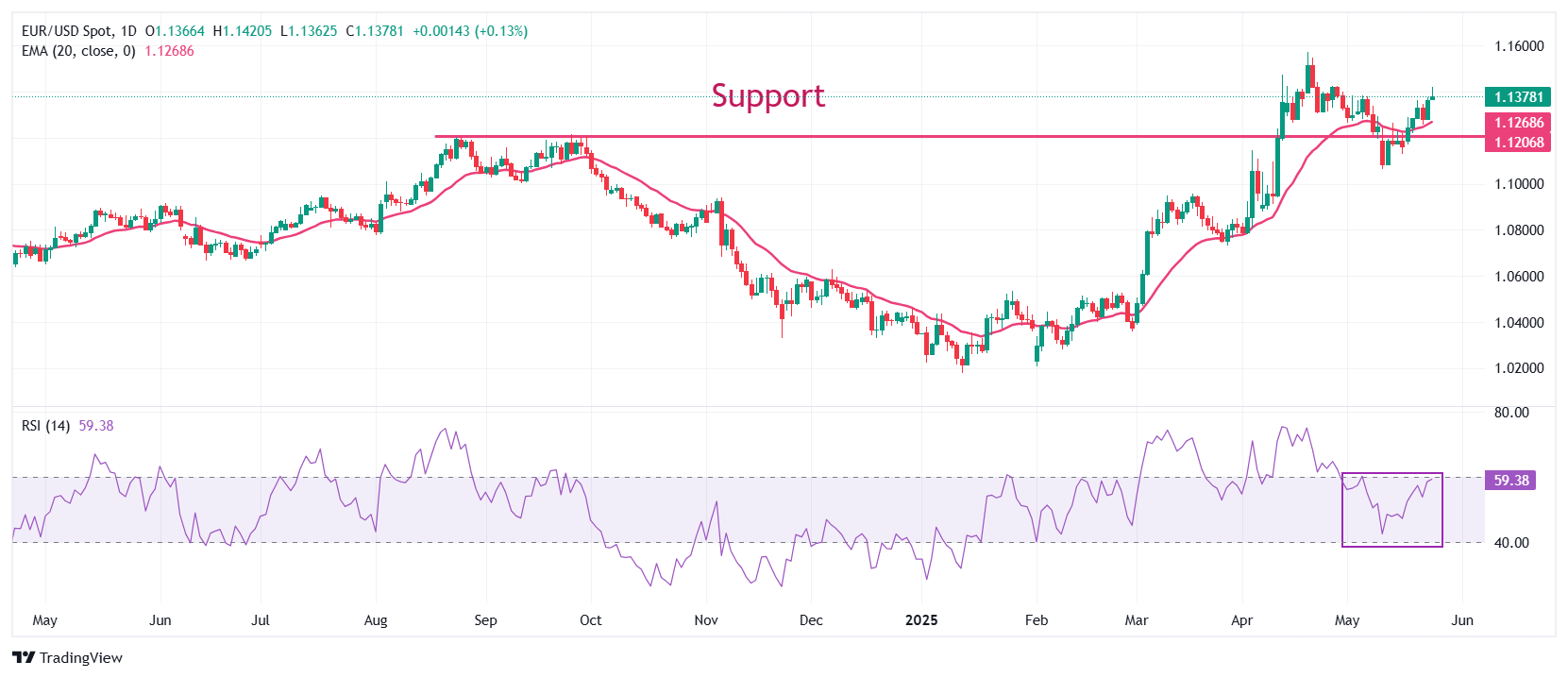
EUR/USD posts a fresh almost a month high near 1.1420 at the start of the week. The near-term outlook of the pair is bullish as it holds the 20-day Exponential Moving Average (EMA), which is around 1.1270.
The 14-period Relative Strength Index (RSI) rises to near 60.00. Bulls would come into action if the RSI breaks above the 60.00 level.
Looking up, the April 21 high of 1.1475 will be the major resistance for the pair. Conversely, the September 25 high of 1.1215 will be a key support for the Euro bulls.
US Dollar FAQs
The US Dollar (USD) is the official currency of the United States of America, and the ‘de facto’ currency of a significant number of other countries where it is found in circulation alongside local notes. It is the most heavily traded currency in the world, accounting for over 88% of all global foreign exchange turnover, or an average of $6.6 trillion in transactions per day, according to data from 2022. Following the second world war, the USD took over from the British Pound as the world’s reserve currency. For most of its history, the US Dollar was backed by Gold, until the Bretton Woods Agreement in 1971 when the Gold Standard went away.
The most important single factor impacting on the value of the US Dollar is monetary policy, which is shaped by the Federal Reserve (Fed). The Fed has two mandates: to achieve price stability (control inflation) and foster full employment. Its primary tool to achieve these two goals is by adjusting interest rates. When prices are rising too quickly and inflation is above the Fed’s 2% target, the Fed will raise rates, which helps the USD value. When inflation falls below 2% or the Unemployment Rate is too high, the Fed may lower interest rates, which weighs on the Greenback.
In extreme situations, the Federal Reserve can also print more Dollars and enact quantitative easing (QE). QE is the process by which the Fed substantially increases the flow of credit in a stuck financial system. It is a non-standard policy measure used when credit has dried up because banks will not lend to each other (out of the fear of counterparty default). It is a last resort when simply lowering interest rates is unlikely to achieve the necessary result. It was the Fed’s weapon of choice to combat the credit crunch that occurred during the Great Financial Crisis in 2008. It involves the Fed printing more Dollars and using them to buy US government bonds predominantly from financial institutions. QE usually leads to a weaker US Dollar.
Quantitative tightening (QT) is the reverse process whereby the Federal Reserve stops buying bonds from financial institutions and does not reinvest the principal from the bonds it holds maturing in new purchases. It is usually positive for the US Dollar.
Author

Sagar Dua
FXStreet
Sagar Dua is associated with the financial markets from his college days. Along with pursuing post-graduation in Commerce in 2014, he started his markets training with chart analysis.

















