|

EUR/USD returns to 1.1300 on mixed German, EMU ZEW

  • The pair exchanges gains with losses around the 1.1300 handle.
  • EMU Economic Sentiment improved to -16.6 in February.
  • German Current Conditions dropped to 15.0 this month.

After a brief adventure to daily highs beyond 1.1320, EUR/USD has now receded to the 1.1300 neighbourhood in the wake of mixed results from the ZEW Survey.

EUR/USD fades the spike to 1.1320/25

The European currency has given away part of its earlier gains after the ZEW Survey came in on a mixed tone for the current month.

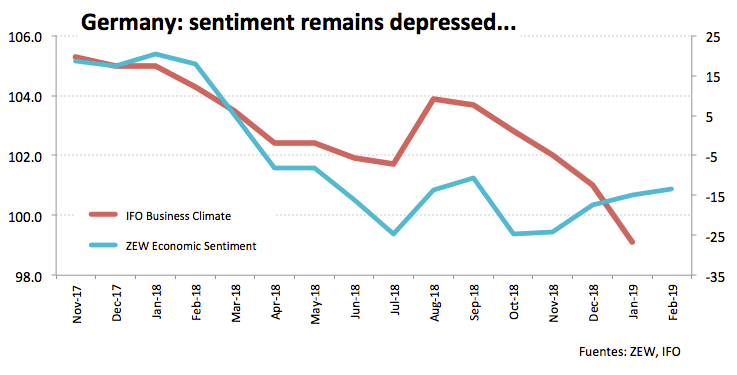
In fact, Economic Sentiment in Germany improved a tad to -13.4 while Current Conditions dropped to 15.0, missing consensus. On the broader euro area, the Economic Sentiment also surprised to the upside, coming in at -16.6.

Earlier in the day, EMU Current Account shrunk at a seasonally adjusted €16.2 billion in December from €22.7 billion in the previous month.

Spot keeps the trade within the familiar range for the time being, always looking to headlines from the US-China trade talks for near term direction.

What to look for around EUR

US-China trade talks will be in centre stage this week and are expected to drive the sentiment in the risk-associated complex. Following recent progress in earlier talks, market participants are now looking at the possibility that both parties could clinch a deal sooner than later. On another direction, EUR should closely follow comments from ECB members regarding the ongoing slowdown in the euro bloc and potential guidance from the ECB in the next months, at a time when speculations that the central bank could refrain from acting on rates this year remain on the rise.

EUR/USD levels to watch

At the moment, the pair is losing 0.02% at 1.1305 and a break below 1.1234 (2019 low Feb.15) would target 1.1215 (2018 low Nov.12) en route to 1.1118 (monthly low Jun.20 2017). On the upside, the next hurdle is located at 1.1339 (high Feb.18) seconded by 1.1356 (23.6% Fibo of the September-November drop) and then 1.1399 (100-day SMA).
Author

Pablo Piovano

Born and bred in Argentina, Pablo has been carrying on with his passion for FX markets and trading since his first college years.


More from Pablo Piovano
Share:

Editor's Picks

EUR/USD holds ground near 1.1550 ahead of US Inflation data

EUR/USD is holding ground at around 1.1550 in the European session on Wednesday. The pair takes advantage of the profit-taking pullback in the US Dollar as traders reposition ahead of the critical US CPI inflation data. However, any upside attempts could be limited amid renewed US-Iran tensions.

GBP/USD keeps range near 1.3400, with eyes on US CPI

GBP/USD clings to minor recovery gains near 1.3400 in Wednesday's European trading, though it remains in a familiar range heading into the US CPI event risk. Traders keep an eye on developments around the Middle East crisis, which could ramp up volatility in the major.

Gold languishes near March low, below $4,200 as traders await US CPI report

Gold maintains its heavily offered tone through the first half of the European session and currently trades near its lowest level since March 23, around the $4,180-$4,175 region. Renewed hostilities between the US and Iran fuel inflationary concerns and bolster bets for more hawkish central banks.

Cardano's downtrend deepens despite on-chain bottoming signals

Cardano edges lower to $0.1600 signaling a potential extension of the 30% loss from last week. The altcoin remains under intense selling pressure, weighing on its retail support. Still, a spike in dormant supply re-entering circulation signals that the selling pressure has run its course, a pattern that often precedes a rebound.

US CPI data set to show inflation at three-year high in May, backing Fed hawkish tilt

The US Bureau of Labor Statistics will publish the May Consumer Price Index (CPI) data on Wednesday. The report is expected to show another step up in consumer inflation, driven by the persistently high Oil prices due to the ongoing crisis in the Middle East.

The US economy defies the rules: 100 days into the Oil shock and the recession signal is still missing

More than three months after the start of the Iran war and the resulting disruption to global energy markets, the US economy continues to display remarkable resilience. The conflict has triggered a sharp rise in Oil prices, reignited inflationary pressures and fueled widespread concerns about a potential economic slowdown.