EUR/USD loses ground as the Dollar picks up with the NFP in sight
- The Euro hit a nearly two-month high at 1.1495 following the ECB’s decision.
- ECB President Lagarde boosted the Euro with an unusually hawkish message.
- Investors are focusing on the US Nonfarm Payrolls data on Friday.

EUR/USD is drifting lower on Friday, trading at 1.1420 area at the moment of writing, down from the six-week highs, near 1.1500, hit on the previous day. A hawkish European Central Bank (ECB) statement boosted the common currency on Thursday, but the market is turning more cautious as the release of May's US Nonfarm Payrolls (NFP) approaches.
The Euro has failed to draw support from the upward revision of the Q1 Gross Domestic Product (GDP) or the stronger-than-expected Eurozone Retail Sales figures seen earlier on Friday. The pair shows a moderately bearish tone, with investors wary of placing significant US Dollar shorts ahead of the US employment report.
GDP data revealed that the Eurozone economy grew at a 0.6% pace in the first quarter, twice as much as the 0.3% growth previously thought, while the yearly growth was revised to 1.5% from the previous 1.2% estimation. Apart from that, Retail Sales increased at a 2.3% pace in April, well above the 1.4% expected. These figures support the hawkish tone shown by the ECB after this week's meeting.
Later today, private payrolls are expected to show a 130,000 rise in May following a 177,000 reading in April, but the unemployment rate might have increased to 4.3% from the previous 4.2%. A string of disappointing US data seen earlier in the week fuelled concerns about the momentum of the US economy, and, in this context, the US Dollar might be more vulnerable to a negative surprise today.
Euro PRICE Today
The table below shows the percentage change of Euro (EUR) against listed major currencies today. Euro was the strongest against the Japanese Yen.
| USD | EUR | GBP | JPY | CAD | AUD | NZD | CHF | |
|---|---|---|---|---|---|---|---|---|
| USD | 0.16% | 0.16% | 0.26% | -0.08% | 0.12% | -0.12% | 0.12% | |
| EUR | -0.16% | 0.01% | 0.07% | -0.23% | -0.09% | -0.26% | -0.04% | |
| GBP | -0.16% | -0.01% | 0.04% | -0.23% | -0.09% | -0.26% | -0.05% | |
| JPY | -0.26% | -0.07% | -0.04% | -0.30% | -0.03% | -0.27% | -0.22% | |
| CAD | 0.08% | 0.23% | 0.23% | 0.30% | 0.20% | -0.03% | 0.19% | |
| AUD | -0.12% | 0.09% | 0.09% | 0.03% | -0.20% | -0.17% | 0.06% | |
| NZD | 0.12% | 0.26% | 0.26% | 0.27% | 0.03% | 0.17% | 0.22% | |
| CHF | -0.12% | 0.04% | 0.05% | 0.22% | -0.19% | -0.06% | -0.22% |
The heat map shows percentage changes of major currencies against each other. The base currency is picked from the left column, while the quote currency is picked from the top row. For example, if you pick the Euro from the left column and move along the horizontal line to the US Dollar, the percentage change displayed in the box will represent EUR (base)/USD (quote).
Daily digest market movers: The ECB signals the end of the cycle
- The ECB cut interest rates by 25 basis points, lowering the key Rate On Deposit Facility to 2.0%, as widely expected, after Thursday’s monetary policy meeting. Still, President Christine Lagarde struck an exceptionally hawkish tone, suggesting that the easing cycle might be nearly over.
- ECB President Christine Lagarde said on Thursday that the central bank is “in a good place to navigate uncertainties,” and suggested that it is nearing the end of the monetary easing cycle.
- Regarding the economic outlook, Lagarde warned about downside risks to growth and observed the highly uncertain inflation outlook. Her tone, however, was more optimistic than in previous meetings, which prompted investors to dial down hopes for further easing in the coming months.
- Futures markets are now pricing only a 20% chance of another rate cut in July, from about 30% before the meeting, according to data by Reuters. The market is now betting on the possibility of just one more rate cut, which will probably take place in December.
- The focus today is on the US NFP release, which will be observed with particular interest after the weak ADP and PMI figures seen earlier this week. A weak reading is likely to convince the Federal Reserve (Fed) to end its "wait-and-see" stance and lower interest rates further. This might push the US Dollar to lower levels.
Technical analysis: EUR/USD needs to stay above 1.1400 to confirm the bullish bias
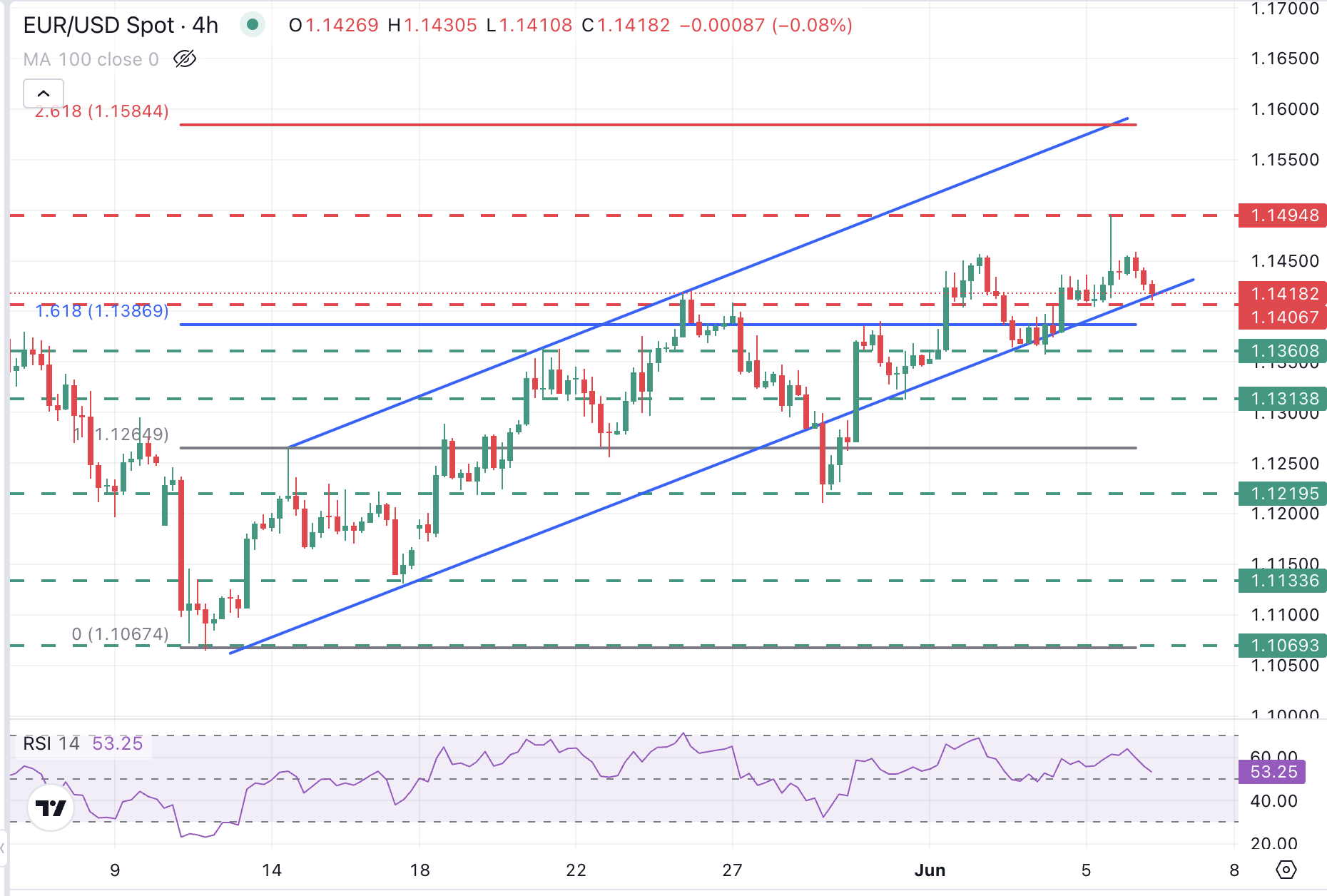
EUR/USD is trading on a positive trend, printing higher highs and higher lows since mid-May as seen in the 4-hour chart below. The pair found sellers at the psychological 1.1500 level on Thursday, but the overall trend remains positive despite the weaker bullish momentum.
The pair is pulling back on Friday, with investors cautious ahead of the release of the US Nonfarm Payrolls report, as prices approach a key support area at 1.1400 (round number, upward-sloping trendline). Below there, the bullish trend would be challenged, with bears focusing on 1.1360 and 1.1315, which have been acting as support and resistance since mid-April.
On the upside, resistances are at 1.1495, which limited the recovery on Thursday, and the 261.8% Fibonacci extension at 1.1585.
Nonfarm Payrolls FAQs
Nonfarm Payrolls (NFP) are part of the US Bureau of Labor Statistics monthly jobs report. The Nonfarm Payrolls component specifically measures the change in the number of people employed in the US during the previous month, excluding the farming industry.
The Nonfarm Payrolls figure can influence the decisions of the Federal Reserve by providing a measure of how successfully the Fed is meeting its mandate of fostering full employment and 2% inflation. A relatively high NFP figure means more people are in employment, earning more money and therefore probably spending more. A relatively low Nonfarm Payrolls’ result, on the either hand, could mean people are struggling to find work. The Fed will typically raise interest rates to combat high inflation triggered by low unemployment, and lower them to stimulate a stagnant labor market.
Nonfarm Payrolls generally have a positive correlation with the US Dollar. This means when payrolls’ figures come out higher-than-expected the USD tends to rally and vice versa when they are lower. NFPs influence the US Dollar by virtue of their impact on inflation, monetary policy expectations and interest rates. A higher NFP usually means the Federal Reserve will be more tight in its monetary policy, supporting the USD.
Nonfarm Payrolls are generally negatively-correlated with the price of Gold. This means a higher-than-expected payrolls’ figure will have a depressing effect on the Gold price and vice versa. Higher NFP generally has a positive effect on the value of the USD, and like most major commodities Gold is priced in US Dollars. If the USD gains in value, therefore, it requires less Dollars to buy an ounce of Gold. Also, higher interest rates (typically helped higher NFPs) also lessen the attractiveness of Gold as an investment compared to staying in cash, where the money will at least earn interest.
Nonfarm Payrolls is only one component within a bigger jobs report and it can be overshadowed by the other components. At times, when NFP come out higher-than-forecast, but the Average Weekly Earnings is lower than expected, the market has ignored the potentially inflationary effect of the headline result and interpreted the fall in earnings as deflationary. The Participation Rate and the Average Weekly Hours components can also influence the market reaction, but only in seldom events like the “Great Resignation” or the Global Financial Crisis.
Author

Guillermo Alcala
FXStreet
Graduated in Communication Sciences at the Universidad del Pais Vasco and Universiteit van Amsterdam, Guillermo has been working as financial news editor and copywriter in diverse Forex-related firms, like FXStreet and Kantox.

















