EUR/USD holds near highs with risk aversion easing
- The Euro remains above 1.1600 following Eurozone data releases.
- Eurozone inflation accelerated in November, although the core HICP remained steady.
- The region's Unemployment rate increased to a 16-month high.

EUR/USD remains little changed on the daily chart on Tuesday, trading at 1.1605 ahead of the US session opening after pulling back from the 1.1650 area on Monday. The unexpected uptick in Eurozone inflation and the higher Unemployment Rate have been practically unnoticed by the market.
Preliminary data released by Eurostat revealed that the Eurozone's Harmonized Index of Consumer Prices (HICP) accelerated in November. Furthermore, the Unemployment rate rose to a 16-month high in October, following an upward revision of September's figures. These data, however, are unlikely to change the ECB's plan to keep interest rates steady in the coming months.
The US Dollar Index (DXY), which measures the value of the US Dollar against a basket of six major peers, found some footing on Monday, as the risk-averse market offset the negative impact of a downbeat US ISM Manufacturing Purchasing Managers' Index (PMI) survey.
The Bank of Japan (BoJ) Governour Kazuo Ueda rattled markets on Monday, hinting at a rate hike in December. The comments triggered a global sell-off in bond markets, which sent US Treasury yields higher and provided some support to an ailing US Dollar.
A well-received auction of Japanese Government Bonds earlier on Tuesday has somewhat eased fears, although risk appetite remains frail. The US economic calendar is thin today, and the focus will remain on the ISM Services PMI and the ADP Employment Change report, due on Wednesday.
Euro Price Today
The table below shows the percentage change of Euro (EUR) against listed major currencies today. Euro was the strongest against the Japanese Yen.
| USD | EUR | GBP | JPY | CAD | AUD | NZD | CHF | |
|---|---|---|---|---|---|---|---|---|
| USD | -0.03% | 0.07% | 0.34% | 0.07% | -0.11% | 0.12% | -0.05% | |
| EUR | 0.03% | 0.11% | 0.38% | 0.11% | -0.09% | 0.17% | -0.01% | |
| GBP | -0.07% | -0.11% | 0.29% | 0.00% | -0.21% | 0.07% | -0.12% | |
| JPY | -0.34% | -0.38% | -0.29% | -0.27% | -0.46% | -0.21% | -0.39% | |
| CAD | -0.07% | -0.11% | -0.00% | 0.27% | -0.19% | 0.06% | -0.12% | |
| AUD | 0.11% | 0.09% | 0.21% | 0.46% | 0.19% | 0.26% | 0.07% | |
| NZD | -0.12% | -0.17% | -0.07% | 0.21% | -0.06% | -0.26% | -0.19% | |
| CHF | 0.05% | 0.01% | 0.12% | 0.39% | 0.12% | -0.07% | 0.19% |
The heat map shows percentage changes of major currencies against each other. The base currency is picked from the left column, while the quote currency is picked from the top row. For example, if you pick the Euro from the left column and move along the horizontal line to the US Dollar, the percentage change displayed in the box will represent EUR (base)/USD (quote).
Daily Digest Market Movers: Eurozone data hits the Euro
- Eurozone's preliminary HICP data revealed that consumer prices accelerated to a 2.2% year-on-year rate in November, from 2.1% in October, and against market expectations of a steady 2.1% reading. The core HICP, however, remained steady, at 2.4% against expectations of an uptick to 2.5%. Monthly inflation contracted 0.3% after a 0.2% increase in October, and the Core HICP fell 0,5% following a 0.3% gain in the previous month.
- At the same time, Eurostat revealed that the Eurozone's Unemployment Rate increased to 6.4%, the highest level since June last year, against market expectations of a 6.3% reading. September's data has been upwardly revised to a 6.4% reading from the previous estimation of 6.3%.
- On Monday, the US ISM Manufacturing PMI revealed that the sector's activity further contracted in November, with the index easing to 48.2 from 48.7 in October, well below the 48.6 expected. New Orders Index fell to 47.4 from 49.4, and the Employment Index dropped to 44 in November from 46 in October. The Prices Paid gauge rose to 58.5 from 58.0, underscoring the inflationary impact from trade tariffs.
- In the Eurozone, manufacturing activity data was also disappointing. The final HCOB Manufacturing PMI was revised down to a five-month low of 49.6 in November, from previous estimates of 49.7, following the standstill level of 50.0 in October.
Technical Analysis: EUR/USD keeps pushing against the 1.1615 resistance area
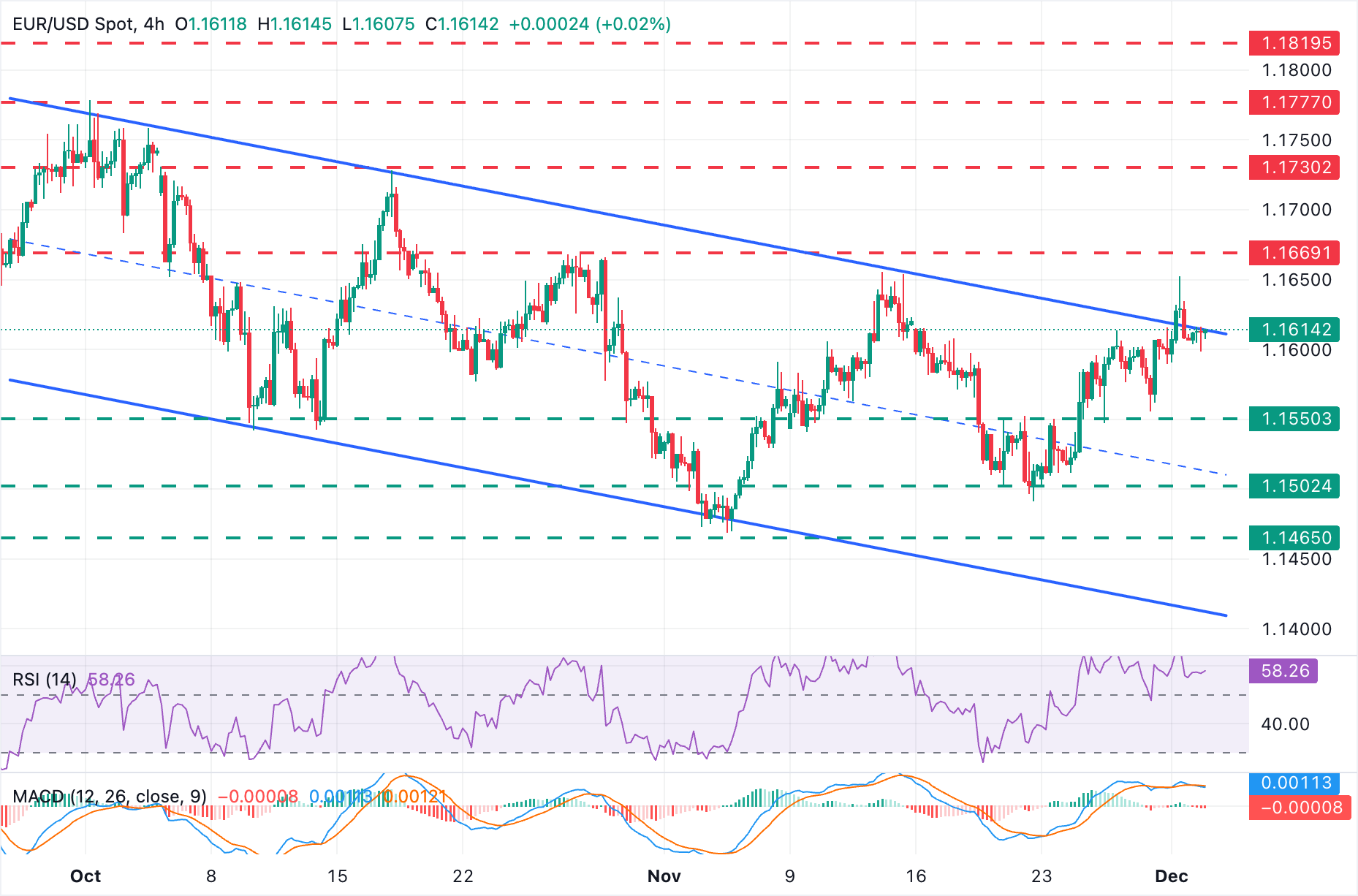
EUR/USD has pulled back from 1.1650 highs, but the immediate bias remains bullish. The pair is attempting to break and consolidate above a trendline resistance at 1.1615, with technical indicators mixed on the 4-hour chart. The Relative Strength Index (RSI) remains in bullish territory near the 60.0 level, while the Moving Average Convergence Divergence (MACD) indicator keeps hovering around the signal line, which highlights a weak momentum.
Above 1.1615, bulls are likely to be challenged at the 1.1660-1.1670 area (October 28, 29, November 13, 14 highs). Further up, the next target is the October 17 high, right below 1.1730, although it seems too distant for Tuesday's session.
On the downside, the pair has been finding support at the 1.1600-1.1590 area (Monday's low, Intraday low), ahead of the 1.1550 area, which held the bears on November 26 and 28. Further down, the 1.1500 psychological level and the November 5 lows, near 1.1470, will come into play.
Risk sentiment FAQs
In the world of financial jargon the two widely used terms “risk-on” and “risk off'' refer to the level of risk that investors are willing to stomach during the period referenced. In a “risk-on” market, investors are optimistic about the future and more willing to buy risky assets. In a “risk-off” market investors start to ‘play it safe’ because they are worried about the future, and therefore buy less risky assets that are more certain of bringing a return, even if it is relatively modest.
Typically, during periods of “risk-on”, stock markets will rise, most commodities – except Gold – will also gain in value, since they benefit from a positive growth outlook. The currencies of nations that are heavy commodity exporters strengthen because of increased demand, and Cryptocurrencies rise. In a “risk-off” market, Bonds go up – especially major government Bonds – Gold shines, and safe-haven currencies such as the Japanese Yen, Swiss Franc and US Dollar all benefit.
The Australian Dollar (AUD), the Canadian Dollar (CAD), the New Zealand Dollar (NZD) and minor FX like the Ruble (RUB) and the South African Rand (ZAR), all tend to rise in markets that are “risk-on”. This is because the economies of these currencies are heavily reliant on commodity exports for growth, and commodities tend to rise in price during risk-on periods. This is because investors foresee greater demand for raw materials in the future due to heightened economic activity.
The major currencies that tend to rise during periods of “risk-off” are the US Dollar (USD), the Japanese Yen (JPY) and the Swiss Franc (CHF). The US Dollar, because it is the world’s reserve currency, and because in times of crisis investors buy US government debt, which is seen as safe because the largest economy in the world is unlikely to default. The Yen, from increased demand for Japanese government bonds, because a high proportion are held by domestic investors who are unlikely to dump them – even in a crisis. The Swiss Franc, because strict Swiss banking laws offer investors enhanced capital protection.
Author

Guillermo Alcala
FXStreet
Graduated in Communication Sciences at the Universidad del Pais Vasco and Universiteit van Amsterdam, Guillermo has been working as financial news editor and copywriter in diverse Forex-related firms, like FXStreet and Kantox.