EUR/USD slips below 1.1050 as US Dollar rises with US NFP in fcous
- EUR/USD drops below 1.1050 as the US Dollar performs strongly ahead of the ISM US Manufacturing PMI release for August.
- The Fed and the ECB are expected to cut interest rates this month.
- This week, investors will focus on the US NFP data for August.

EUR/USD falls back after failing to extend recovery above the immediate resistance of 1.1080 in Tuesday’s North American session. The major currency pair drops as the US Dollar (USD) clings to gains to near an almost two-week high as the US Dollar Index (DXY), which tracks the Greenback’s value against six major currencies, trades close to 101.80.
The US Dollar exhibits strength as investors focus on the United States (US) Nonfarm Payrolls (NFP) data for August, which will be published on Friday. Investors will keenly focus on the labor market data to get cues about the likely interest rate cut size by the Federal Reserve (Fed) in the September monetary policy. Market participants remain confident that the US central bank will pivot to policy normalization this month.
According to the CME FedWatch tool, the likelihood of a 50-basis points (bps) interest rate reduction in September is 31%, while the rest favors a 25-bps decline to 5.00%-5.25%. The probability of a large rate cut size has declined from 36% a week earlier, particularly after the revised Q2 Gross Domestic Product (GDP) estimate indicated that the US economy grew at a faster rate of 3% from the preliminary assumption of 2.8%.
Meanwhile, the ISM Manufacturing Purchasing Managers Index (PMI) data came in lower-than-expected in August. Activities in the manufacturing sector contracted for the fifth straight month, with PMI coming in at 47.2, lower than estimates 47.5.
Daily digest market movers: EUR/USD drops as ECB Villeroy sees rate cuts due to weak economic growth
- EUR/USD drops below 1.1050 in European trading hours. The major currency pair faces severe pressure as the Euro is on the back foot on firm speculation that the European Central Bank (ECB) will cut interest rates this month. This would be the second interest rate cut by the ECB as it pivoted to policy normalization in June, with policymakers remaining confident that price pressures will return to the bank’s target of 2% in 2025.
- Market speculation for ECB interest rate cuts in September has strengthened as Eurozone price pressures have decelerated significantly and signs of a potential recession in Germany have swelled. Eurozone’s headline inflation declined to 2.2% in August due to a sharp decline in energy prices.
- The German economy contracted in the second quarter and is expected to go through a rough phase due to weak demand from domestic and overseas markets.
- Meanwhile, ECB policymakers are also comfortable with market expectations of September rate cuts. Bank of France Governor Francois Villeroy de Galhau said in French magazine Le Point on Friday that “it would be fair and wise to decide in favor of a new rate cut." Villeroy added: "Unfortunately, our growth remains too weak,” and that “the balance of risks still needs to be monitored in Europe,” Reuters reports.
Technical Analysis: EUR/USD trades close to 20-day EMA
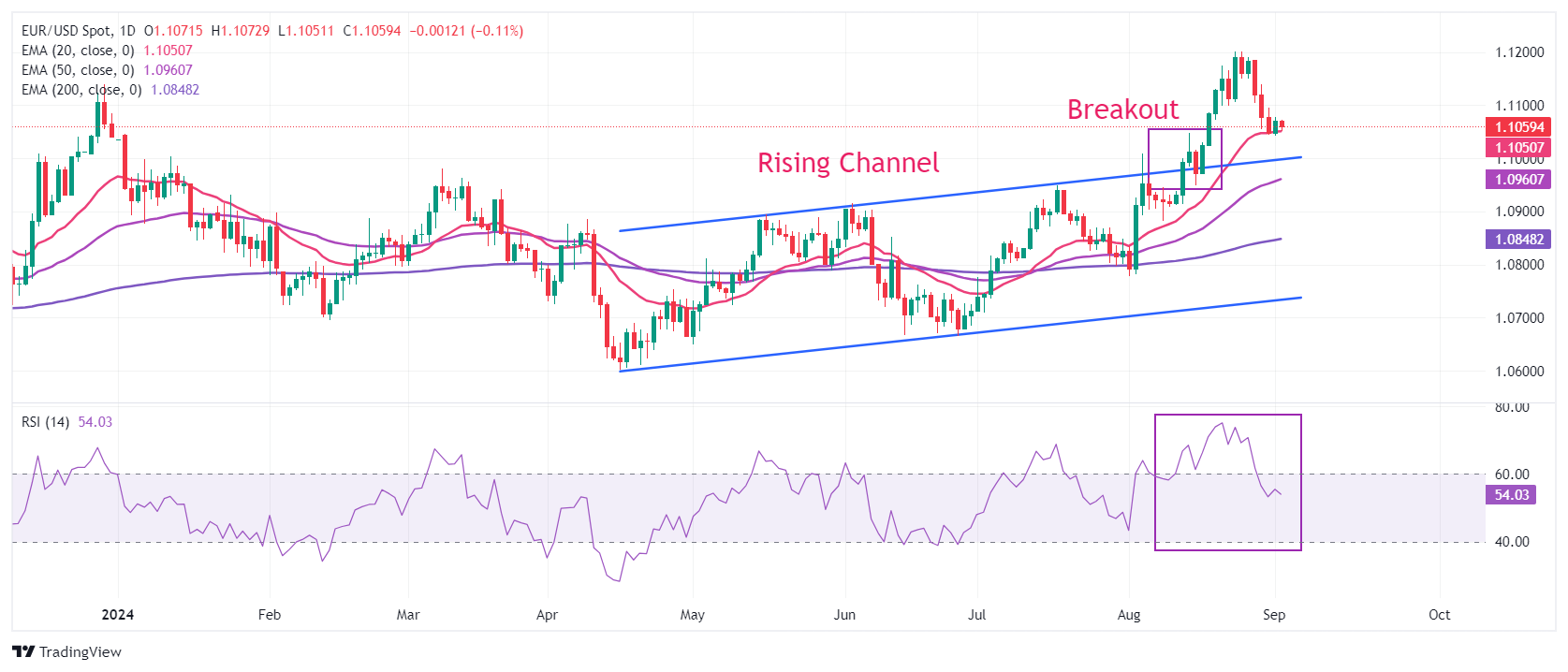
EUR/USD trades inside Monday’s trading range after steading below the crucial resistance of 1.1100. The near-term outlook of the major currency pair is still firm as all short-to-long-term Exponential Moving Averages (EMAs) are sloping higher.
Earlier, the major currency pair strengthened after breaking above the Rising Channel formation on a daily timeframe.
The 14-day Relative Strength Index (RSI) has declined below 60.00 after turning overbought near 75.00.
On the upside, a recent high of 1.1200 and the July 2023 high at 1.1275 will be the next stop for the Euro bulls. Meanwhile, the downside is expected to remain cushioned near the psychological support of 1.1000.
Economic Indicator
Nonfarm Payrolls
The Nonfarm Payrolls release presents the number of new jobs created in the US during the previous month in all non-agricultural businesses; it is released by the US Bureau of Labor Statistics (BLS). The monthly changes in payrolls can be extremely volatile. The number is also subject to strong reviews, which can also trigger volatility in the Forex board. Generally speaking, a high reading is seen as bullish for the US Dollar (USD), while a low reading is seen as bearish, although previous months' reviews and the Unemployment Rate are as relevant as the headline figure. The market's reaction, therefore, depends on how the market assesses all the data contained in the BLS report as a whole.
Read more.Next release: Fri Sep 06, 2024 12:30
Frequency: Monthly
Consensus: 160K
Previous: 114K
Source: US Bureau of Labor Statistics
America’s monthly jobs report is considered the most important economic indicator for forex traders. Released on the first Friday following the reported month, the change in the number of positions is closely correlated with the overall performance of the economy and is monitored by policymakers. Full employment is one of the Federal Reserve’s mandates and it considers developments in the labor market when setting its policies, thus impacting currencies. Despite several leading indicators shaping estimates, Nonfarm Payrolls tend to surprise markets and trigger substantial volatility. Actual figures beating the consensus tend to be USD bullish.
Author

Sagar Dua
FXStreet
Sagar Dua is associated with the financial markets from his college days. Along with pursuing post-graduation in Commerce in 2014, he started his markets training with chart analysis.