EUR/USD fluctuates within range with all eyes on US CPI figures
- EUR/USD consolidates around 1.1650 on Tuesday after rejection at the 1.1700 area the previous day.
- Hawkish comments by Fed's Williams provided some support to the US Dollar on Monday.
- The market is bracing for a strong US CPI reading later on Tuesday.

EUR/USD is trading at 1.1660 at the time of writing, after moving back and forth between 1.1650 and 1.1675 during the Asian ans European Markets on Monday. The pair eased from weekly highs near 1.1700 on Monday after New York Federal Reserve’s (Fed) President John Williams conveyed an optimistic view on the US economic outlook, and curbed expectations of any immediate rate cut.
Previously, investors had sold the US Dollar across the board, as a report by the New York Times affirming that the US Government was initiating a criminal investigation against the Fed Chairman, Jerome Powell, boosted concerns about the independence of the US central bank.
The US government's action is the last episode of a long-lasting conflict between US President Donald Trump and Jerome Powell, which raises questions about the central bank’s ability to set its monetary policy based solely on its dual mandate of maximum employment and stable prices. The Presidents of the world's major central banks issued an unprecedented statement on Tuesday in solidarity with Chairman Powell.
Macroeconomic data is expected to return to the focus on Tuesday, as the US Bureau of Labour Statistics (BLS) releases the December US Consumer Price Index (CPI) report. Price pressures are expected to have remained well above the Fed’s 2% target, with core inflation ticking up. Barring surprises, these figures are likely to endorse the positions of the Fed's hawkish party.
Euro Price Today
The table below shows the percentage change of Euro (EUR) against listed major currencies today. Euro was the strongest against the Japanese Yen.
| USD | EUR | GBP | JPY | CAD | AUD | NZD | CHF | |
|---|---|---|---|---|---|---|---|---|
| USD | -0.01% | -0.05% | 0.41% | 0.04% | 0.22% | 0.06% | 0.09% | |
| EUR | 0.00% | -0.04% | 0.43% | 0.05% | 0.23% | 0.06% | 0.10% | |
| GBP | 0.05% | 0.04% | 0.45% | 0.09% | 0.28% | 0.11% | 0.14% | |
| JPY | -0.41% | -0.43% | -0.45% | -0.37% | -0.18% | -0.35% | -0.31% | |
| CAD | -0.04% | -0.05% | -0.09% | 0.37% | 0.18% | 0.02% | 0.05% | |
| AUD | -0.22% | -0.23% | -0.28% | 0.18% | -0.18% | -0.16% | -0.13% | |
| NZD | -0.06% | -0.06% | -0.11% | 0.35% | -0.02% | 0.16% | 0.02% | |
| CHF | -0.09% | -0.10% | -0.14% | 0.31% | -0.05% | 0.13% | -0.02% |
The heat map shows percentage changes of major currencies against each other. The base currency is picked from the left column, while the quote currency is picked from the top row. For example, if you pick the Euro from the left column and move along the horizontal line to the US Dollar, the percentage change displayed in the box will represent EUR (base)/USD (quote).
Daily Digest Market Movers: Concerns about Fed's independence keep weighing on the US Dollar
- The Euro (EUR) has lost ground but remains above Friday's lows, with the US Dollar still vulnerable amid the US Government's attacks on the Fed's independence.
- Fitc Ratings warned on Monday that the Fed's independence is a key factor supporting the US AA++ sovereign rating and that they will continue monitoring the governance, including "checks and balances," in their assessment of the US ratings.
- S&P Global Ratings also said that Fed credibility is a key pillar of US sovereign creditworthiness. In a previous report, the rating agency also warned that the US rating would come under pressure if the strength of American institutions is undermined.
- The heads of the European Central Bank (ECB), the Bank of England (BoE) the Bank of Canada (BoC), and eight further central banks have raised their voices in solidarity with Chairman Powell, defending the independence of the central banks as a cornerstone for price, financial, and economic stabilit, in the interest of the citizens that they serve.
- On Monday, New York Fed President Johnsn Williams provided some support for the US Dollar, stating that recent Fed decisions have moved “the modestly restrictive stance closer to neutral” and that he expects a healthy economy in 2026. Williams also said that he sees monetary policy well-positioned to support the stabilisation of the labour market, and that he sees no reason to cut interest rates anytime soon.
- The market is pricing a 95% chance that the Fed will keep interest rates unchanged at its January meeting, and hopes of a rate cut in March have dropped to 24% from 41% one week ago, according to data released by the CME Group's Fedwatch tool.
- The release of the US CPI report, due later on Tuesday, might shed some more light on the Fed's monetary policy path. Headline inflation is seen growing steadily at a 2.7% yearly pace, while core inflation, the most relevant from the monetary policy perspective, is seen ticking up to 2.7% YoY, from 2.6% in November.
Technical Analysis: EUR/USD holds within the descending channel
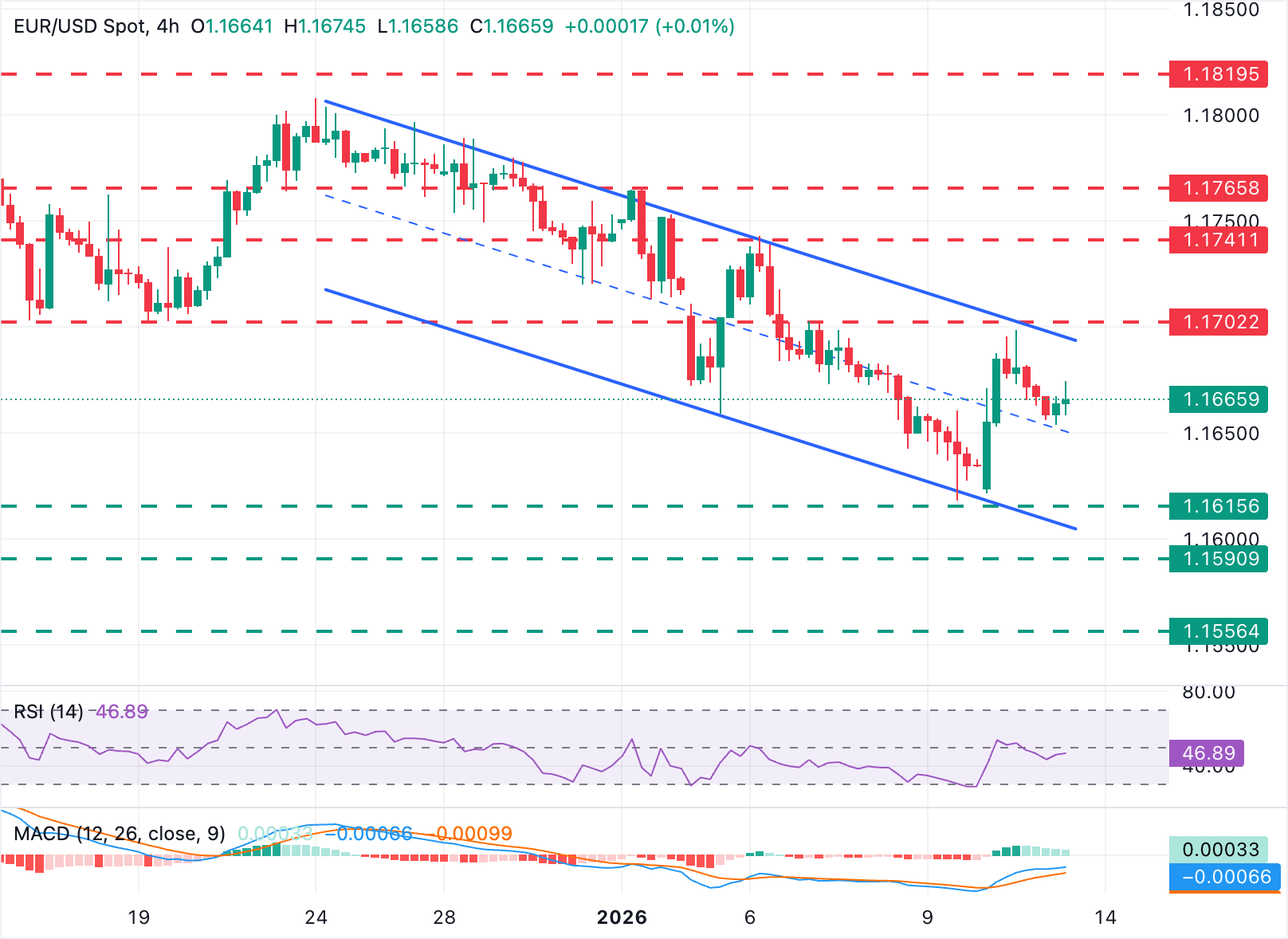
The EUR/USD pair keeps the broader bearish trend from late December highs intact. The pair failed to breach resistance at 1.1700 and returned to the mid-range of the 1.1600s.
Technical indicators are mixed on the 4-hour chart. The Moving Average Convergence Divergence (MACD) line remains above the signal line, but the histogram bars are contracting, which highlights a waning upside momentum. The Relative Strength Index (RSI) has pulled back below 50, showing a neutral-to-bearish stance.
The intraday low, at 1.1653, is likely to provide some support, ahead of Friday's low of 1.1618 and the channel's bottom, now at the 1.1600 area. To the upside, trendline resistance is now at 1.1694, a few pips below Monday's high. A confirmation above this level clears the path towards the January 6 high, at the 1.1740 area.
(The technical analysis of this story was written with the help of an AI tool.)
Economic Indicator
Consumer Price Index (YoY)
Inflationary or deflationary tendencies are measured by periodically summing the prices of a basket of representative goods and services and presenting the data as The Consumer Price Index (CPI). CPI data is compiled on a monthly basis and released by the US Department of Labor Statistics. The YoY reading compares the prices of goods in the reference month to the same month a year earlier.The CPI is a key indicator to measure inflation and changes in purchasing trends. Generally speaking, a high reading is seen as bullish for the US Dollar (USD), while a low reading is seen as bearish.
Read more.Next release: Tue Jan 13, 2026 13:30
Frequency: Monthly
Consensus: 2.7%
Previous: 2.7%
Source: US Bureau of Labor Statistics
The US Federal Reserve (Fed) has a dual mandate of maintaining price stability and maximum employment. According to such mandate, inflation should be at around 2% YoY and has become the weakest pillar of the central bank’s directive ever since the world suffered a pandemic, which extends to these days. Price pressures keep rising amid supply-chain issues and bottlenecks, with the Consumer Price Index (CPI) hanging at multi-decade highs. The Fed has already taken measures to tame inflation and is expected to maintain an aggressive stance in the foreseeable future.
Economic Indicator
Consumer Price Index ex Food & Energy (YoY)
Inflationary or deflationary tendencies are measured by periodically summing the prices of a basket of representative goods and services and presenting the data as the Consumer Price Index (CPI). CPI data is compiled on a monthly basis and released by the US Department of Labor Statistics. The YoY reading compares the prices of goods in the reference month to the same month a year earlier. The CPI Ex Food & Energy excludes the so-called more volatile food and energy components to give a more accurate measurement of price pressures. Generally speaking, a high reading is bullish for the US Dollar (USD), while a low reading is seen as bearish.
Read more.Next release: Tue Jan 13, 2026 13:30
Frequency: Monthly
Consensus: 2.7%
Previous: 2.6%
Source: US Bureau of Labor Statistics
The US Federal Reserve has a dual mandate of maintaining price stability and maximum employment. According to such mandate, inflation should be at around 2% YoY and has become the weakest pillar of the central bank’s directive ever since the world suffered a pandemic, which extends to these days. Price pressures keep rising amid supply-chain issues and bottlenecks, with the Consumer Price Index (CPI) hanging at multi-decade highs. The Fed has already taken measures to tame inflation and is expected to maintain an aggressive stance in the foreseeable future.
Author

Guillermo Alcala
FXStreet
Graduated in Communication Sciences at the Universidad del Pais Vasco and Universiteit van Amsterdam, Guillermo has been working as financial news editor and copywriter in diverse Forex-related firms, like FXStreet and Kantox.