EUR/USD recovers sharply as weak US Job vacancies boosts Fed large rate cut bets
- EUR/USD recovers swiftly from the two-week low of 1.1030 after downbeat US JOLTS Job Openings data for July.
- The US Dollar weakens as lower-than-expected US job vacancies prompt downside risks to the labor market.
- Investors see the ECB cutting interest rates again in September.

EUR/USD bounces back strongly from a fresh two-week low of 1.1025 in Wednesday’s North American session. The major currency pair strengthens as the US Dollar (USD) tumbles after the release of the United States (US) JOLTS Job Openings report. Job vacancies posted by US employers in July came in lower at 7.673 million than estimates of 8.1 million and June's reading of 7.91 million, downwardly revised from 8.184 million.
The US Dollar Index (DXY), which tracks the Greenback’s value against six major currencies, slumps to near 101.40 as weak job openings data renewed risks of deteriorating job growth. On Tuesday, the DXY corrected from a two-week high near 102.00 after downbeat US ISM Manufacturing PMI data for August.
The ISM Manufacturing PMI, released on Tuesday, came in at 47.2, missing estimates of 47.5 but improving from an eight-month low of 46.8. Despite the slight improvement, markets considered that the overall trend points to a slowdown as a figure below 50.0 suggests a contraction in manufacturing activity.
Amid a data-heavy week, investors keenly await the US Nonfarm Payrolls (NFP) data for August, which will be published on Friday. The official labor market data will shape the Federal Reserve’s (Fed) interest rate cut path for September. Investors seem to be confident that the Fed will start reducing its key borrowing rates this month but are divided over the size of this potential rate cut.
The importance of the labor market data has increased significantly after the commentary from Fed Chair Jerome Powell at the Jackson Hole (JH) Symposium, who signalled that the central bank is very much concerned about weakening labor demand.
Daily digest market movers: EUR/USD gains sharply as US Dollar has been hit hard
- EUR/USD recovers fast in North American trading hours as the US Dollar slides further. The Euro’s (EUR) near-term outlook remains downbeat as market participants expect that the European Central Bank’s (ECB) policy-easing cycle could be aggressive given the steep decline in Eurozone inflationary pressures and weak economic growth.
- Economists at Bank of America (BofA) said in their latest report about the Eurozone: "We still see more cuts in 2025/26 than the markets are pricing, with a return to a deposit rate of 2% by 3Q25 (at the latest) and to 1.5% in 2026." BofA said that Europe's recovery remains fragile and will likely be shallow, pressured by several economic factors such as slowing growth in China as well as politics.
- ECB officials also remain worried about increasing risks to Eurozone economic growth. ECB Executive board member Piero Cipollone said in an interview with a French newspaper said that there is a real risk that our stance could become too restrictive," adding that, "we must ensure that inflation converges to our target without holding back the economy unnecessarily," Reuters reported.
- On the economic front, investors await the Eurozone Retail Sales data for July, which will be published on Thursday. Economists estimate the Retail Sales to have grown by 0.1% after contracting 0.3% in June on a monthly as well as an annual basis. A slight improvement in sales at retail stores would be insufficient to dampen market speculation that the ECB will resume its policy-easing cycle this month, which it started in June, after pausing in July.
- Meanwhile, the Eurozone Producer Price Index (PPI) data came in better than projected in July. The PPI report showed that prices of goods and services at factory gates were deflated at a slower pace of 2.1% from the estimates of 2.5% and July's reading of 3.2%. The producer inflation is unlikely to diminish expectations for ECB rate cuts in September as it continues to deflate.
Technical Analysis: EUR/USD discovers strong buying interest near 1.1030
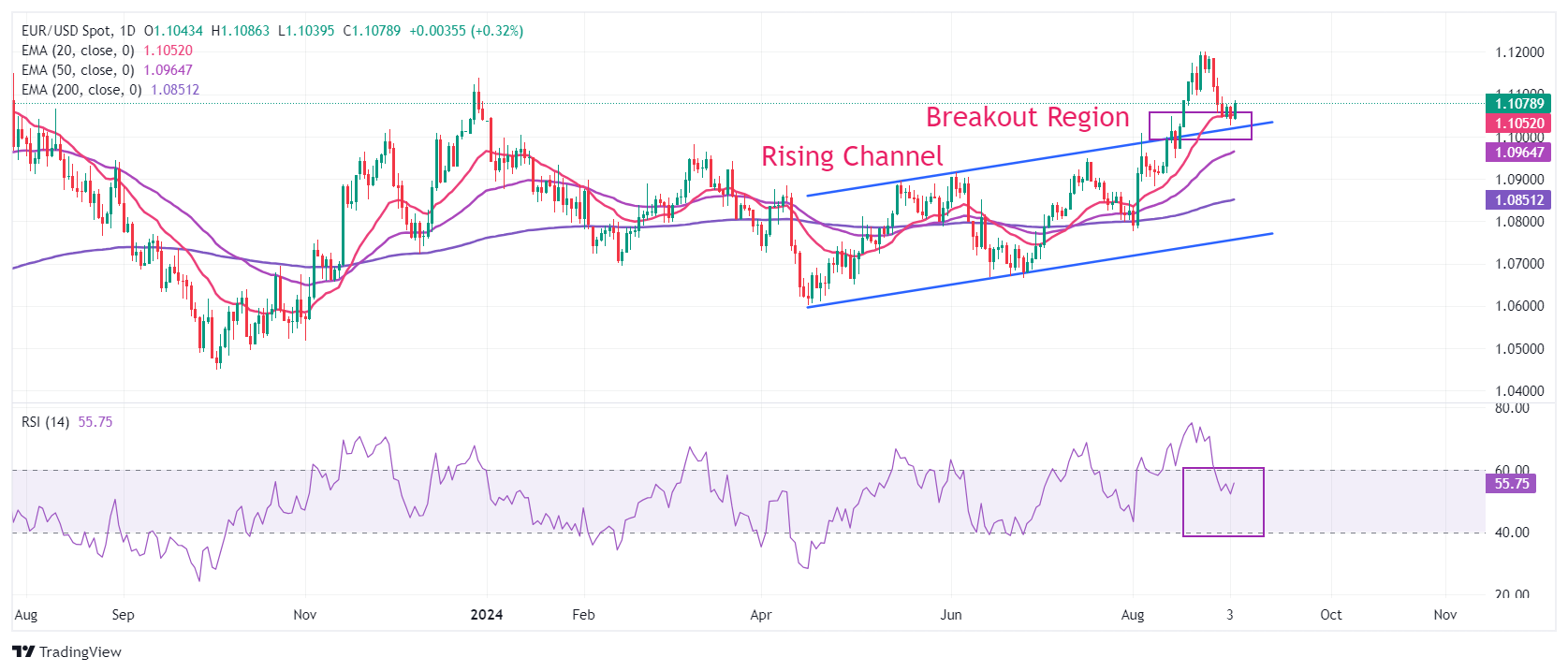
EUR/USD gains sharply from a fresh two-week low near 1.1025. The near-term outlook of the major currency pair has improved as it manages to gain firm footing near the 20-day Exponential Moving Average (EMA) around 1.1020.
The longer-term outlook is also bullish as the 50-day and 200-day EMAs at 1.0964 and 1.0850, respectively, are sloping higher. Also, the shared currency pair holds the Rising Channel breakout on a daily time frame.
The 14-day Relative Strength Index (RSI) has declined below 60.00 after turning overbought near 75.00.
On the upside, the recent high of 1.1200 and the July 2023 high at 1.1275 will be the next stop for the Euro bulls. Meanwhile, the downside is expected to remain cushioned near the psychological support of 1.1000.
Economic Indicator
JOLTS Job Openings
JOLTS Job Openings is a survey done by the US Bureau of Labor Statistics to help measure job vacancies. It collects data from employers including retailers, manufacturers and different offices each month.
Read more.Last release: Wed Sep 04, 2024 14:00
Frequency: Monthly
Actual: 7.673M
Consensus: 8.1M
Previous: 8.184M
Source: US Bureau of Labor Statistics
Author

Sagar Dua
FXStreet
Sagar Dua is associated with the financial markets from his college days. Along with pursuing post-graduation in Commerce in 2014, he started his markets training with chart analysis.
















