EUR/USD bounces back as US Dollar drops, Fed sees two rate cuts in 2025
- EUR/USD rebounds above 1.0400 as the US Dollar takes a breather after the rally induced by the Fed’s hawkish guidance.
- Fed officials see only two interest rate cuts in 2025, fewer than the four projected earlier.
- ECB Wunsch said he is comfortable with market expectations of four 25 bps interest rate cuts in 2025.

EUR/USD jumps above 1.0400 in Thursday’s North American session as US Dollar’s (USD) bulls take a breather after a sharp run-up on Wednesday. The US Dollar Index (DXY), which tracks the Greenback’s value against six major currencies, clings to gains near a fresh two-year high above 108.00. The Greenback attracted significant bids after the Federal Reserve (Fed) reduced its key borrowing rates by 25 basis points (bps) to 4.25%-4.50% on Wednesday, as expected, but signaled fewer interest rate cuts for the next year.
In the latest dot plot, the Fed revised its projections for the number of interest rate cuts in 2025 to two from the four forecasted in the September monetary policy meeting. In the press conference, Fed Chair Jerome Powell cited uncertainty over inflation, easing downside risks to employment, and strong growth in the second half of the year as factors that forced officials to be cautious about interest rate cuts. I also point out that we're closer to the neutral rate, which is another reason to be cautious about further moves," Powell added.
The Fed has also revised the forecast for the core Personal Consumption Expenditures Price Index (PCE), the Fed's preferred inflation measure, for 2025 to 2.5%, up from prior estimates of 2.2% in its latest economic projections.
Jerome Powell refrained from commenting on the consequences of the incoming immigration, tariff, and taxation policies by President-elect Donald Trump on the economy. "It is very premature to make any kind of conclusions,” he said. “We don’t know what will be tariffed, from what countries, for how long, in what size," Powell added.
Meanwhile, the second estimate for the Q3 United States (US) Gross Domestic Product (GDP) data has shown that the economy rose at a faster pace of 3.1% than the preliminary estimate of 2.8%. Initial Jobless Claims for the week ending December 16 have come in lower than projected. Individuals claiming jobless benefits for the first time were 220K, lower than estimates of 230K and the former release of 242K.
On Friday, investors will pay close attention to the US PCE inflation data for November. The core PCE Price Index data is estimated to have accelerated to 2.9% from 2.8% in October. On month, the inflation measure is expected to have grown by 0.2%, slower than the prior release of 0.3%.
Daily digest market movers: EUR/USD gains as Euro outperforms
- EUR/USD advances on Thursday as the Euro (EUR) performs strongly against its major peers even though European Central Bank (ECB) officials have guided a continuation of the policy-easing spell in 2025. The ECB has already reduced its Deposit Facility rate by 100 basis points (bps) to 3% and is expected to cut by a similar margin next year.
- ECB policymaker and Governor of National Bank of Belgium Pierre Wunsch has also backed four more interest rate cuts, citing concerns over Eurozone economic growth due to protectionist US policies under Trump’s administration. “Four more rate cuts are a meaningful scenario that I feel relatively comfortable with,” Wunsch said.
- Pierre Wunsch openly discussed a potential Euro parity with the US Dollar in an attempt to compensate for the 10% tariffs by the US. “If the Euro touches parity against the dollar, we wouldn't lose as much in terms of competitiveness,” Wunsch said and added: “A larger Euro depreciation would cushion the impact of tariffs on growth.”
Technical Analysis: EUR/USD recovers from 1.0340
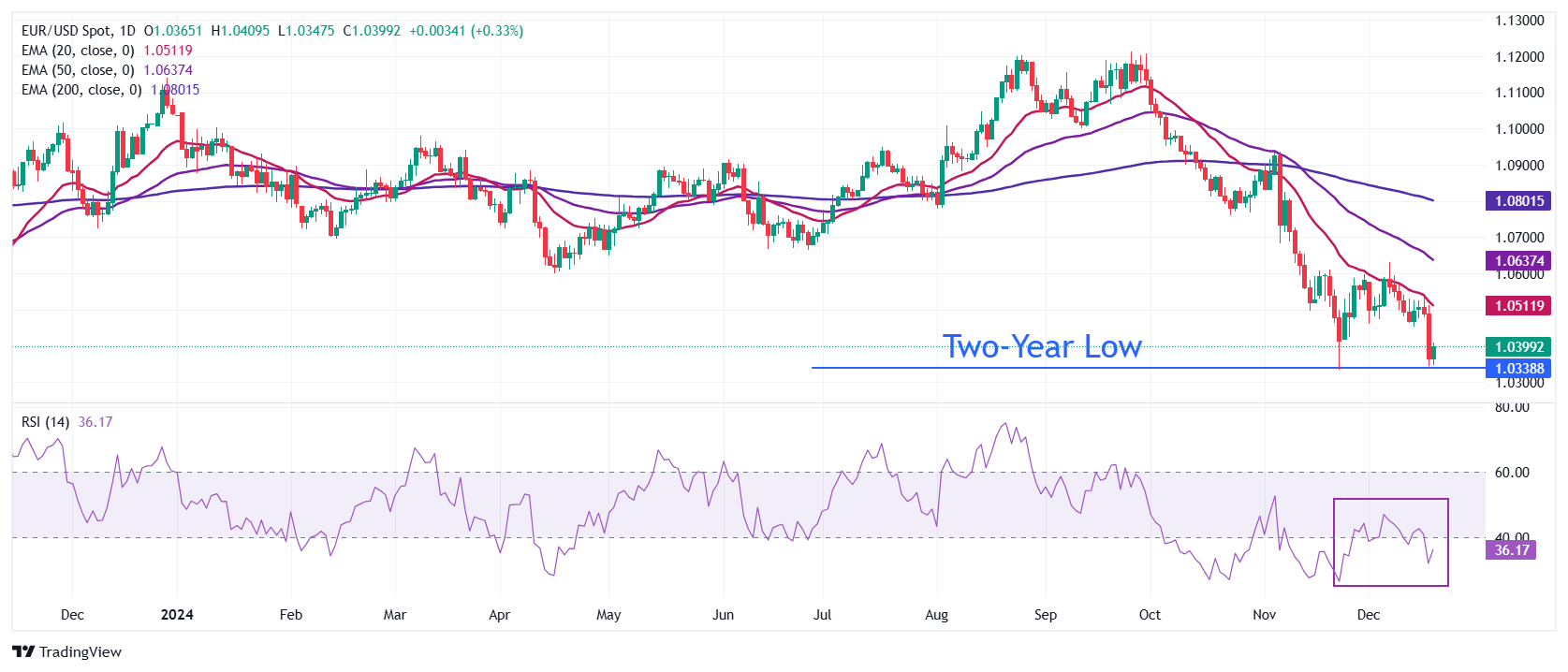
EUR/USD bounces back after refreshing a more than three-week low at 1.0340 after the Fed meeting. However, the outlook of the major currency pair remains clearly bearish as all short-to-long-term Exponential Moving Averages (EMAs) are declining.
The 14-day Relative Strength Index (RSI) slides into the bearish range of 20.00-40.00, suggesting that a fresh downside momentum has been triggered.
Looking down, the pair could decline to near the round-level support of 1.0200 after breaking below the two-year low of 1.0330. Conversely, the 20-day EMA near 1.0500 will be the key barrier for the Euro bulls.
Author

Sagar Dua
FXStreet
Sagar Dua is associated with the financial markets from his college days. Along with pursuing post-graduation in Commerce in 2014, he started his markets training with chart analysis.

















