EUR/USD rallies as Trump's attacks to the Fed boost rate-cut bets
- The Euro extends gains as Trump's attacks on the Fed erode the US Dollar's reserve currency status.
- Weak US data and Trump's pressures have boosted hopes of Fed cuts in the next months.
- EUR/USD is struggling to consolidate above 1.1700.

The EUR/USD appreciates for the sixth consecutive day and is trading around the 1.1700 level, after pulling back from nearly four-year highs above 1.1750 earlier on Thursday. News reports that US President Donald Trump is considering an early announcement of the Federal Reserve (Fed) Chair Jerome Powell's successor have rattled markets and sent the US Dollar (USD) tumbling.
A report by the Wall Street Journal suggests that Trump is considering announcing the name of Jerome Powell's replacement in September or October. This would be an unusual move, as Powell ends his term next May, and would create a shadow Fed Chair and undermine the central bank's credibility.
This news comes after Powell reaffirmed his cautious tone regarding further interest rate cuts in his semiannual testimony to Congress, which triggered the umpteenth attack from President Trump, calling him "terrible" and flagging that he has "three to four" candidates to replace him.
The ongoing pressures on the US central bank, however, coupled with weak macroeconomic data and some dissenting voices within the Fed calling for less restrictive rates, have prompted investors to ramp up their bets this week. The CME Group's Fed Watch Tool shows a 24% chance of a July cut, up from 14% only one week before, while the odds for a September cut have risen to 90% from about 65% last week, adding negative pressure on the Grenback.
The US economic calendar is busy today with May's Durable Goods orders and the final reading of the first quarter's Gross Domestic Product (GDP) grabbing the focus. The highlight of the week, however, will be Friday's Personal Consumption Expenditures (PCE) Price Index. This is the Fed's inflation gauge of choice and will be observed with attention to assess Fed easing expectations.
Euro PRICE Today
The table below shows the percentage change of Euro (EUR) against listed major currencies today. Euro was the strongest against the US Dollar.
| USD | EUR | GBP | JPY | CAD | AUD | NZD | CHF | |
|---|---|---|---|---|---|---|---|---|
| USD | -0.57% | -0.65% | -0.78% | -0.31% | -0.52% | -0.45% | -0.57% | |
| EUR | 0.57% | -0.01% | -0.24% | 0.29% | 0.10% | 0.13% | 0.03% | |
| GBP | 0.65% | 0.01% | -0.24% | 0.31% | 0.11% | 0.17% | 0.04% | |
| JPY | 0.78% | 0.24% | 0.24% | 0.49% | 0.30% | 0.33% | 0.23% | |
| CAD | 0.31% | -0.29% | -0.31% | -0.49% | -0.20% | -0.23% | -0.27% | |
| AUD | 0.52% | -0.10% | -0.11% | -0.30% | 0.20% | -0.03% | -0.07% | |
| NZD | 0.45% | -0.13% | -0.17% | -0.33% | 0.23% | 0.03% | -0.04% | |
| CHF | 0.57% | -0.03% | -0.04% | -0.23% | 0.27% | 0.07% | 0.04% |
The heat map shows percentage changes of major currencies against each other. The base currency is picked from the left column, while the quote currency is picked from the top row. For example, if you pick the Euro from the left column and move along the horizontal line to the US Dollar, the percentage change displayed in the box will represent EUR (base)/USD (quote).
Daily digest market movers: Doubts about Fed independence undermine the Dollar's reserve currency status
- The US Dollar has tumbled across the board as Trump's attacks on the head of the Fed undermine the credibility of the central bank and threaten the Greenback's status as the world's reserve currency. The Euro (EUR) has been one of the main beneficiaries of US Dollar weakness, with the pair appreciating nearly 2% so far this week, with no significant macroeconomic driver to support that rally.
- With geopolitical tensions out of the foreground, as the truce between Iran and Israel holds for its third day, Trump's erratic trade policy is back in focus. The July 9 deadline approaches, and there is no sign of progress on trade deals with key partners. This is another source of negative pressure for the US Dollar.
- Data released on Thursday revealed that the German GFK Consumer Sentiment Survey deteriorated to -20.3 for July from -20 in the previous month. Germans are showing an increasing willingness to save, which weighs on consumption and highlights a sentiment of economic uncertainty.
- At 12:30 GMT, the US Durable Goods Orders, an advanced gauge for manufacturing activity, are expected to have increased by 8.5% in May after a 6.3% drop in April. Excluding transportation, however, orders for all other products are seen stalled, after a 0.2% increase in the previous month. This may offset the positive impact of an upbeat headline reading.
- At the same time, the first quarter's US GDP reading is expected to confirm a 0.2% contraction in the quarter and a 3.7% year-on-year growth. The impact of these figures is expected to be minimal unless there is a significant revision of previous estimations.
- On Wednesday, Fed Chair Jerome Powell stood firm against President Trump's pressures to cut rates and reiterated that the central bank is "well-positioned to wait" on interest rate adjustments until there is more clarity about the inflationary effects of trade tariffs.
- Trump reacted, calling Powell names again and suggesting that he has narrowed down a list of candidates to replace him. Market sources have aired the names of former Fed Governor Kevin Warsh, National Economic Council director Kevin Hassett, and Treasury Secretary Scott Bessent as the best-positioned to take the job.
EUR/USD reaches overbought levels above 1.1700, some correction looks likely
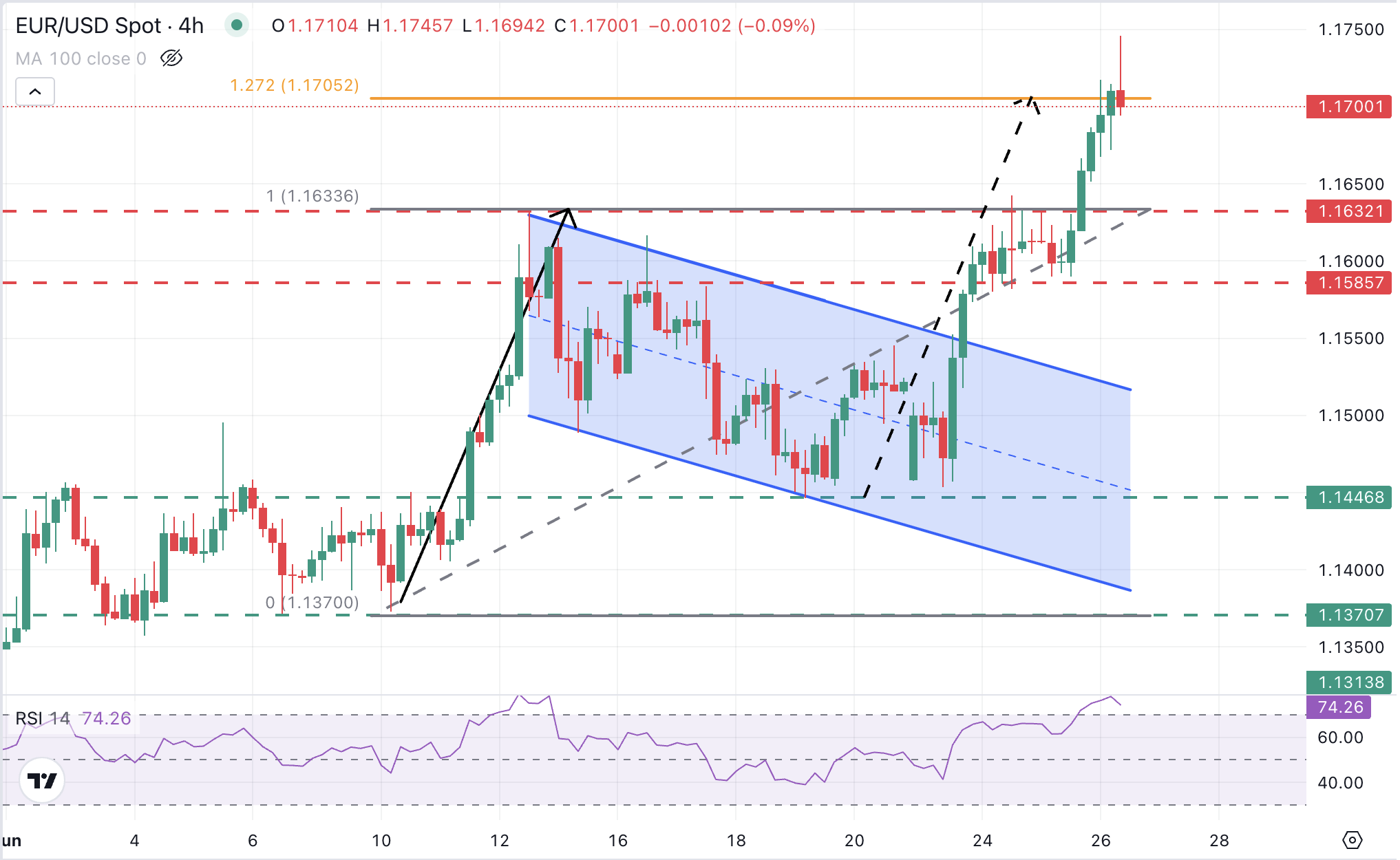
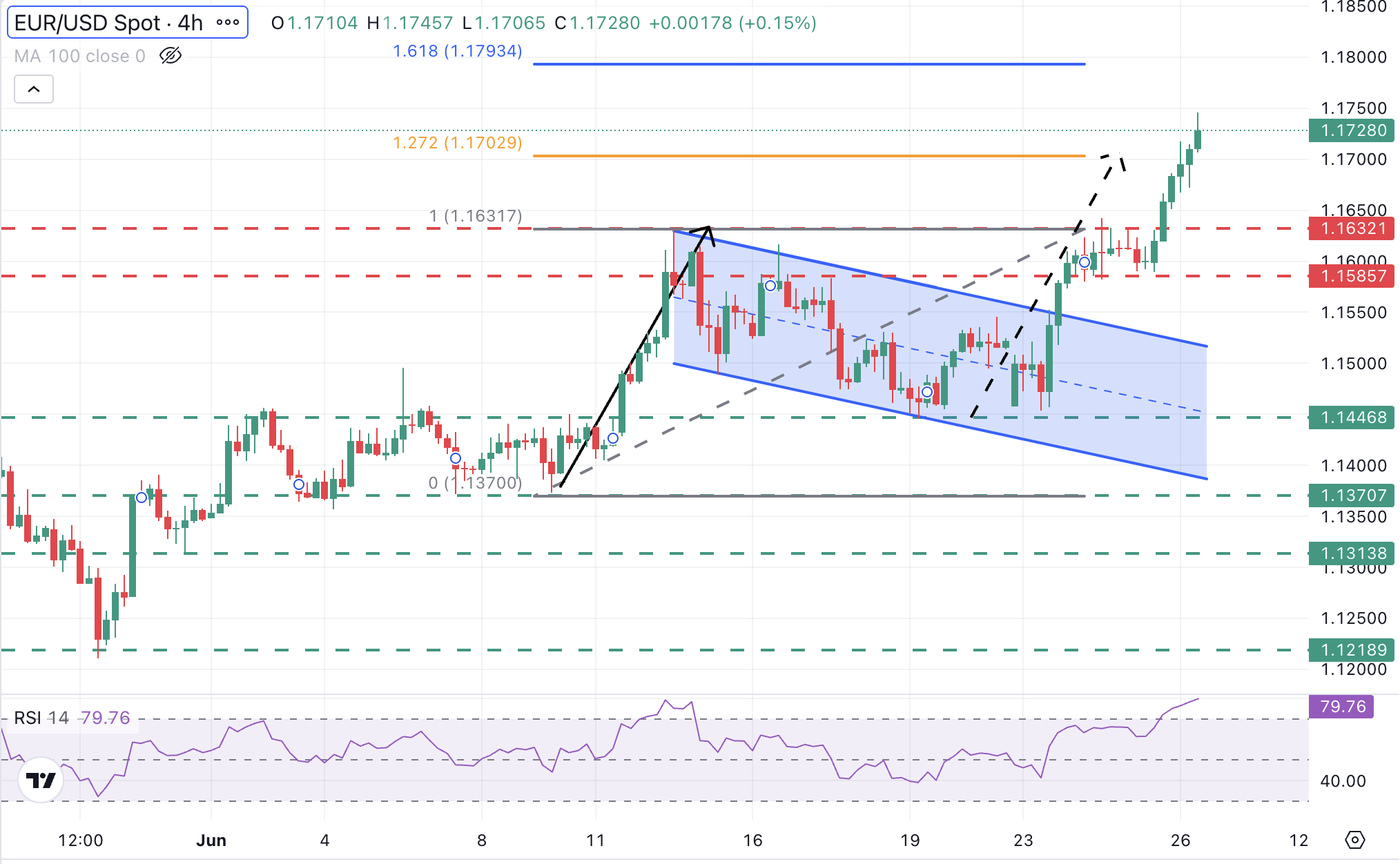
EUR/USD rallies further on early Thursday trading, favoured by US Dollar weakness, and reaches the target of the previous two weeks' bullish flag formation, right above 1.1700. The fundamental context remains supportive, but the 14-period Relative Strength Index (RSI) indicator is overbought in most timeframes and looks heavily stretched on 4-hour charts. These levels are often the prelude to a consolidation or even a bearish correction.
On the downside, the pair may find support at the previous resistance area near 1.1630 (June 12, 24 highs) ahead of 1.1585 (June 24, 25 lows) and the downward sloping trendline, now at 1.1520.
Immediate resistance is at the 1.1700 area, the 127.2% Fibonacci extension of the June 10-12 rally, and above here, 1.1795, the 161,8% Fibonacci extension of the mentioned move.
Economic Indicator
Durable Goods Orders
The Durable Goods Orders, released by the US Census Bureau, measures the cost of orders received by manufacturers for durable goods, which means goods planned to last for three years or more, such as motor vehicles and appliances. As those durable products often involve large investments they are sensitive to the US economic situation. The final figure shows the state of US production activity. Generally speaking, a high reading is bullish for the USD.
Read more.Next release: Thu Jun 26, 2025 12:30
Frequency: Monthly
Consensus: 8.5%
Previous: -6.3%
Source: US Census Bureau
Economic Indicator
Durable Goods Orders ex Transportation
The Durable Goods Orders measures, released by the US Census Bureau, the cost of orders received by manufacturers for durable goods, which means goods planned to last for three years or more, excluding the transport sector. As those durable products often involve large investments they are sensitive to the US economic situation. Generally speaking, a high reading is bullish for the USD, while a low reading is seen as Bearish.
Read more.Next release: Thu Jun 26, 2025 12:30
Frequency: Monthly
Consensus: 0%
Previous: 0.2%
Source: US Census Bureau
Economic Indicator
Gross Domestic Product Annualized
The real Gross Domestic Product (GDP) Annualized, released quarterly by the US Bureau of Economic Analysis, measures the value of the final goods and services produced in the United States in a given period of time. Changes in GDP are the most popular indicator of the nation’s overall economic health. The data is expressed at an annualized rate, which means that the rate has been adjusted to reflect the amount GDP would have changed over a year’s time, had it continued to grow at that specific rate. Generally speaking, a high reading is seen as bullish for the US Dollar (USD), while a low reading is seen as bearish.
Read more.Next release: Thu Jun 26, 2025 12:30
Frequency: Quarterly
Consensus: -0.2%
Previous: -0.2%
Source: US Bureau of Economic Analysis
The US Bureau of Economic Analysis (BEA) releases the Gross Domestic Product (GDP) growth on an annualized basis for each quarter. After publishing the first estimate, the BEA revises the data two more times, with the third release representing the final reading. Usually, the first estimate is the main market mover and a positive surprise is seen as a USD-positive development while a disappointing print is likely to weigh on the greenback. Market participants usually dismiss the second and third releases as they are generally not significant enough to meaningfully alter the growth picture.
Author

Guillermo Alcala
FXStreet
Graduated in Communication Sciences at the Universidad del Pais Vasco and Universiteit van Amsterdam, Guillermo has been working as financial news editor and copywriter in diverse Forex-related firms, like FXStreet and Kantox.