EUR/USD pressured as USD gains traction on uneven data and Fed divide
- EUR/USD drops on resilient US PMIs, while risk aversion boosts the Greenback.
- UoM sentiment plunges close to its record low, consumers frustrated with inflation and income.
- Although Fed officials deliver mixed messages, markets price a 71% chance of a December rate cut.

EUR/USD posts moderate losses during the North American session on Friday as the US Dollar (USD) holds firm after the release of mixed economic data and dovish comments by Federal Reserve (Fed) officials. The pair trades at 1.1504, down 0.20%, after hitting a two-week low of 1.1491.
Euro retreats 0.20% as weak US sentiment contrasts with firmer PMIs, markets rise December cut odds
Data in the US was mixed, yet the economy shows signs of resilience. The S&P Global Manufacturing and Services PMIs were mixed in November but revealed that business confidence had improved.
Other data showed that American households turned pessimistic about the economic outlook, according to the University of Michigan (UoM) Consumer Sentiment for November. Sentiment hit its lowest level since 2009, as consumers remain frustrated about high prices and weakening incomes.
After the data, the EUR/USD’s reaction was muted, as traders digested mixed comments from many Federal Reserve officials.
Dovish comments from New York Fed President John Williams and Governor Stephen Miran boosted investor expectations for a 25-basis-point rate cut at the December meeting. Conversely, Boston Fed President Susan Collins and Dallas Fed President Lorie Logan argued for maintaining a restrictive policy stance, signaling support for keeping rates unchanged.
Given the backdrop, market participants had priced in a 71% chance of a December rate cut, a sharp jump from around 31% earlier in the day.
Daily market movers: Euro’s tumble despite Fed’s dovish tilt
- New York Fed President John Williams said policymakers could still cut rates in the “near-term,” a remark that lifted market odds for a December move. Echoing that tone, Fed Governor Stephen Miran said that Thursday’s Nonfarm Payrolls data supports a December rate cut, adding that if his vote were decisive, he “would vote for a 25-bps cut.”
- On the other side, Dallas Fed President Lorie Logan argued that rates need to remain on hold “for a time” while the Fed evaluates the impact of current policy on inflation, saying she finds it “difficult” to support a cut in December. Boston Fed President Susan Collins agreed, stressing that a “restrictive policy is very appropriate right now.”
- The S&P Global Manufacturing PMI slipped to 51.9 in November from 52.5, coming in just below the 52 consensus. In contrast, the Services PMI edged up to 55 from 54.8, topping expectations and signaling continued resilience in the sector.
- Separately, the University of Michigan’s Consumer Sentiment Index rose in November to 51 from a preliminary 50.3, beating forecasts but posting a decline from October's reading of 53.6. Inflation expectations improved, with the one-year outlook easing to 4.5% from 4.7% and the five-year measure falling to 3.4% from 3.6%.
- The US Bureau of Labor Statistics (BLS) revealed that Nonfarm Payrolls for September rose by 119K, doubling estimates of 50,000. Despite registering a solid number, the Unemployment Rate jumped from 4.3% to 4.4% but it remained within the Federal Reserve’s projections.
- European Central Bank (ECB) speakers crossed the wires. Joachim Nagel said that he is confident that the central bank will fulfill its inflation mandate. The ECB Vice-President Luis de Guindos said that risks to growth are balanced and that the policy rate is at an appropriate level.
- Eurozone manufacturing activity fell back into contraction territory in November, with the Manufacturing PMI dropping to 49.7 from October’s 50 and missing expectations for an improvement to 50.2. The Services PMI increased to 53.1 versus forecasts of a hold in 53.
Technical Outlook: EUR/USD downtrend resumes as bears gain traction
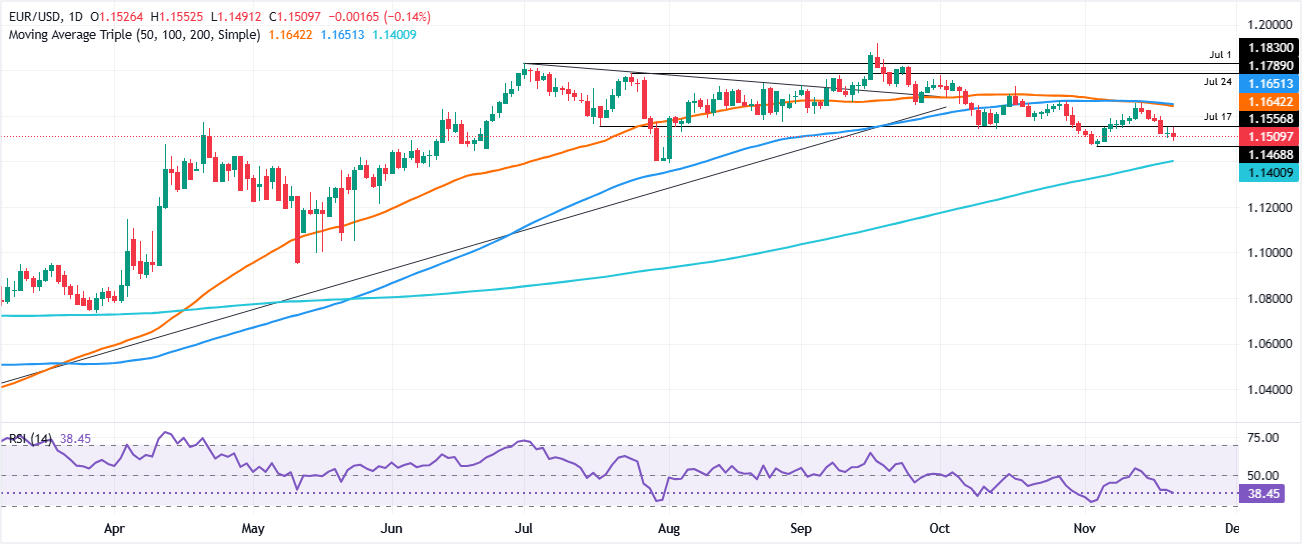
EUR/USD extended its losses and hovers around 1.1500 after reaching a daily low of 1.1491. A daily close below the former would open the door for further downside. The next support levels would be 1.1491, the November 5 daily low at 1.1468, and the 200-day SMA near 1.1405.
For a bullish reversal, buyers must clear the 20-day SMA at 1.1566, followed by the confluence of the 50- and 100-day Simple Moving Averages (SMAs) at 1.1641/1.1650. Up next lies 1.1700.
Euro FAQs
The Euro is the currency for the 20 European Union countries that belong to the Eurozone. It is the second most heavily traded currency in the world behind the US Dollar. In 2022, it accounted for 31% of all foreign exchange transactions, with an average daily turnover of over $2.2 trillion a day. EUR/USD is the most heavily traded currency pair in the world, accounting for an estimated 30% off all transactions, followed by EUR/JPY (4%), EUR/GBP (3%) and EUR/AUD (2%).
The European Central Bank (ECB) in Frankfurt, Germany, is the reserve bank for the Eurozone. The ECB sets interest rates and manages monetary policy. The ECB’s primary mandate is to maintain price stability, which means either controlling inflation or stimulating growth. Its primary tool is the raising or lowering of interest rates. Relatively high interest rates – or the expectation of higher rates – will usually benefit the Euro and vice versa. The ECB Governing Council makes monetary policy decisions at meetings held eight times a year. Decisions are made by heads of the Eurozone national banks and six permanent members, including the President of the ECB, Christine Lagarde.
Eurozone inflation data, measured by the Harmonized Index of Consumer Prices (HICP), is an important econometric for the Euro. If inflation rises more than expected, especially if above the ECB’s 2% target, it obliges the ECB to raise interest rates to bring it back under control. Relatively high interest rates compared to its counterparts will usually benefit the Euro, as it makes the region more attractive as a place for global investors to park their money.
Data releases gauge the health of the economy and can impact on the Euro. Indicators such as GDP, Manufacturing and Services PMIs, employment, and consumer sentiment surveys can all influence the direction of the single currency. A strong economy is good for the Euro. Not only does it attract more foreign investment but it may encourage the ECB to put up interest rates, which will directly strengthen the Euro. Otherwise, if economic data is weak, the Euro is likely to fall. Economic data for the four largest economies in the euro area (Germany, France, Italy and Spain) are especially significant, as they account for 75% of the Eurozone’s economy.
Another significant data release for the Euro is the Trade Balance. This indicator measures the difference between what a country earns from its exports and what it spends on imports over a given period. If a country produces highly sought after exports then its currency will gain in value purely from the extra demand created from foreign buyers seeking to purchase these goods. Therefore, a positive net Trade Balance strengthens a currency and vice versa for a negative balance.
Author

Christian Borjon Valencia
FXStreet
Markets analyst, news editor, and trading instructor with over 14 years of experience across FX, commodities, US equity indices, and global macro markets.

















