EUR/USD refreshes yearly high near 1.1200 on firm Fed dovish bets
- EUR/USD rises slightly above 1.1200 as the Euro gains despite deepening worries over Eurozone economic growth.
- The ECB is expected to cut interest rates once in any of the remaining two policy meetings this year.
- The next major trigger for the US Dollar will be the US core PCE inflation data for August on Friday.

EUR/USD tests territory above the key resistance of 1.1200 in Wednesday’s North American session. The major currency pair gains as the US Dollar (USD) remains under pressure amid an improvement in investors’ risk appetite due to China’s massive stimulus plans announcement on Tuesday in an attempt to revive their economy from growing slowdown risks. Generally, investment flows to the US Dollar get reduced in times of cheerful market sentiment.
Apart from China’s massive stimulus, increasing Federal Reserve (Fed) large rate cut bets in November has also kept the US Dollar on the back foot. The US Dollar Index (DXY), which tracks the Greenback’s value against six major currencies, edges higher on Wednesday but remains close to the yearly low of 100.20.
The CME FedWatch tool shows that the likelihood of the Fed reducing interest rates by 50 basis points (bps) to the range of 4.25%-4.50% has increased to 60% from 37% a week ago. The Fed also started the policy-easing cycle on September 18 with a larger-than-usual rate cut of 50 bps as officials were concerned over declining labor demand.
This week, the major trigger for the US Dollar will be the United States (US) core Personal Consumption Expenditures Price Index (PCE) data for August, the Fed’s preferred inflation gauge, which will be published on Friday. The underlying inflation measure is estimated to have accelerated to 2.7% from 2.6% in July.
Before the Fed’s preferred inflation gauge, investors will focus on the US Durable Goods Orders for August, which will be published on Thursday. New Orders for Durable Goods are expected to have declined by 2.6% against a robust growth of 9.8% in July.
Daily digest market movers: EUR/USD gains as Euro remains firm despite Eurozone growth concerns
- EUR/USD gains further in New York trading hours as the Euro (EUR) performs strongly against its major peers despite growing concerns over Eurozone economic growth. Flash HCOB Composite Purchasing Managers Index (PMI), compiled by S&P Global and Hamburg Commercial Bank (HCOB) and released on Monday, unexpectedly contracted to 48.9 in September, the lowest level since January.
- The major decline in overall business activity came from a deeper contraction in activities in the manufacturing sector in the Eurozone’s major economies. German HCOB Manufacturing PMI came in at its lowest since September 2023 at 40.3, extending its contraction for 27 months in a row. Meanwhile, the French HCOB Composite PMI also returned to the contraction phase after expanding in August due to the one-off Olympic event.
- Going forward, the Euro will be guided by market expectations for European Central Bank (ECB) interest rate cut prospects for the rest of the year. The ECB is expected to deliver one interest rate cut in any of its two meetings remaining this year.
Technical Analysis: EUR/USD recaptures 1.1200
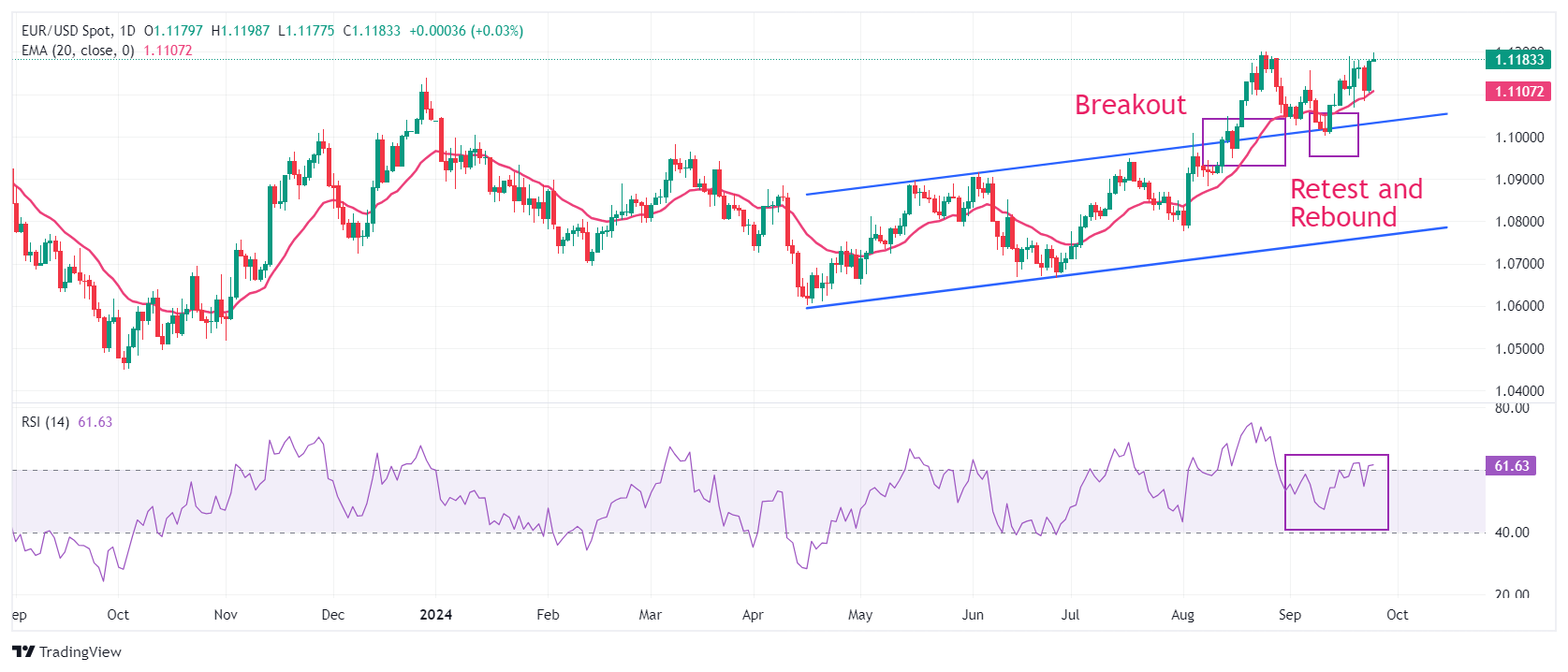
EUR/USD rises to near the key resistance of 1.1200 and aims to capture it in the European trading session on Wednesday. The major currency pair delivers a sharp recovery after finding strong buying interest near the 20-day Exponential Moving Average (EMA), which trades around 1.1100.
The outlook of the major currency pair would remain firm till it holds the breakout of the Rising Channel chart pattern formed on a daily time frame near the psychological support of 1.1000.
The 14-day Relative Strength Index (RSI) moves lower to 55.00, suggesting momentum is weakening.
Looking up, a decisive break above the round-level resistance of 1.1200 will result in further appreciation toward the July 2023 high of 1.1276. On the downside, the psychological level of 1.1000 and the July 17 high near 1.0950 will be major support zones.
ECB FAQs
The European Central Bank (ECB) in Frankfurt, Germany, is the reserve bank for the Eurozone. The ECB sets interest rates and manages monetary policy for the region. The ECB primary mandate is to maintain price stability, which means keeping inflation at around 2%. Its primary tool for achieving this is by raising or lowering interest rates. Relatively high interest rates will usually result in a stronger Euro and vice versa. The ECB Governing Council makes monetary policy decisions at meetings held eight times a year. Decisions are made by heads of the Eurozone national banks and six permanent members, including the President of the ECB, Christine Lagarde.
In extreme situations, the European Central Bank can enact a policy tool called Quantitative Easing. QE is the process by which the ECB prints Euros and uses them to buy assets – usually government or corporate bonds – from banks and other financial institutions. QE usually results in a weaker Euro. QE is a last resort when simply lowering interest rates is unlikely to achieve the objective of price stability. The ECB used it during the Great Financial Crisis in 2009-11, in 2015 when inflation remained stubbornly low, as well as during the covid pandemic.
Quantitative tightening (QT) is the reverse of QE. It is undertaken after QE when an economic recovery is underway and inflation starts rising. Whilst in QE the European Central Bank (ECB) purchases government and corporate bonds from financial institutions to provide them with liquidity, in QT the ECB stops buying more bonds, and stops reinvesting the principal maturing on the bonds it already holds. It is usually positive (or bullish) for the Euro.
Author

Sagar Dua
FXStreet
Sagar Dua is associated with the financial markets from his college days. Along with pursuing post-graduation in Commerce in 2014, he started his markets training with chart analysis.