Dow Jones Industrial Average dips as Warsh Fed nomination sparks uncertainty

• Major indexes edged lower as investors digested Trump's nomination of Kevin Warsh to succeed Fed Chair Powell in May.
• Verizon surged on strong subscriber growth and upbeat 2026 guidance, while American Express fell despite a revenue beat.
• Silver plunged over 17% in a dramatic reversal from record highs, triggering profit-taking across precious metals.
• Despite Friday's pullback, all three major averages posted solid gains for January, capping a strong start to 2026.
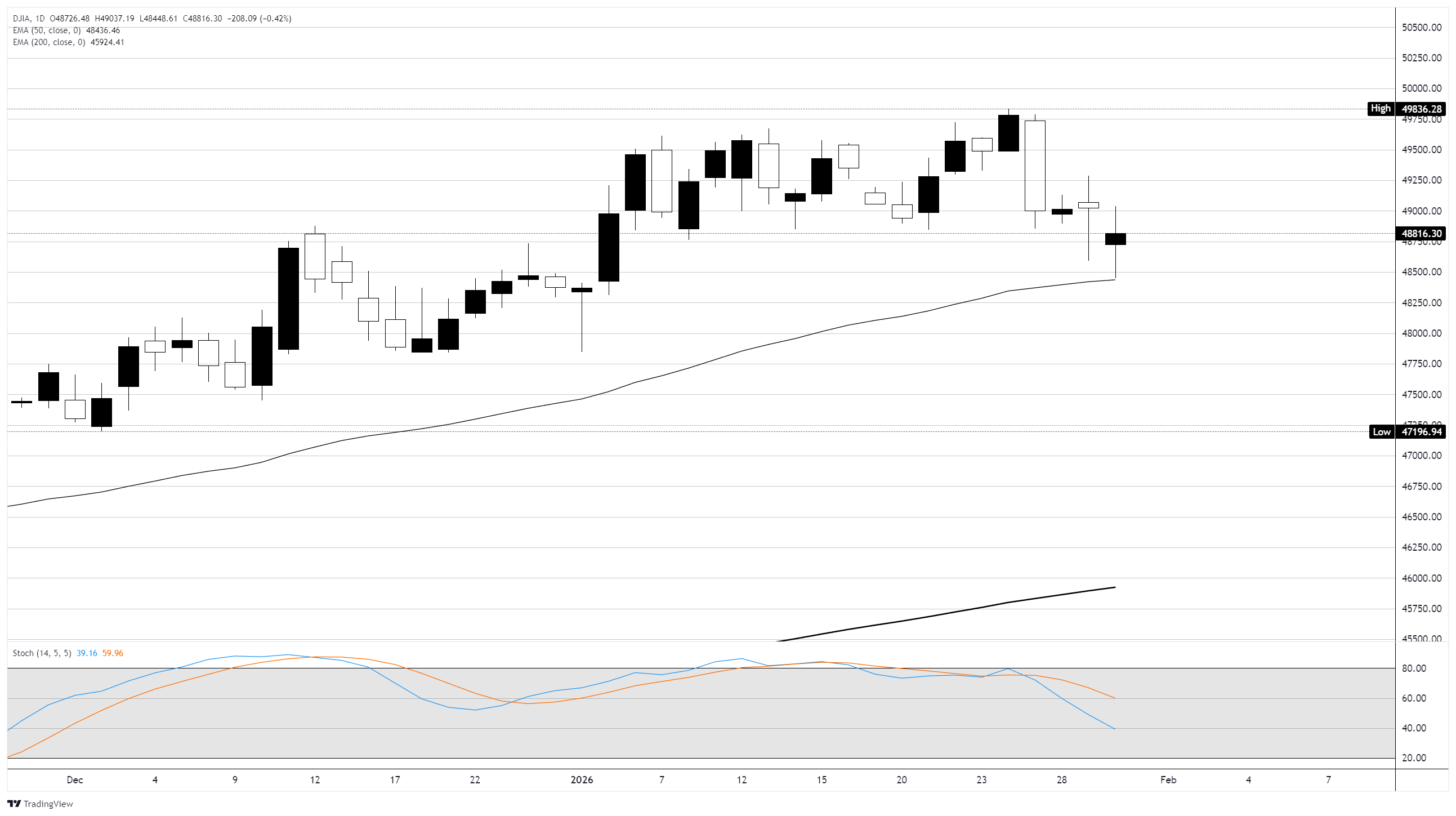
The Dow Jones Industrial Average (DJIA) slipped around 200 points on Friday, falling 0.2% as investors weighed President Donald Trump's nomination of former Federal Reserve (Fed) Governor Kevin Warsh to succeed Jerome Powell as Fed Chair when his term expires in May. The S&P 500 also declined 0.2%, while the Nasdaq Composite fell 0.3%. Despite the Friday pullback, all three major averages closed out January with solid gains: the Dow advanced 2.1%, the S&P 500 rose 1.8%, and the Nasdaq added 1.9% for the month.
Warsh nomination ends months of Fed speculation
Trump announced his selection of Kevin Warsh to lead the Federal Reserve on Friday morning, ending months of speculation about who would replace Powell. Warsh, 55, previously served on the Fed's Board of Governors from 2006 to 2011 and was a key adviser during the 2008 financial crisis. Markets view Warsh as a more hawkish pick who would support lower interest rates, though less aggressively than other potential candidates. The nomination faces a challenging Senate confirmation process, with Republican Senator Thom Tillis threatening to block any Fed nominees until a Justice Department probe into Powell is resolved.
Verizon surges on record subscriber additions
Verizon Communications Inc. (VZ) was the clear standout among Dow components, surging 6.6% after reporting its highest quarterly subscriber additions since 2019. The telecom giant added 616,000 monthly bill-paying wireless phone subscribers in the fourth quarter, far exceeding expectations of 417,250. New CEO Dan Schulman's aggressive promotional strategy, including deals like four phone lines for $100 per month, resonated with holiday shoppers. Verizon's 2026 guidance also impressed, with the company forecasting adjusted earnings of $4.90 to $4.95 per share, above consensus estimates of $4.76.
Financial stocks retreat despite mixed earnings
American Express Company (AXP) fell 3.1% after reporting fourth-quarter earnings roughly in line with expectations but disappointing some investors. The payments company posted earnings per share of $3.53 on revenue of $18.98 billion, up 10.5% year-over-year. While the company raised its 2026 outlook above consensus and announced a 16% dividend increase, higher credit loss provisions and rising expenses weighed on sentiment. Visa Inc. (V) also declined 2.3% despite beating revenue and earnings estimates, while International Business Machines (IBM) dropped 1.6%, giving back some of Thursday's 5% post-earnings surge.
Oil giants beat estimates amid production records
Chevron Corporation (CVX) rose 0.5% after posting better-than-expected quarterly earnings, even as lower oil prices pressured the energy sector. The company reported record production levels from the Permian Basin and offshore Guyana operations. ExxonMobil Corporation (XOM) also beat earnings estimates but slipped 0.8% as both oil majors grappled with a global supply glut that has pushed crude prices lower. Both companies emphasized cost discipline and their ability to remain profitable even if oil prices fall to $35 per barrel, though annual profits retreated from the highs seen in previous years.
Apple dips despite blowout iPhone quarter
Apple Inc. (AAPL) fell 1.2% on Friday despite reporting fiscal first-quarter results that crushed expectations. The tech giant posted revenue of $143.8 billion, up 16% year-over-year, driven by iPhone sales that surged 23% to $85.27 billion. CEO Tim Cook called demand for the iPhone 17 series "simply staggering," with the company setting all-time revenue records across every geographic segment. Apple's installed device base now exceeds 2.5 billion, up from 2.35 billion a year ago. However, some investors opted to take profits after the stock's strong run, while the broader tech sector faced headwinds following Microsoft Corporation's (MSFT) 10% plunge on Thursday due to disappointing cloud guidance.
Silver plummets in dramatic reversal from record highs
Silver prices tumbled as much as 21% on Friday, retreating from all-time highs in what analysts called the metal's biggest single-day drop in 14 years. The white metal had surged to a record $122 per ounce on Thursday before aggressive profit-taking triggered a broad retreat across precious metals. Despite the sharp correction, silver remained on track for a monthly gain of more than 30%, supported by elevated geopolitical uncertainty, dollar weakness, and tight physical market conditions. The iShares Silver Trust (SLV) saw massive turnover as retail investors who had piled into the rally rushed for the exits. Gold also retreated from recent record highs above $5,500 per ounce.
Dow Jones daily chart
Silver FAQs
Silver is a precious metal highly traded among investors. It has been historically used as a store of value and a medium of exchange. Although less popular than Gold, traders may turn to Silver to diversify their investment portfolio, for its intrinsic value or as a potential hedge during high-inflation periods. Investors can buy physical Silver, in coins or in bars, or trade it through vehicles such as Exchange Traded Funds, which track its price on international markets.
Silver prices can move due to a wide range of factors. Geopolitical instability or fears of a deep recession can make Silver price escalate due to its safe-haven status, although to a lesser extent than Gold's. As a yieldless asset, Silver tends to rise with lower interest rates. Its moves also depend on how the US Dollar (USD) behaves as the asset is priced in dollars (XAG/USD). A strong Dollar tends to keep the price of Silver at bay, whereas a weaker Dollar is likely to propel prices up. Other factors such as investment demand, mining supply – Silver is much more abundant than Gold – and recycling rates can also affect prices.
Silver is widely used in industry, particularly in sectors such as electronics or solar energy, as it has one of the highest electric conductivity of all metals – more than Copper and Gold. A surge in demand can increase prices, while a decline tends to lower them. Dynamics in the US, Chinese and Indian economies can also contribute to price swings: for the US and particularly China, their big industrial sectors use Silver in various processes; in India, consumers’ demand for the precious metal for jewellery also plays a key role in setting prices.
Silver prices tend to follow Gold's moves. When Gold prices rise, Silver typically follows suit, as their status as safe-haven assets is similar. The Gold/Silver ratio, which shows the number of ounces of Silver needed to equal the value of one ounce of Gold, may help to determine the relative valuation between both metals. Some investors may consider a high ratio as an indicator that Silver is undervalued, or Gold is overvalued. On the contrary, a low ratio might suggest that Gold is undervalued relative to Silver.
Author

Joshua Gibson
FXStreet
Joshua joins the FXStreet team as an Economics and Finance double major from Vancouver Island University with twelve years' experience as an independent trader focusing on technical analysis.

















