EUR/USD lurched higher on Thursday, breaks into fresh highs on tariff tantrum
- EUR/USD rose 1.8% on Thursday, breaking north of 1.1000.
- Bullish momentum cooled later in the day, but the Greenback remains notably on weaker footing.
- US NFP net job gains are on deck next, due on Friday.

EUR/USD rallied hard on Thursday, with the Euro getting pushed higher alongside the rest of the market as the US Dollar tumbles on the heels of the Trump administration’s combined flat and “reciprocal” tariff packages that were unveiled this week.
Forex Today: US NFP will be in the limelight
This week, the European side of the economic data docket is relatively sparse, but a new report on US Nonfarm Payrolls (NFP) will be published on Friday. This NFP data could significantly influence markets as the US economy transitions to a post-tariff landscape, with March’s labor figures expected to serve as a “bellwether” for the effects of the Trump administration’s tariff strategies.
US ISM Services Purchasing Managers Index (PMI) figures through March further hampered investor sentiment on Thursday, falling to a nine-month low of 50.8 and declining at one of its fastest month-on-month rates since the pandemic. Business activity and consumer confidence evaporated in the run-up to the Trump administration’s tariffs, and post-tariff realities are unlikely to see sentiment recover quickly.
- Fed's Jefferson warns Fed is not in a rush to change rates
- Fed's Cook expects inflation progress to stall after tariffs
The Trump administration’s “Liberation Day” tariff proposals have ignited global backlash, with former US Treasury Secretary Larry Summers claiming the government calculated tariffs without proper data. This claim aligns with the Trump team’s publications, which explain that their reciprocal tariffs are computed by dividing a country’s net exports to the US by imports from the US and then halving that figure, with a minimum tariff of 10%. As a result of the Trump administration’s tariff “methodology”, the US has imposed a 10% “reciprocal” tariff on Heard Island and McDonald Islands, A territory that remains entirely uninhabited by humans.
US President Donald Trump approved a 10% tariff on all imports effective April 5, with calculated “reciprocal” tariffs starting on April 9. According to Fitch Ratings, US economic growth will dip below the downgraded forecast from March. The Fitch Ratings agency has warned that the effects of Trump's tariffs will also reach the Federal Reserve (Fed), which may delay interest rate cuts as it monitors the inflation and employment impacts of these tariffs.
EUR/USD price forecast
On Thursday, EUR/USD experienced a significant rally, climbing substantially and settling close to the 1.1100 mark following the European session. The pair achieved notable intraday gains, propelled by ongoing bullish momentum that moved it toward the upper half of its broad daily range. Despite some oscillators signaling caution, the moving average configuration supports the bullish trend as it heads into the Asian session.
The technical outlook still leans toward the bulls. The Relative Strength Index (RSI) increased to 72.32, indicating overbought conditions, while the Moving Average Convergence Divergence (MACD) presents a sell signal, suggesting possible exhaustion. Nevertheless, other momentum indicators, such as the Williams Percent Range at -18.88 and Momentum at 0.022, provide a mixed to bullish perspective.
EUR/USD daily chart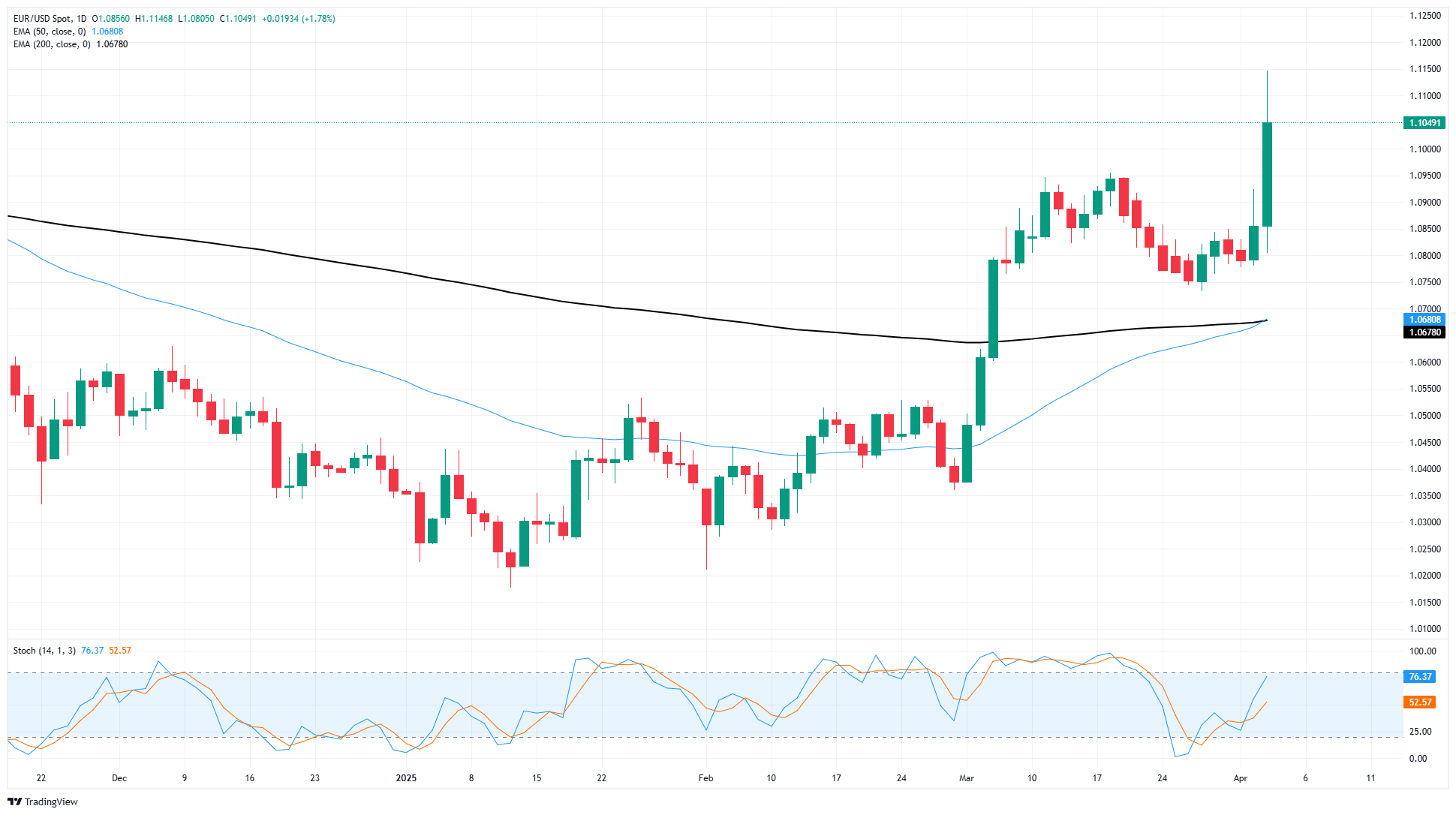
Euro FAQs
The Euro is the currency for the 19 European Union countries that belong to the Eurozone. It is the second most heavily traded currency in the world behind the US Dollar. In 2022, it accounted for 31% of all foreign exchange transactions, with an average daily turnover of over $2.2 trillion a day. EUR/USD is the most heavily traded currency pair in the world, accounting for an estimated 30% off all transactions, followed by EUR/JPY (4%), EUR/GBP (3%) and EUR/AUD (2%).
The European Central Bank (ECB) in Frankfurt, Germany, is the reserve bank for the Eurozone. The ECB sets interest rates and manages monetary policy. The ECB’s primary mandate is to maintain price stability, which means either controlling inflation or stimulating growth. Its primary tool is the raising or lowering of interest rates. Relatively high interest rates – or the expectation of higher rates – will usually benefit the Euro and vice versa. The ECB Governing Council makes monetary policy decisions at meetings held eight times a year. Decisions are made by heads of the Eurozone national banks and six permanent members, including the President of the ECB, Christine Lagarde.
Eurozone inflation data, measured by the Harmonized Index of Consumer Prices (HICP), is an important econometric for the Euro. If inflation rises more than expected, especially if above the ECB’s 2% target, it obliges the ECB to raise interest rates to bring it back under control. Relatively high interest rates compared to its counterparts will usually benefit the Euro, as it makes the region more attractive as a place for global investors to park their money.
Data releases gauge the health of the economy and can impact on the Euro. Indicators such as GDP, Manufacturing and Services PMIs, employment, and consumer sentiment surveys can all influence the direction of the single currency. A strong economy is good for the Euro. Not only does it attract more foreign investment but it may encourage the ECB to put up interest rates, which will directly strengthen the Euro. Otherwise, if economic data is weak, the Euro is likely to fall. Economic data for the four largest economies in the euro area (Germany, France, Italy and Spain) are especially significant, as they account for 75% of the Eurozone’s economy.
Another significant data release for the Euro is the Trade Balance. This indicator measures the difference between what a country earns from its exports and what it spends on imports over a given period. If a country produces highly sought after exports then its currency will gain in value purely from the extra demand created from foreign buyers seeking to purchase these goods. Therefore, a positive net Trade Balance strengthens a currency and vice versa for a negative balance.
Author

Joshua Gibson
FXStreet
Joshua joins the FXStreet team as an Economics and Finance double major from Vancouver Island University with twelve years' experience as an independent trader focusing on technical analysis.