EUR/USD exhibits sheer strength with eyes on Eurozone/US Inflation data
- EUR/USD rises further to 1.0880 as the US Dollar extends its downside.
- The US Dollar weakens even though investors see the Fed returning to policy normalization in the last quarter of the year.
- ECB policymakers refuse to commit to more rate cuts after June.

EUR/USD posts a fresh weekly high at 1.0880 in Tuesday’s American session. The major currency pair strengthens amid soft US Dollar (USD) and deepening uncertainty over the pace at which the European Central Bank (ECB) will reduce key borrowing rates after the June meeting.
The US Dollar Index (DXY), which tracks the US Dollar’s value against six major currencies, extends its decline to 104.40. The US Dollar is facing the heat even though investors’ expectations for the Federal Reserve (Fed) reducing interest rates from the September meeting have faded significantly. The CME FedWatch tool shows that the probability of the Fed maintaining the current policy framework in September has increased to 50% compared with the roughly 35% seen a week before.
The strong United States (US) economic outlook and policymakers’ hawkish guidance on interest rates have forced traders to pare rate bets. In the European session, Minneapolis Fed Bank President Neel Kashkari said the central bank should wait for significant progress in inflation before lowering interest rates. Kashkari added that room for more rate hikes remains open if inflation fails to come down.
This week, the market speculation for Fed rate cuts will be guided by the core Personal Consumption Expenditure price index (PCE) data for April, which will be published on Friday. The core PCE inflation data, which is the Fed’s preferred inflation measure, is estimated to have remained steady on a monthly and annual basis.
Daily digest market movers: EUR/USD rises further ahead of German Inflation data
- EUR/USD extends its winning streak for the third trading day on Tuesday. The shared currency pair jumps to 1.0880 as debate over the path of rate cuts by the European Central Bank has deepened. The ECB is all set to deliver an interest rate cut in its monetary policy meeting on June 6, barring no surprise. Therefore, investors discuss how far and at what pace the ECB will ease its monetary policy after June.
- ECB policymakers refuse to commit to any pre-defined rate-cut path and prefer to remain data-dependent. Meanwhile, market speculation for ECB rate cuts for the entire year has also been impacted as a few policymakers have warned that the adaptation of an aggressive policy easing could revamp price pressures again. Investors now expect that the ECB will lower key borrowing costs one more time after June. A week ago, investors were expecting three rate cuts in 2024 while expecting six rate cuts at the beginning of the year.
- On Monday, ECB policymaker and Governor of the French central bank François Villeroy de Galhau said in an interview with German newspaper Boersen Zeitung that the June rate cut is a done deal and discussions are about how far and fast interest rates will come down. Villeroy pushed back suggestions of one rate cut each quarter and said: "I don't say that we should commit already in July, but let us keep our freedom on the timing and pace."
- On the same day, ECB Chief economist Philip Lane said in a speech in Dublin that the pace at which interest rates will be reduced depends on the strength of the underlying inflation demand, Reuters reported. The absence of upward surprises in inflation and demand will allow the ECB to deploy an aggressive rate-cut approach, while upside risks to inflation and demand would force the ECB to ease interest rates gradually.
- This week, the major trigger for the Euro’s price action will be the Eurozone preliminary inflation data for May, which will be published on Friday. The inflation data will provide fresh cues about whether the ECB will extend the rate-cut spell to July. But before that, investors will focus on the preliminary May inflation reading for Germany, which will be released on Wednesday. Monthly headline and harmonized inflation is expected to have grown at a slower rate by 0.2%. The annual headline inflation is estimated to have accelerated to 2.7% from 2.4% in April.
Technical Analysis: EUR/USD aims to extend upside towards 1.0900
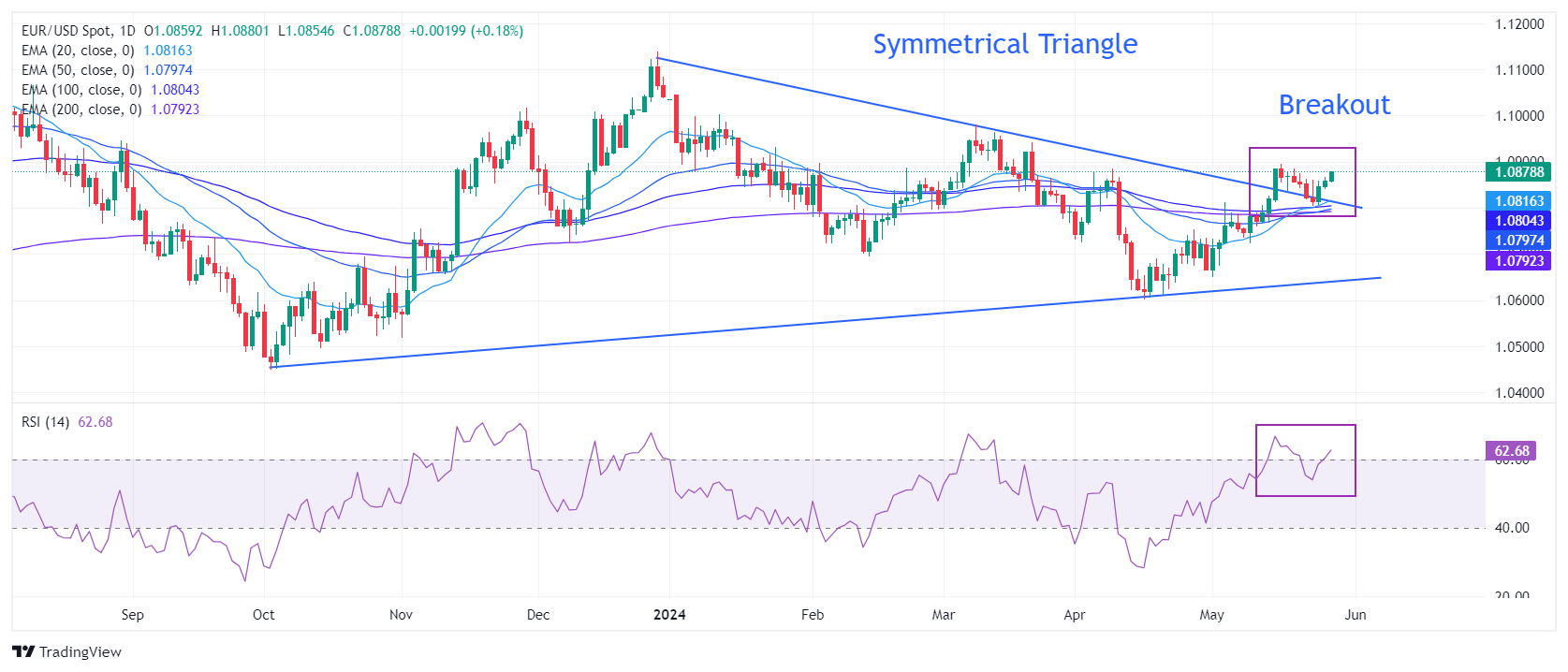
EUR/USD climbs to 1.0880 ahead of crucial Eurozone/US inflation data. The major currency pair indicates broader strength as it firmly holds the breakout of the Symmetrical Triangle chart pattern formed on a daily timeframe.
The shared currency pair’s near-term outlook remains firm as it trades well above all short-to-long-term Exponential Moving Averages (EMAs).
The 14-period Relative Strength Index (RSI) has slipped into the 40.00-60.00 range, suggesting that the momentum, which was leaned toward the upside, has faded for now.
The major currency pair is likely to recapture a two-month high around 1.0900. A decisive break above this level would drive the asset towards the March 21 high at around 1.0950 and the psychological resistance of 1.1000. However, a downside move below the 200-day EMA at 1.0800 could push it further down.
Economic Indicator
Consumer Price Index (YoY)
The Consumer Price Index (CPI), released by the German statistics office Destatis on a monthly basis, measures the average price change for all goods and services purchased by households for consumption purposes. The CPI is the main indicator to measure inflation and changes in purchasing trends. The YoY reading compares prices in the reference month to a year earlier. Generally, a high reading is bullish for the Euro (EUR), while a low reading is bearish.
Read more.Next release: Wed May 29, 2024 12:00 (Prel)
Frequency: Monthly
Consensus: -
Previous: 2.2%
Author
Sagar Dua
FXStreet
Sagar Dua is associated with the financial markets from his college days. Along with pursuing post-graduation in Commerce in 2014, he started his markets training with chart analysis.