EUR/USD holds strength amid firm speculation over Fed rate cuts
- EUR/USD clings to gains near 1.0900 due to strong appeal for risk-sensitive assets.
- Traders expect the ECB reducing interest rates three times this year.
- Investors shift focus to the US weekly jobless claims data.


EUR/USD falls slightly from the crucial resistance of 1.0900 in Thursday’s European session. The major currency pair retraces as the US Dollar (USD) stabilizes after a sharp fall to fresh monthly lows. The US Dollar Index (DXY), which tracks the US Dollar’s value against six major currencies, rebounds to 104.30 after falling to 104.00 earlier on the day. However, the appeal of the US Dollar is downbeat as the Fed is expected to begin lowering interest rates from the September meeting.
The Euro remains firm as traders have priced in three rate cuts by the European Central Bank (ECB) this year. Meanwhile, ECB policymakers are also confident that the central bank will start normalizing the monetary policy from June.
On Wednesday, European Central Bank Governing Council Member and Bank of France Governor François Villeroy de Galhau said: “As we have sufficient confidence, we will very probably begin cutting central-bank rates, doubtless at our meeting at the start of June”, in an interview with RTL radio. Galhau added that lower rates should help the economy to pick up more in 2025.
Daily digest market movers: EUR/USD posts fresh seven-week highs near 1.0900
- EUR/USD refreshes seven-week high near the round-level resistance of 1.0900. The major currency pair strengthens as appeal for risk-sensitive assets improve due to that fact that investors are confident about the Federal Reserve (Fed) returning to policy normalization after maintaining a hawkish interest rate framework for almost two years.
- The confidence of investors for Fed to begin lowering interest rates from the September meeting has increased as United States inflation has declined in April after remaining stubbornly higher in the first quarter of the year. This is expected to provide some relief to Fed policymakers as they were uncertain over the progress in the disinflation process. However, Fed policymakers are expected to continue to emphasize keeping interest rates at their current levels for a longer period as one good inflation reading would be insufficient to improve their conviction about inflation returning sustainably to the 2% target.
- The US Consumer Price Index (CPI) report showed that annual headline and core inflation (which strips off volatile food and energy prices) declined as expected to 3.4% and 3.6%, respectively. The decline in the inflation data came from lower prices of utility gas services and used cars and trucks. Rentals, transportation and medical services price index continue to march higher.
- Meanwhile, the US inflation outlook has also softened as monthly Retail Sales were unchanged in April after expanding 0.6% in March. Economists forecasted them to rise by 0.4%. Weak Retail Sales data suggests that high inflation and interest rates by the Fed have narrowed consumers’ pockets.
- In Thursday’s session, investors will focus on the Initial Jobless Claims data for the week ending May 10. The US Department of Labor is expected to show a decline in number of individuals claiming jobless benefits for the first time to 220K, from eight-month high of 231K registered the week ending May 3.
- Last week, the US Dollar saw a significant fall after the release of the larger-than-expected jobless claims as it raised concerns over the labor market strength.
Technical Analysis: EUR/USD targets 1.1000
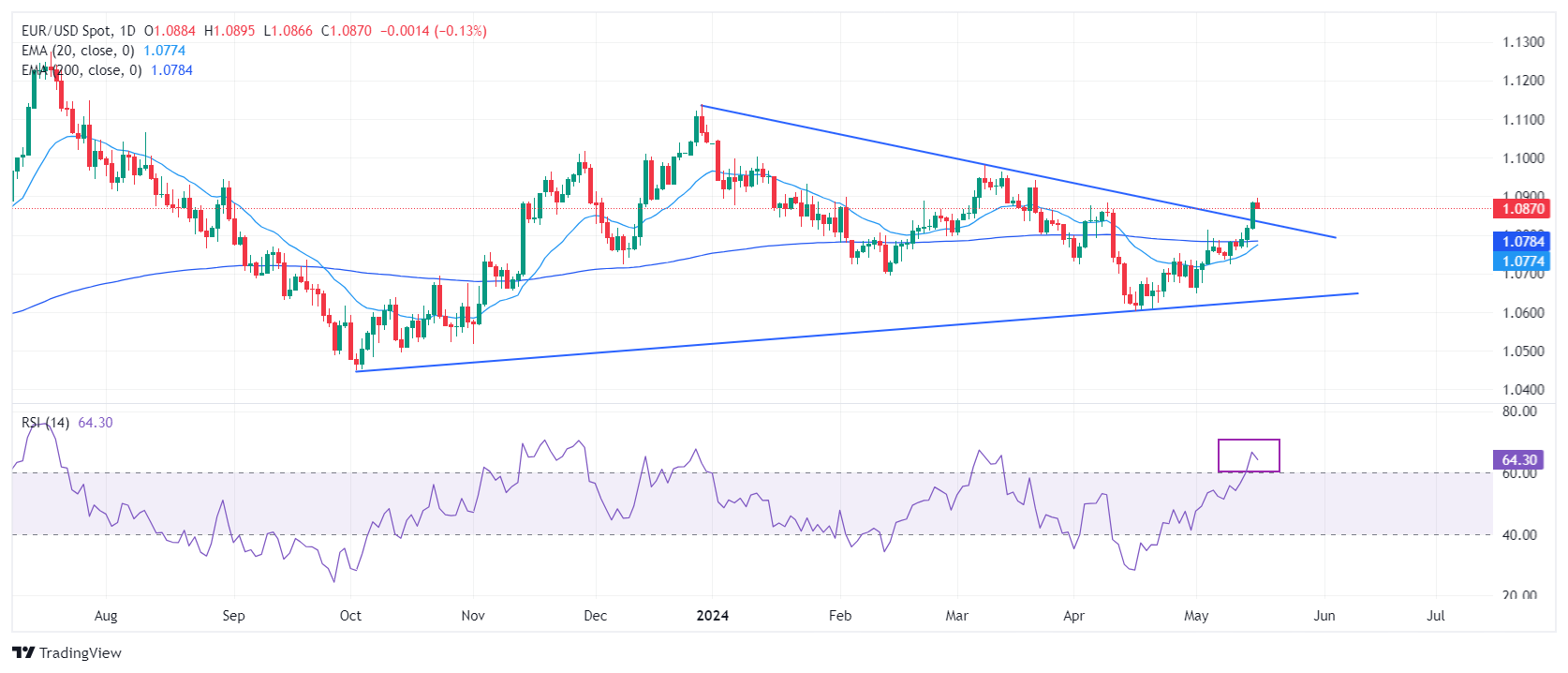
EUR/USD retraces slightly down from 1.0900 in Thursday’s European session but keeps broadly strong after a Symmetrical Triangle breakout on a daily timeframe. A breakout of a volatility contraction pattern results in high buying volume and wider movements.
The appeal of the shared currency pair has strengthened as it seems well-established above all short-to-long-term Exponential Moving Averages (EMAs).
The 14-period Relative Strength Index (RSI) has shifted into the bullish range of 60.00-80.00, suggesting a strong upside move ahead. Going forward, EUR/USD is likely to extend its upside towards the psychological resistance of 1.1000.
Euro FAQs
The Euro is the currency for the 20 European Union countries that belong to the Eurozone. It is the second most heavily traded currency in the world behind the US Dollar. In 2022, it accounted for 31% of all foreign exchange transactions, with an average daily turnover of over $2.2 trillion a day. EUR/USD is the most heavily traded currency pair in the world, accounting for an estimated 30% off all transactions, followed by EUR/JPY (4%), EUR/GBP (3%) and EUR/AUD (2%).
The European Central Bank (ECB) in Frankfurt, Germany, is the reserve bank for the Eurozone. The ECB sets interest rates and manages monetary policy. The ECB’s primary mandate is to maintain price stability, which means either controlling inflation or stimulating growth. Its primary tool is the raising or lowering of interest rates. Relatively high interest rates – or the expectation of higher rates – will usually benefit the Euro and vice versa. The ECB Governing Council makes monetary policy decisions at meetings held eight times a year. Decisions are made by heads of the Eurozone national banks and six permanent members, including the President of the ECB, Christine Lagarde.
Eurozone inflation data, measured by the Harmonized Index of Consumer Prices (HICP), is an important econometric for the Euro. If inflation rises more than expected, especially if above the ECB’s 2% target, it obliges the ECB to raise interest rates to bring it back under control. Relatively high interest rates compared to its counterparts will usually benefit the Euro, as it makes the region more attractive as a place for global investors to park their money.
Data releases gauge the health of the economy and can impact on the Euro. Indicators such as GDP, Manufacturing and Services PMIs, employment, and consumer sentiment surveys can all influence the direction of the single currency. A strong economy is good for the Euro. Not only does it attract more foreign investment but it may encourage the ECB to put up interest rates, which will directly strengthen the Euro. Otherwise, if economic data is weak, the Euro is likely to fall. Economic data for the four largest economies in the euro area (Germany, France, Italy and Spain) are especially significant, as they account for 75% of the Eurozone’s economy.
Another significant data release for the Euro is the Trade Balance. This indicator measures the difference between what a country earns from its exports and what it spends on imports over a given period. If a country produces highly sought after exports then its currency will gain in value purely from the extra demand created from foreign buyers seeking to purchase these goods. Therefore, a positive net Trade Balance strengthens a currency and vice versa for a negative balance.
Author
Sagar Dua
FXStreet
Sagar Dua is associated with the financial markets from his college days. Along with pursuing post-graduation in Commerce in 2014, he started his markets training with chart analysis.