EUR/USD freezes in place near multi-month highs
- EUR/USD stuck to its near-term midrange as Fiber traders mull their options.
- US data dominates the economic release calendar this week.
- US JOLTS Job Openings, CPI and PPI inflation, and Consumer Sentiment loom over the week.

EUR/USD cycled in familiar territory on Monday, kicking off the new trading week on a notable quiet note as Fiber traders gear up for a US-data-heavy data docket on the cards for this week. Equities roiled on Monday, falling nearly across the board as investors pull back in the face of rising recession fears, but Fiber traders have battened down the hatches as they await key US inflation figures this week before solidifying their bets.
Forex Today: Attention shifts to Japanese GDP and US jobs data
European economic data is strictly mid-tier or lower this week, as markets pivot to face a wide spread of key US releases. JOLTS Jobs Openings kick things off on Tuesday, which are forecast to rise slightly to 7.75M in January from the previous 7.6M. US Consumer Price Index (CPI) inflation follows up on Tuesday, and investors are hoping for a continued easing in inflation pressures after a surprise uptick in inflation metrics at the start of 2025 blindsided markets. Investors have been betting on easing inflation to keep pushing the Federal Reserve (Fed) toward more rate cuts, despite ongoing talking points from policymakers increasingly tipping their hats to wobbly US trade policies increasingly hampering forecasting abilities.
Median market forecasts expect a slight cooling in headline and core CPI numbers. Headline CPI inflation in February is expected to ease to 0.3% MoM from 0.5%, while core monthly CPI is expected to tick down to a matching 0.3% from 0.4%. Annualized CPI is similarly expected to drop slightly to 2.9% YoY from 3.0%, while core CPI for the year ended in February is forecast t tick down to 3.2% from 3.3%.
On-and-off tariffs weigh on investor sentiment
Markets continue to feel bearish pressure due to President Donald Trump’s clumsy tariff threats, which his administration keeps revisiting. The White House is attempting to impose significant tariffs on the US's closest trading partners to generate revenue that can counterbalance the large deficits arising from Trump’s proposed tax cuts. However, implementation is challenging, as the most vocal opponents of Trump’s tariff plans are largely US consumers and businesses that face heightened spending and operational costs due to retaliatory tariffs affecting crucial US industries and sectors.
President Trump faced down questions about a possible recession in the US economy, waving the subject off and branding an economic downturn as a “transition” period during a weekend interview with Fox News that was held from broadcast until early Monday. Donald Trump eventually capitulated on his own words, acknowledging that the US could be in for a ‘rough patch’. President Trump and his staff pulled double-duty on Monday attempting to rebrand the recent upswing in inflation and broad-market risk aversion as the fault of the previous Biden administration, rather than a direct result of the US’ wobbly approach to enacting tariffs on key US trading partners.
EUR/USD price forecast
EUR/USD got stuck in the muck on Monday, mulching chart paper near the 1.0850 region as Fiber’s recent bull run looks set to end. EUR/USD easily pierced through the 200-day Exponential Moving Average (EMA) last week, soaring through the key moving average near 1.0630.
Fiber climbed 5.1%, or 528 pips, bottom-to-top from the last swing low at 1.0360, but bullish momentum looks set to take a pause. Technical oscillators are pinned in overbought territory, implying EUR/USD could be primed for a fresh push to the low side.
EUR/USD daily chart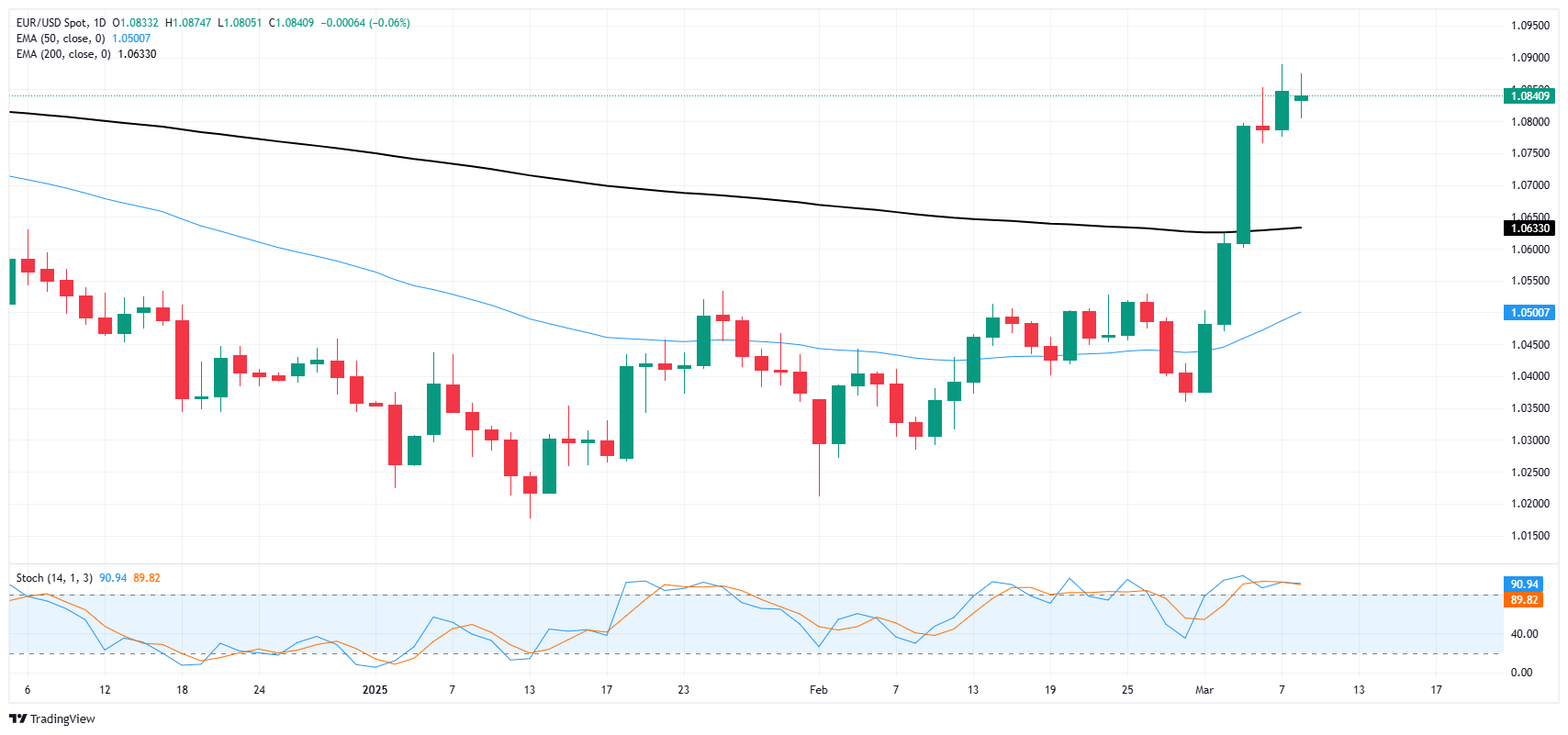
Euro FAQs
The Euro is the currency for the 19 European Union countries that belong to the Eurozone. It is the second most heavily traded currency in the world behind the US Dollar. In 2022, it accounted for 31% of all foreign exchange transactions, with an average daily turnover of over $2.2 trillion a day. EUR/USD is the most heavily traded currency pair in the world, accounting for an estimated 30% off all transactions, followed by EUR/JPY (4%), EUR/GBP (3%) and EUR/AUD (2%).
The European Central Bank (ECB) in Frankfurt, Germany, is the reserve bank for the Eurozone. The ECB sets interest rates and manages monetary policy. The ECB’s primary mandate is to maintain price stability, which means either controlling inflation or stimulating growth. Its primary tool is the raising or lowering of interest rates. Relatively high interest rates – or the expectation of higher rates – will usually benefit the Euro and vice versa. The ECB Governing Council makes monetary policy decisions at meetings held eight times a year. Decisions are made by heads of the Eurozone national banks and six permanent members, including the President of the ECB, Christine Lagarde.
Eurozone inflation data, measured by the Harmonized Index of Consumer Prices (HICP), is an important econometric for the Euro. If inflation rises more than expected, especially if above the ECB’s 2% target, it obliges the ECB to raise interest rates to bring it back under control. Relatively high interest rates compared to its counterparts will usually benefit the Euro, as it makes the region more attractive as a place for global investors to park their money.
Data releases gauge the health of the economy and can impact on the Euro. Indicators such as GDP, Manufacturing and Services PMIs, employment, and consumer sentiment surveys can all influence the direction of the single currency. A strong economy is good for the Euro. Not only does it attract more foreign investment but it may encourage the ECB to put up interest rates, which will directly strengthen the Euro. Otherwise, if economic data is weak, the Euro is likely to fall. Economic data for the four largest economies in the euro area (Germany, France, Italy and Spain) are especially significant, as they account for 75% of the Eurozone’s economy.
Another significant data release for the Euro is the Trade Balance. This indicator measures the difference between what a country earns from its exports and what it spends on imports over a given period. If a country produces highly sought after exports then its currency will gain in value purely from the extra demand created from foreign buyers seeking to purchase these goods. Therefore, a positive net Trade Balance strengthens a currency and vice versa for a negative balance.
Author

Joshua Gibson
FXStreet
Joshua joins the FXStreet team as an Economics and Finance double major from Vancouver Island University with twelve years' experience as an independent trader focusing on technical analysis.