Dow Jones Industrial Average plummets 850 points as economic fears grow
- The Dow Jones backslid another 850 points on Monday.
- Investor sentiment continues to worsen as market mood sours.
- Key US CPI and PPI inflation prints are due later this week.

The Dow Jones Industrial Average (DJIA) took another leg lower on Monday, kicking off the new trading week with a fresh 1,000-plus-point decline before a late-session recovery that dragged bids back to a more moderate 850 decline for the day. The Dow Jones backslid into fresh lows below 42,000 as fears of an economic downturn continue to grow and the Trump administration roils global markets with its haphazard, on-again-off-again tariff policy.
It’s a quiet start to the week on the economic data docket, but that all changes on Wednesday when the latest round of Consumer Price Index (CPI) inflation figures for February hit markets. Median market forecasts expect a slight cooling in headline and core CPI numbers. Headline CPI inflation in February is expected to ease to 0.3% MoM from 0.5%, while core monthly CPI is expected to tick down to a matching 0.3% from 0.4%. Annualized CPI is similarly expected to drop slightly to 2.9% YoY from 3.0%, while core CPI for the year ended in February is forecast t tick down to 3.2% from 3.3%.
Despite their ambiguous existence, markets are still feeling the bearish pressure from US President Donald Trump’s ham-handed tariff threats, which the Trump administration continues to pivot endlessly around. The White House team is struggling to enact steep tariffs on the US’ closest trading partners to generate government income to offset steep deficits coming from President Trump’s planned tax cuts. However, execution is proving difficult as the loudest opponents to team Trump’s tariff proposals are overwhelmingly US consumers and businesses facing steep spending and operating cost increases as counter-tariffs target key US industries and sectors.
The Trump administration faced down questions about a possible recession in the US economy, waving the subject off and branding an economic downturn as a “transition” period.
Dow Jones news
Despite Monday’s steep decline in the overall index, some listed securities held on the high side for the day. Amgen (AMGN) rose 2.3%, climbing above $332 per share as the pharma giant explores adding its own weight loss drug to the field.
Losses were concentrated in tech and banking stocks on Monday, with Goldman Sachs (GS) falling 6%. Goldman Sachs sank to $526 per share as recession fears and tariff concerns weighed on profit-led industries.
Dow Jones price forecast
The Dow Jones Industrial Average pierced the Exponential Moving Average (EMA) just below the 42,000 major price handle for the first time since November of 2023, hitting the major moving average for the first time in over two years and ending the Dow's stellar run of outpacing its own long-term moving average, The Dow Jones hit a fresh 8-week low on Monday, adding to the major equity index’s 6.55% decline from the last swing high just above the 45,000 level.
Dow Jones daily chart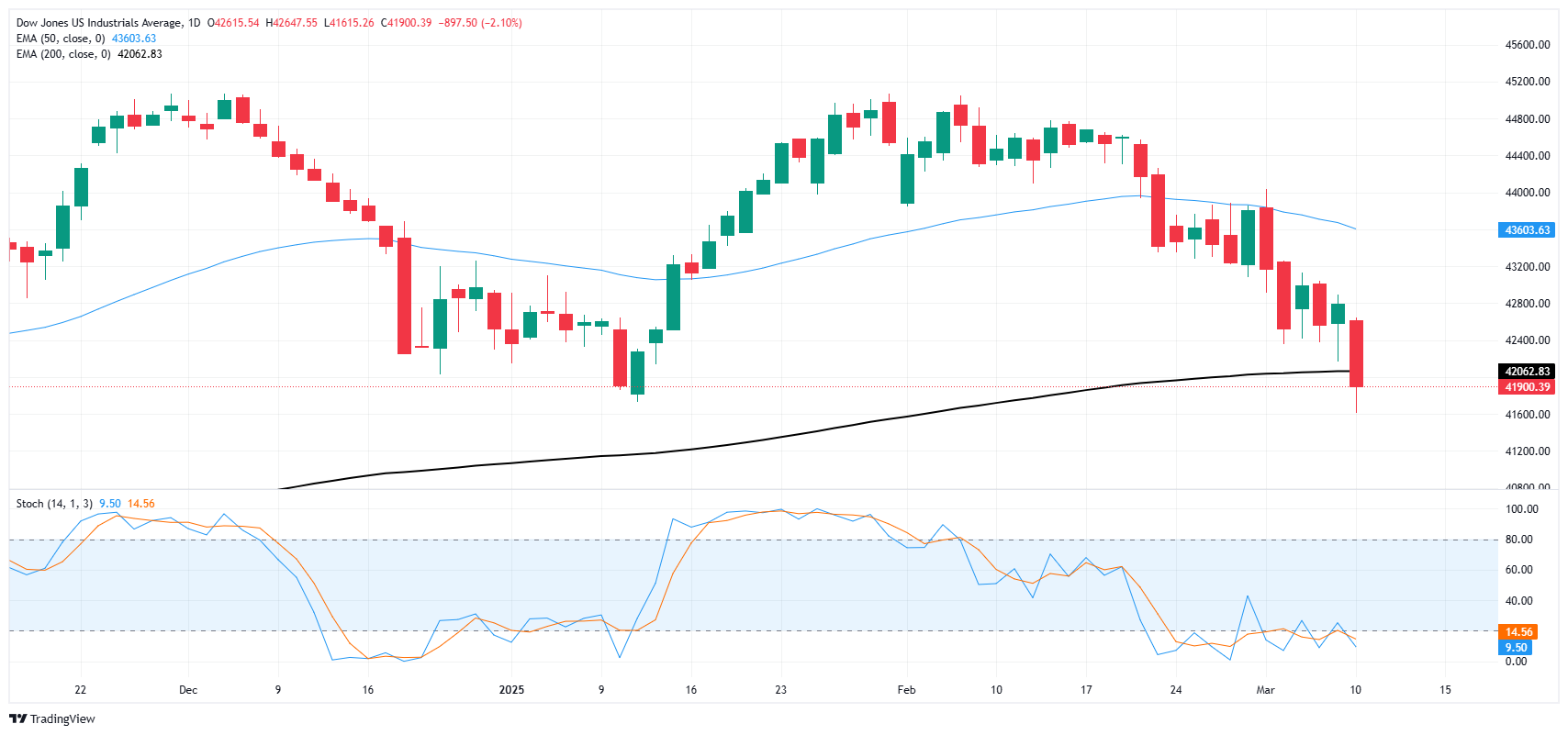
Dow Jones FAQs
The Dow Jones Industrial Average, one of the oldest stock market indices in the world, is compiled of the 30 most traded stocks in the US. The index is price-weighted rather than weighted by capitalization. It is calculated by summing the prices of the constituent stocks and dividing them by a factor, currently 0.152. The index was founded by Charles Dow, who also founded the Wall Street Journal. In later years it has been criticized for not being broadly representative enough because it only tracks 30 conglomerates, unlike broader indices such as the S&P 500.
Many different factors drive the Dow Jones Industrial Average (DJIA). The aggregate performance of the component companies revealed in quarterly company earnings reports is the main one. US and global macroeconomic data also contributes as it impacts on investor sentiment. The level of interest rates, set by the Federal Reserve (Fed), also influences the DJIA as it affects the cost of credit, on which many corporations are heavily reliant. Therefore, inflation can be a major driver as well as other metrics which impact the Fed decisions.
Dow Theory is a method for identifying the primary trend of the stock market developed by Charles Dow. A key step is to compare the direction of the Dow Jones Industrial Average (DJIA) and the Dow Jones Transportation Average (DJTA) and only follow trends where both are moving in the same direction. Volume is a confirmatory criteria. The theory uses elements of peak and trough analysis. Dow’s theory posits three trend phases: accumulation, when smart money starts buying or selling; public participation, when the wider public joins in; and distribution, when the smart money exits.
There are a number of ways to trade the DJIA. One is to use ETFs which allow investors to trade the DJIA as a single security, rather than having to buy shares in all 30 constituent companies. A leading example is the SPDR Dow Jones Industrial Average ETF (DIA). DJIA futures contracts enable traders to speculate on the future value of the index and Options provide the right, but not the obligation, to buy or sell the index at a predetermined price in the future. Mutual funds enable investors to buy a share of a diversified portfolio of DJIA stocks thus providing exposure to the overall index.
Author

Joshua Gibson
FXStreet
Joshua joins the FXStreet team as an Economics and Finance double major from Vancouver Island University with twelve years' experience as an independent trader focusing on technical analysis.