EUR/USD flubs key technical levels and backslides once again
- EUR/USD failed to extend a near term technical recovery, sheds 0.4% on Tuesday.
- German Retail Sales, EU PPI inflation, US ADP jobs preview on the docket for Wednesday.
- Another NFP Friday looms ahead, crimping market momentum as Fed rate cut fears weigh.

EUR/USD turned tail and swooned against the Greenback on Tuesday, shedding four-tenths of one percent after a failed recovery of the 1.0400 handle fizzled out completely. The pair is still trading up from last week’s 26-month low, but not by much. Euro bulls are in desperate need of a turnaround as Fiber continues to grind its way back toward 1.0200.
European Harmonized Index of Consumer Prices (HICP) inflation came in about as expected, with annualized HICP for the year ended in December ticking upwards slightly to 2.4% YoY from the previous 2.2%. However, most of the upward pressure in European inflation figures appears to be either baked into older numbers, or is non-structural ticket items, giving Euro traders some hope that things will continue to improve.
On the US side, ISM Services Purchasing Managers Index (PMI) business activity survey results came in much hotter than expected, as did ISM Services Prices Paid. Both figures were for the month of December, igniting fresh market concerns that the Federal Reserve (Fed) may not be able to deliver near as many rate cuts in 2025 as investors had initially hoped.
Early Wednesday, German Retail Sales and pan-EU Producer Price Index (PPI) inflation data are set to be released, with market forecasts indicating a robust rebound in both metrics. Meanwhile, in the US, December ADP Employment Change figures and the latest Meeting Minutes from the Fed are scheduled for release during the upcoming trading session. The ADP employment figures are seen as an unreliable predictor of what Friday’s Nonfarm Payrolls (NFP) data may reveal, but traders won’t let that stop them from overreacting to large deviations from forecasts. Investors will be looking for any signs that could point to a potential rate cut before June, which would include a pronounced, but not too severe, softening in the labor market.
EUR/USD price forecast
EUR/USD continues to churn on the low side as the US Dollar remains the market’s favored jumping-in point. The pair has shed a little over 6.5% since peaking just above 1.0900 in early November, chalking in a clean technical rejection from the 200-day Exponential Moving Average (EMA) which is now grinding its way down into the 1.0700 handle. Fiber bulls hoping to cement in a fresh bull run from multi-year lows will need to first contend with the 50-day EMA, which is descending into 1.0500.
EUR/USD daily chart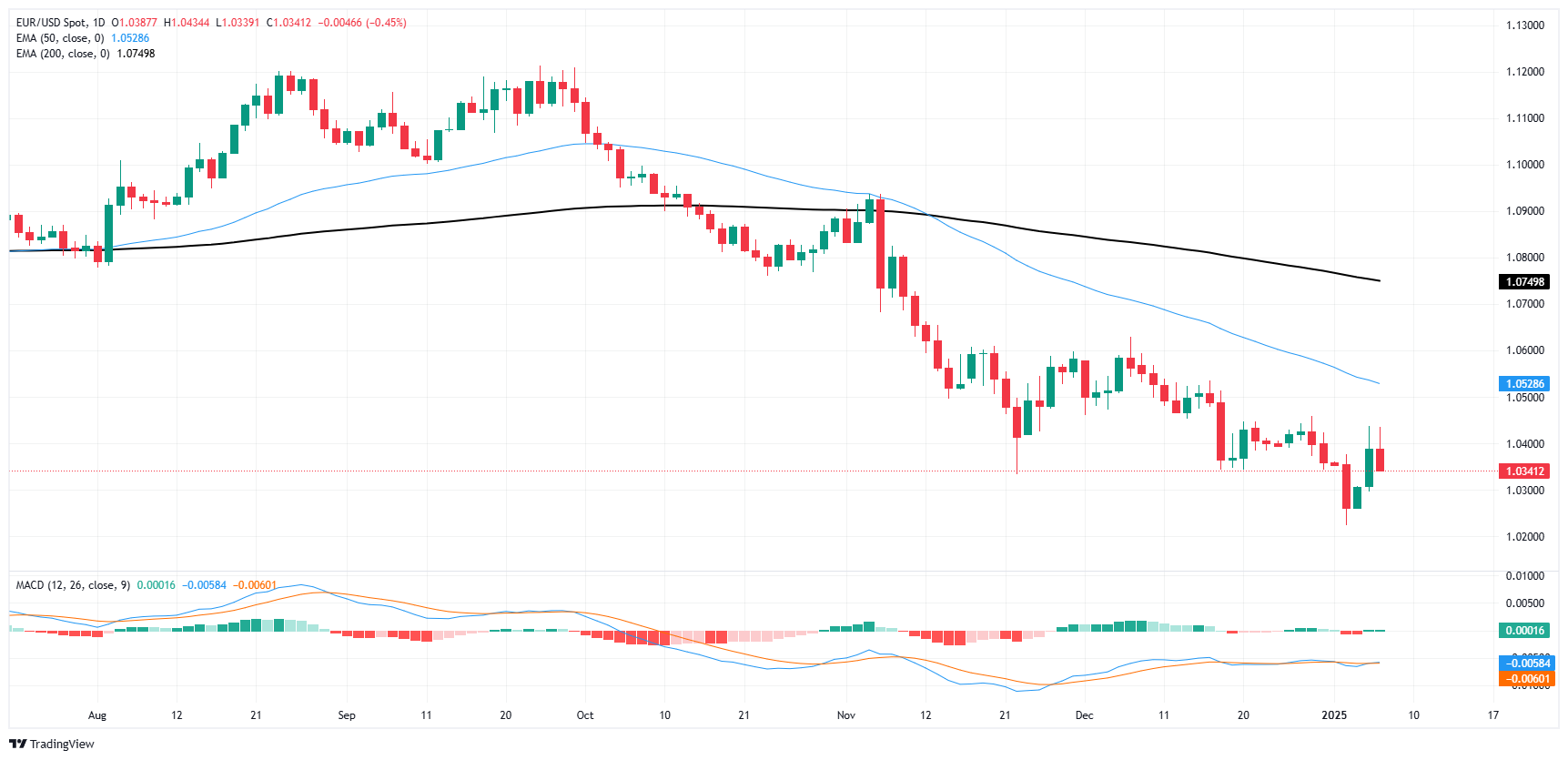
Euro FAQs
The Euro is the currency for the 19 European Union countries that belong to the Eurozone. It is the second most heavily traded currency in the world behind the US Dollar. In 2022, it accounted for 31% of all foreign exchange transactions, with an average daily turnover of over $2.2 trillion a day. EUR/USD is the most heavily traded currency pair in the world, accounting for an estimated 30% off all transactions, followed by EUR/JPY (4%), EUR/GBP (3%) and EUR/AUD (2%).
The European Central Bank (ECB) in Frankfurt, Germany, is the reserve bank for the Eurozone. The ECB sets interest rates and manages monetary policy. The ECB’s primary mandate is to maintain price stability, which means either controlling inflation or stimulating growth. Its primary tool is the raising or lowering of interest rates. Relatively high interest rates – or the expectation of higher rates – will usually benefit the Euro and vice versa. The ECB Governing Council makes monetary policy decisions at meetings held eight times a year. Decisions are made by heads of the Eurozone national banks and six permanent members, including the President of the ECB, Christine Lagarde.
Eurozone inflation data, measured by the Harmonized Index of Consumer Prices (HICP), is an important econometric for the Euro. If inflation rises more than expected, especially if above the ECB’s 2% target, it obliges the ECB to raise interest rates to bring it back under control. Relatively high interest rates compared to its counterparts will usually benefit the Euro, as it makes the region more attractive as a place for global investors to park their money.
Data releases gauge the health of the economy and can impact on the Euro. Indicators such as GDP, Manufacturing and Services PMIs, employment, and consumer sentiment surveys can all influence the direction of the single currency. A strong economy is good for the Euro. Not only does it attract more foreign investment but it may encourage the ECB to put up interest rates, which will directly strengthen the Euro. Otherwise, if economic data is weak, the Euro is likely to fall. Economic data for the four largest economies in the euro area (Germany, France, Italy and Spain) are especially significant, as they account for 75% of the Eurozone’s economy.
Another significant data release for the Euro is the Trade Balance. This indicator measures the difference between what a country earns from its exports and what it spends on imports over a given period. If a country produces highly sought after exports then its currency will gain in value purely from the extra demand created from foreign buyers seeking to purchase these goods. Therefore, a positive net Trade Balance strengthens a currency and vice versa for a negative balance.
Author

Joshua Gibson
FXStreet
Joshua joins the FXStreet team as an Economics and Finance double major from Vancouver Island University with twelve years' experience as an independent trader focusing on technical analysis.