|

EUR/USD eyes 1.0890 as the next downside target – Confluence Detector

EUR/USD has been on the back foot as the US dollar stormed the board. As it nears the 2019 low of 1.0926, it is time to look at the next downside targets. 

The Technical Confluences Indicator is showing that EUR/USD has some support at 1.0941, which is the meeting point of the Pivot Point one-week Support 2 and the previous daily low.

If the world's most popular currency pair slips to lower ground, the next support line is 1.0890, which is the convergence of the PP 1m-S1, the PP 1d-S2, and the PP 1w-S3.

Noteworthy resistance awaits at 1.0992, which is the confluence of the Fibonacci 61.8% one-day, the Bollinger Band 1h-Upper, the BB 4h-Middle, and the previous weekly low.

A considerable cap awaits at 1.1032, where we see several substantial liens converge – the Fibonacci 38.2% one-week, the Simple Moving Average 100-4h, and the Fibonacci 23.6% one-month.

Here is how it looks on the tool:
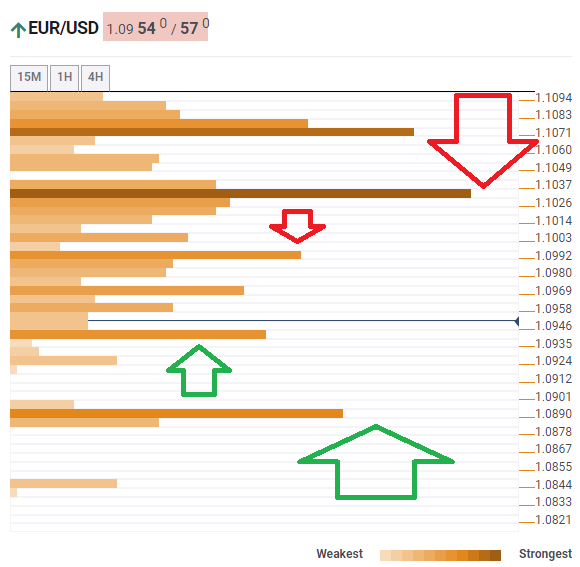
EUR USD technical confluence September 26 2019

Confluence Detector

The Confluence Detector finds exciting opportunities using Technical Confluences. The TC is a tool to locate and point out those price levels where there is a congestion of indicators, moving averages, Fibonacci levels, Pivot Points, etc. Knowing where these congestion points are located is very useful for the trader, and can be used as a basis for different strategies.

This tool assigns a certain amount of “weight” to each indicator, and this “weight” can influence adjacents price levels. These weightings mean that one price level without any indicator or moving average but under the influence of two “strongly weighted” levels accumulate more resistance than their neighbors. In these cases, the tool signals resistance in apparently empty areas.

Learn more about Technical Confluence

Author

Yohay Elam

Yohay Elam

FXStreet

Yohay is in Forex since 2008 when he founded Forex Crunch, a blog crafted in his free time that turned into a fully-fledged currency website later sold to Finixio.


More from Yohay Elam
Share:

Editor's Picks

AUD/USD: Next upside target comes at 0.7000

AUD/USD has advanced further, clinching its third consecutive day of gains and trading at shouting distance from the key 0.7000 threshold on Tuesday. The widespread improved sentiment in the risk complex helped the Aussie maintain its upside momentum, while the fresh selling impulse in the Greenback also contributed to the move.

USD/JPY rises back above 158.00 despite hawkish BoJ outlook

USD/JPY rises back above 158.00 in the early European morning on Tuesday. The pair strengthens as the Japanese Yen fails to find any inspiration from hawkish BoJ expectations and looming intervention risks. Meanwhile, geopolitical uncertainty and elevated US bond yields keep the US Dollar near its YTD high despite receding October Fed hike bets. This, in turn, helps the pair stay supported.

Gold stays firm; looks at $4,200

Gold builds on Monday’s marginal bounce, although it struggles to reclaim the key $4,200 mark per troy ounce so far on Tuesday. The yellow metal’s advance comes on the back of the fresh downside momentum in the US Dollar in tandem with retreating US Treasury yields across the curve.

ZEC expands institutional momentum as Winklevoss files for Zcash ETF
Winklevoss Asset Services, co-owned by crypto exchange Gemini founders Cameron and Tyler Winklevoss, filed a Form S-1 registration statement with the US Securities and Exchange Commission (SEC) on Tuesday for the Winklevoss Zcash (ZEC) ETF. The filing proposes a fund that would hold ZEC and seek to track its price.
RBI looks set to step up Repo Rate by 25 bps to 5.5%

The Reserve Bank of India is set to announce its bi-monthly monetary policy decision on Wednesday at 10:00 AM IST, in a meeting where the central bank is expected to initiate an interest rate hike cycle after maintaining a status-quo so far this calendar year. According to the market consensus, the RBI will hike its key Repo Rate by 25 basis points to 5.5% from 5.25%.

Eurozone inflation just hit 3.8%, its highest in three years. This chart shows why the ECB can’t simply hike its way out

The ECB would normally have a relatively straightforward answer to inflation running almost twice its target: raise interest rates. But these are not normal circumstances. This time, the bond market is already doing part of the tightening for it, leaving the ECB facing an increasingly difficult dilemma.