EUR/USD extends upside as US credit downgrade keeps Greenback on backfoot
- EUR/USD extends its upside to near 1.1250 as the US Dollar continues to face pressure due to the US Sovereign Credit rating downgrade.
- Washington highlights Huawei-made AI chips as a threat to US export controls.
- The EU’s executive arm sees inflation averaging 1.7% in 2026.

EUR/USD trades firmly near 1.1250 in Tuesday’s North American session, following the previous day’s upside move. The major currency pair remains on the frontfoot as the United States (US) Sovereign Credit downgrade by Moody’s continues to batter the US Dollar (USD), with the US Dollar Index (DXY) extending its downside to near 100.00.
On Friday, Moody’s downgraded the US credit rating by one notch to Aa1 from Aaa. This move shifted the focus of financial market participants to the growing $36 trillion US government debt pile and fiscal imbalances, which would lead to a long-term increase in the cost of capital for the US administration.
Investors are worried that the US debt issues are expected to widen further, with US President Donald Trump's “big beautiful bill” likely adding $3 trillion-$5 trillion to the already giant debt stress.
This has renewed concerns over the US Dollar’s credibility, which has already been battered by “ever-changing” headlines on the tariff policy by Washington.
Meanwhile, fresh concerns over de-escalation in the US-China trade war have also weighed on the Greenback. Earlier in the day, China accused the US of discouraging the use of Huawei-made Artificial Intelligence (AI) chips and Chinese AI models, highlighting them as a threat to US export control.
According to a Chinese Commerce Ministry spokesperson, the US Commerce Department's advice is "discriminatory" and "market distorting," prompting Beijing to "demand" that the administration "correct its mistakes.” Beijing warned that comments from Washington pointing to Chinese-made chips as a threat undermine the trade agreement, which took place in Geneva last weekend.
Daily digest market movers: EUR/USD gains as Euro remains firm
- Further upside in the EUR/USD pair is also driven by some Euro (EUR) strength. The major currency pair continues to attract bids even though the executive arm of the European Union (EU) has warned of risks to inflation undershooting the European Central Bank’s (ECB) target of 2%.
- The spring forecast report released by the EU’s executive arm on Monday showed that consumer inflation will return to the 2% target by the middle of the year, averaging around 1.7% in 2026. According to the report, lower energy costs, the rerouting of Chinese goods, and a stronger Euro will be responsible for downside risks to inflation.
- A slew of ECB officials have also warned of risks to inflation skewing to the downside and have argued in favor of more interest rate cuts. ECB governing council member Isabel Schnabel, who has usually been a hawk, has also expressed confidence that “disinflation is on track” in her comments during European trading hours. However, Schnabel still believes that tariffs by the US will pose “upside risks to inflation in the medium term”.
- This week, investors will focus on the preliminary HCOB Purchasing Managers’ Index (PMI) data for May, which will be published on Thursday. According to the estimates, the overall business activity is expected to have grown at a faster pace than in April. In the US economy, the preliminary S&P Global Composite PMI is estimated to have grown steadily.
Euro PRICE Today
The table below shows the percentage change of Euro (EUR) against listed major currencies today. Euro was the strongest against the Australian Dollar.
| USD | EUR | GBP | JPY | CAD | AUD | NZD | CHF | |
|---|---|---|---|---|---|---|---|---|
| USD | 0.09% | 0.14% | -0.10% | -0.13% | 0.91% | 0.55% | -0.14% | |
| EUR | -0.09% | 0.05% | -0.16% | -0.20% | 0.82% | 0.47% | -0.23% | |
| GBP | -0.14% | -0.05% | -0.23% | -0.27% | 0.74% | 0.43% | -0.24% | |
| JPY | 0.10% | 0.16% | 0.23% | -0.05% | 0.98% | 0.62% | -0.01% | |
| CAD | 0.13% | 0.20% | 0.27% | 0.05% | 1.04% | 0.67% | 0.02% | |
| AUD | -0.91% | -0.82% | -0.74% | -0.98% | -1.04% | -0.35% | -1.00% | |
| NZD | -0.55% | -0.47% | -0.43% | -0.62% | -0.67% | 0.35% | -0.65% | |
| CHF | 0.14% | 0.23% | 0.24% | 0.01% | -0.02% | 1.00% | 0.65% |
The heat map shows percentage changes of major currencies against each other. The base currency is picked from the left column, while the quote currency is picked from the top row. For example, if you pick the Euro from the left column and move along the horizontal line to the US Dollar, the percentage change displayed in the box will represent EUR (base)/USD (quote).
Technical Analysis: EUR/USD stays above 1.1200
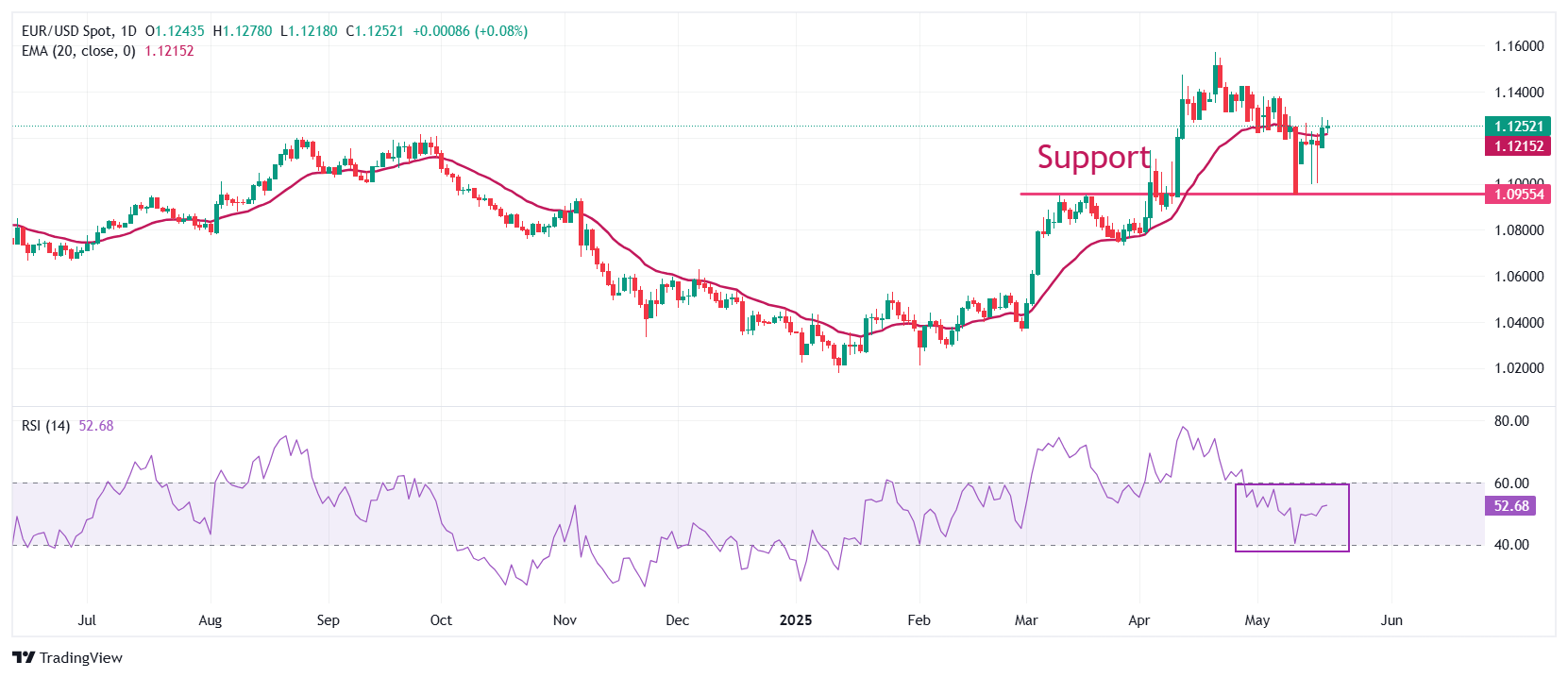
EUR/USD moves higher to near 1.1250 on Tuesday. The near-term outlook of the pair is bullish as it holds the 20-day Exponential Moving Average (EMA), which is around 1.1214.
The 14-period Relative Strength Index (RSI) oscillates inside the 40.00-60.00 range, suggesting indecisiveness among traders.
Looking up, the April 28 high of 1.1425 will be the major resistance for the pair. Conversely, the psychological level of 1.1000 will be a key support for the Euro bulls.
US Dollar FAQs
The US Dollar (USD) is the official currency of the United States of America, and the ‘de facto’ currency of a significant number of other countries where it is found in circulation alongside local notes. It is the most heavily traded currency in the world, accounting for over 88% of all global foreign exchange turnover, or an average of $6.6 trillion in transactions per day, according to data from 2022. Following the second world war, the USD took over from the British Pound as the world’s reserve currency. For most of its history, the US Dollar was backed by Gold, until the Bretton Woods Agreement in 1971 when the Gold Standard went away.
The most important single factor impacting on the value of the US Dollar is monetary policy, which is shaped by the Federal Reserve (Fed). The Fed has two mandates: to achieve price stability (control inflation) and foster full employment. Its primary tool to achieve these two goals is by adjusting interest rates. When prices are rising too quickly and inflation is above the Fed’s 2% target, the Fed will raise rates, which helps the USD value. When inflation falls below 2% or the Unemployment Rate is too high, the Fed may lower interest rates, which weighs on the Greenback.
In extreme situations, the Federal Reserve can also print more Dollars and enact quantitative easing (QE). QE is the process by which the Fed substantially increases the flow of credit in a stuck financial system. It is a non-standard policy measure used when credit has dried up because banks will not lend to each other (out of the fear of counterparty default). It is a last resort when simply lowering interest rates is unlikely to achieve the necessary result. It was the Fed’s weapon of choice to combat the credit crunch that occurred during the Great Financial Crisis in 2008. It involves the Fed printing more Dollars and using them to buy US government bonds predominantly from financial institutions. QE usually leads to a weaker US Dollar.
Quantitative tightening (QT) is the reverse process whereby the Federal Reserve stops buying bonds from financial institutions and does not reinvest the principal from the bonds it holds maturing in new purchases. It is usually positive for the US Dollar.
Author

Sagar Dua
FXStreet
Sagar Dua is associated with the financial markets from his college days. Along with pursuing post-graduation in Commerce in 2014, he started his markets training with chart analysis.