EUR/USD ticks lower following Warsh's nomination for the Fed
- EUR/USD wavers within the lower range of the 1.1900s after retrrateing from 1.2000.
- Trump confirms market rumours and nominates Kevin Warsh as the next Fed Chairman.
- Eurozone and German GDP figures beat expectations in the last quarter of 2025.

The Euro (EUR) has pulled back following news of the nomination of Kevin Warsh as the next Federal Reserve (Fed) Chairman, but remains trading in a tight range, with bulls called below 1.1950 and support at the 1.1900 area containing downside attempts for now. Better-than-expected Gross Domestic Product (GDP) figures in Germany and the Eurozone, and the uptick in German inflation, have failed to provide any significant support to the pair.
US President Donald Trump has confirmed market rumours, choosing former Fed governor Kevin Warsh as the replacement for Jerome Powell as the head of the Fed. The news, advanced by market media earlier on Friday, had improved invesotrs sentiment, on the belief that Warsh will guarantee the central bank's independence rather than act on Trump's command.
Beyond that, news that US Senate Democrats and Republicans have reached an agreement on a package of spending bills has boosted hopes that another government shutdown can be averted, providing additional support for the Greenback.
US economic data released on Thursday was mixed. Factory Orders bounced up beyond forecasts, but Initial Jobless Claims were also higher than expected, and the trade deficit widened. On Friday, the focus will be on the US Producer Price Index (PPI) data for December.
Euro Price Today
The table below shows the percentage change of Euro (EUR) against listed major currencies today. Euro was the strongest against the Japanese Yen.
| USD | EUR | GBP | JPY | CAD | AUD | NZD | CHF | |
|---|---|---|---|---|---|---|---|---|
| USD | 0.24% | 0.30% | 0.59% | 0.23% | 0.53% | 0.29% | 0.32% | |
| EUR | -0.24% | 0.06% | 0.35% | -0.01% | 0.29% | 0.05% | 0.08% | |
| GBP | -0.30% | -0.06% | 0.30% | -0.07% | 0.23% | -0.01% | 0.02% | |
| JPY | -0.59% | -0.35% | -0.30% | -0.35% | -0.07% | -0.31% | -0.27% | |
| CAD | -0.23% | 0.01% | 0.07% | 0.35% | 0.28% | 0.05% | 0.09% | |
| AUD | -0.53% | -0.29% | -0.23% | 0.07% | -0.28% | -0.24% | -0.21% | |
| NZD | -0.29% | -0.05% | 0.00% | 0.31% | -0.05% | 0.24% | 0.03% | |
| CHF | -0.32% | -0.08% | -0.02% | 0.27% | -0.09% | 0.21% | -0.03% |
The heat map shows percentage changes of major currencies against each other. The base currency is picked from the left column, while the quote currency is picked from the top row. For example, if you pick the Euro from the left column and move along the horizontal line to the US Dollar, the percentage change displayed in the box will represent EUR (base)/USD (quote).
Daily Digest market Movers: Warsh's name soothes markets
- The US Dollar is trimming some of the losses seen over the last two weeks after the name of Kevin Warsh has emerged as the next Fed Chair, soothing investors who were concerned about the central bank's autonomy. Beyond that, hopes that a deal to avoid an immediate US shutdown is still possible, and some profit-taking ahead of the weekend have contributed to giving some oxygen to the battered US Dollar.
- In Europe, the recent Euro rally is starting to raise concerns about the competitiveness of European products in foreign markets and the growing downside risks for inflation, which has prompted the first calls for interest rate cuts since last summer. If more European Central Bank (ECB) officials follow this path, we might see a deeper Euro correction.
- Eurozone data released earlier on Friday revealed that the region's economy grew at a steady 0.3% pace in Q4, and 1.4% year-on-year, against the market consensus that had anticipated a slowdown to 0.2% and 1.2% respectively.
- German preliminary Harmonized Index of Consumer Prices (HICP) revealed that price pressures contracted in January, at a 0.1% pace, following a 0.2% reading in December, while Yearly inflation increased by 2.1% from 2.0% in the previous year, against market expectations of a steady 2% reading.
- Previously, German preliminary Gross Domestic Product (GDP) figures revealed that growth accelerated to 0.3% in Q4, from a flat reading in the previous quarter, and beating expectations of a 0.2% improvement. Year-on-year, the German economy grew 0.4% from 0.3% in Q3.
- Later on the day, the preliminary German HICP is expected to show a 0.2% contraction in January, following a 0.2% growth in the previous month, although the yearly inflation is seen as steady at 2%.
- In the US, Producer Price Index (PPI) figures for December are forecast to have moderated to a 2.7% yearly growth, from 3% in the previous month, while the core PPI is seen easing to 2.9% year-on-year, from 3% in the previous month.
Technical Analysis: EUR/USD corrects lower, with support at 1.1900 under pressure
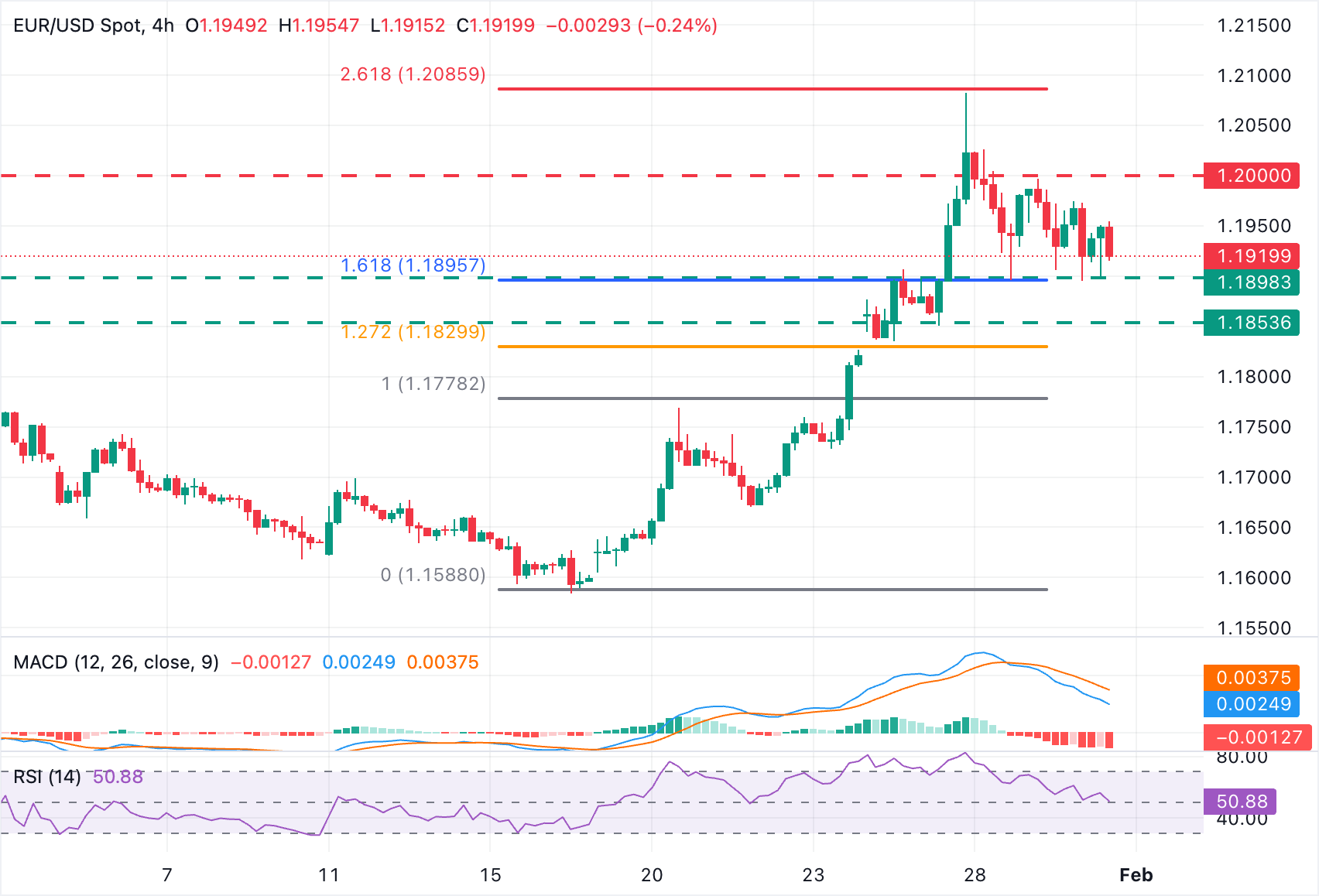
The EUR/USD rally has lost steam as the last two days' lower highs suggest that sellers are taking control, although support at 1.1895 is limiting losses for now. Technical indicators show increasing bearish momentum. The Moving Average Convergence Divergence (MACD) histogram has slipped below zero on the 4-hour chart, and the red bars are expanding, while the Relative Strength Index (RSI) is attempting to break the key 50 level on the same time frame.
A confirmation below the mentioned 1.1895 area (January 28, 29 lows) increases negative pressure towards the January 27 low, at 1.1850, and the January 23 low near 1.1730. To the upside, resistances are at the January 29 high, near the 1.2000 psychological level, and the January 27 high, at 1.2082.
(The technical analysis of this story was written with the help of an AI tool.)
Economic Indicator
Harmonized Index of Consumer Prices (MoM)
The Harmonized Index of Consumer Prices (HICP), released by the German statistics office Destatis on a monthly basis, is an index of inflation based on a statistical methodology that has been harmonized across all European Union (EU) member states to facilitate comparisons. The MoM figure compares the prices of goods in the reference month to the previous month. Generally, a high reading is bullish for the Euro (EUR), while a low reading is bearish.
Read more.Last release: Fri Jan 30, 2026 13:00 (Prel)
Frequency: Monthly
Actual: -0.1%
Consensus: -0.2%
Previous: 0.2%
Economic Indicator
Harmonized Index of Consumer Prices (YoY)
The Harmonized Index of Consumer Prices (HICP), released by the German statistics office Destatis on a monthly basis, is an index of inflation based on a statistical methodology that has been harmonized across all European Union (EU) member states to facilitate comparisons. The YoY reading compares prices in the reference month to a year earlier. Generally, a high reading is bullish for the Euro (EUR), while a low reading is bearish.
Read more.Last release: Fri Jan 30, 2026 13:00 (Prel)
Frequency: Monthly
Actual: 2.1%
Consensus: 2%
Previous: 2%
,
Author

Guillermo Alcala
FXStreet
Graduated in Communication Sciences at the Universidad del Pais Vasco and Universiteit van Amsterdam, Guillermo has been working as financial news editor and copywriter in diverse Forex-related firms, like FXStreet and Kantox.














