EUR/USD gives up gains as ECB officials back more rate cuts
- EUR/USD surrenders intraday gains as ECB officials support further interest rate cuts.
- The ECB is expected to cut interest rates further by 100 bps next year.
- Investors will keenly focus on the Fed’s dot plot for fresh interest rate projections in the US.

EUR/USD surrenders its intraday gains and returns below the psychological level of 1.0500 in Monday’s North American session as a significant number of European Central Bank (ECB) policymakers, including President Christine Lagarde, have backed further policy easing and a gradual move towards neutral rate, which they expect to be around 2%. "Will cut rates further if incoming data confirm that disinflation is on track", Lagarde said at an Annual Economics Conference in Monday's European session. Lagarde's dovish remarks on the policy outlook were backed by the assumption that "Inflation momentum for services has dropped steeply recently."
ECB Vice President Luis de Guindos also supported further policy easing, saying, “In the near term, we will continue in the same direction as in the past few months.” Meanwhile, ECB policymaker and Slovak Central Bank Governor Peter Kazimir advocated a "Gradual, step-by-step approach through 25 bps rate cuts is the most prudent strategy.”
The ECB cut its Deposit Facility rate by 25 basis points (bps) to 3% on Thursday, accumulating a total of 100 bps interest rate reductions this year. Given that Eurozone inflation has come under control and officials are worried about growing economic risks, market participants expect the ECB to deliver another 100 bps reduction in its key borrowing rates by June 2025.
On the economic data front, preliminary Eurozone HCOB Purchasing Managers’ Index (PMI) data for December has come in better than forecasted. The PMI report showed that overall business activity improved to 49.5 from 48.3, suggesting that the private sector activity contracted at a slower pace. An improvement in the overall activity came from higher service sector output, which returned to the expansion territory after contracting in November. The Services PMI, which gauges activity in the services sector, surprisingly expanded to 51.4 from 49.5. Economists expected the Services PMI to have declined at a slightly faster pace to 49.4. The Manufacturing PMI contracted at a steady pace to 45.2, slower than estimates of 45.0. A figure below 50.0 is taken as a contraction in economic activities.
The German and French Composite PMIs have also come in better than expected, mainly due to a sharp improvement in the service sector activity. However, the Composite PMI remained below the 50.0 threshold, a figure that separates expansion from contraction.
On the political front, French President Emmanuel Macron appointed Francois Bayrou as the new prime minister on Friday. He replaced Michel Barnier, who lost a no-confidence vote because he failed to pass the budget, which included tax hikes worth 60 billion Euros to cut the fiscal deficit. Bayrou, who is expected to face similar challenges in his administration, is scheduled to meet leaders of the Far Right and left wing on Monday and Tuesday, respectively, according to Reuters.
Daily digest market movers: EUR/USD turns flat as US Dollar rebounds
- EUR/USD gives up its mild upside move as the US Dollar (USD) has rebounded. The US Dollar Index (DXY), which tracks the Greenback’s value against six major currencies, recovers to near the key resistance of 107.00. The Greenback is expected to remain volatile amid uncertainty ahead of the Federal Reserve’s (Fed) interest rate decision, which will be announced on Wednesday.
- The Fed is widely anticipated to cut its key borrowing rates by 25 bps to 4.25%-4.50%. Therefore, investors will pay close attention to the Fed’s Summary of Economic Projections or the so-called “dot plot”, which shows where policymakers see the Federal Funds Rate heading in the medium and longer term.
- According to a Bloomberg survey conducted from December 6 to 11, a majority of economists expect a less dovish Fed outlook for 2025. Economists see the Fed reducing interest rates three times next year on the assumption that progress in the disinflation process has slowed. The survey also indicated that economists have become more worried about upside risks to inflation than downside risks to employment due to incoming President-elect Donald Trump's policies, including mass deportations, new tariffs, and tax cuts.
- In Monday’s session, investors will focus on the United States (US) S&P Global PMI report for December, which will be published at 14:45 GMT.
US Dollar PRICE Today
The table below shows the percentage change of US Dollar (USD) against listed major currencies today. US Dollar was the strongest against the Japanese Yen.
| USD | EUR | GBP | JPY | CAD | AUD | NZD | CHF | |
|---|---|---|---|---|---|---|---|---|
| USD | 0.03% | -0.25% | 0.26% | 0.09% | 0.04% | -0.10% | -0.05% | |
| EUR | -0.03% | -0.22% | 0.36% | 0.13% | 0.18% | -0.05% | -0.02% | |
| GBP | 0.25% | 0.22% | 0.45% | 0.35% | 0.40% | 0.15% | 0.20% | |
| JPY | -0.26% | -0.36% | -0.45% | -0.20% | -0.24% | -0.36% | -0.25% | |
| CAD | -0.09% | -0.13% | -0.35% | 0.20% | -0.00% | -0.19% | -0.14% | |
| AUD | -0.04% | -0.18% | -0.40% | 0.24% | 0.00% | -0.23% | -0.20% | |
| NZD | 0.10% | 0.05% | -0.15% | 0.36% | 0.19% | 0.23% | 0.03% | |
| CHF | 0.05% | 0.02% | -0.20% | 0.25% | 0.14% | 0.20% | -0.03% |
The heat map shows percentage changes of major currencies against each other. The base currency is picked from the left column, while the quote currency is picked from the top row. For example, if you pick the US Dollar from the left column and move along the horizontal line to the Japanese Yen, the percentage change displayed in the box will represent USD (base)/JPY (quote).
Technical Analysis: EUR/USD is at make or a break near 1.0500
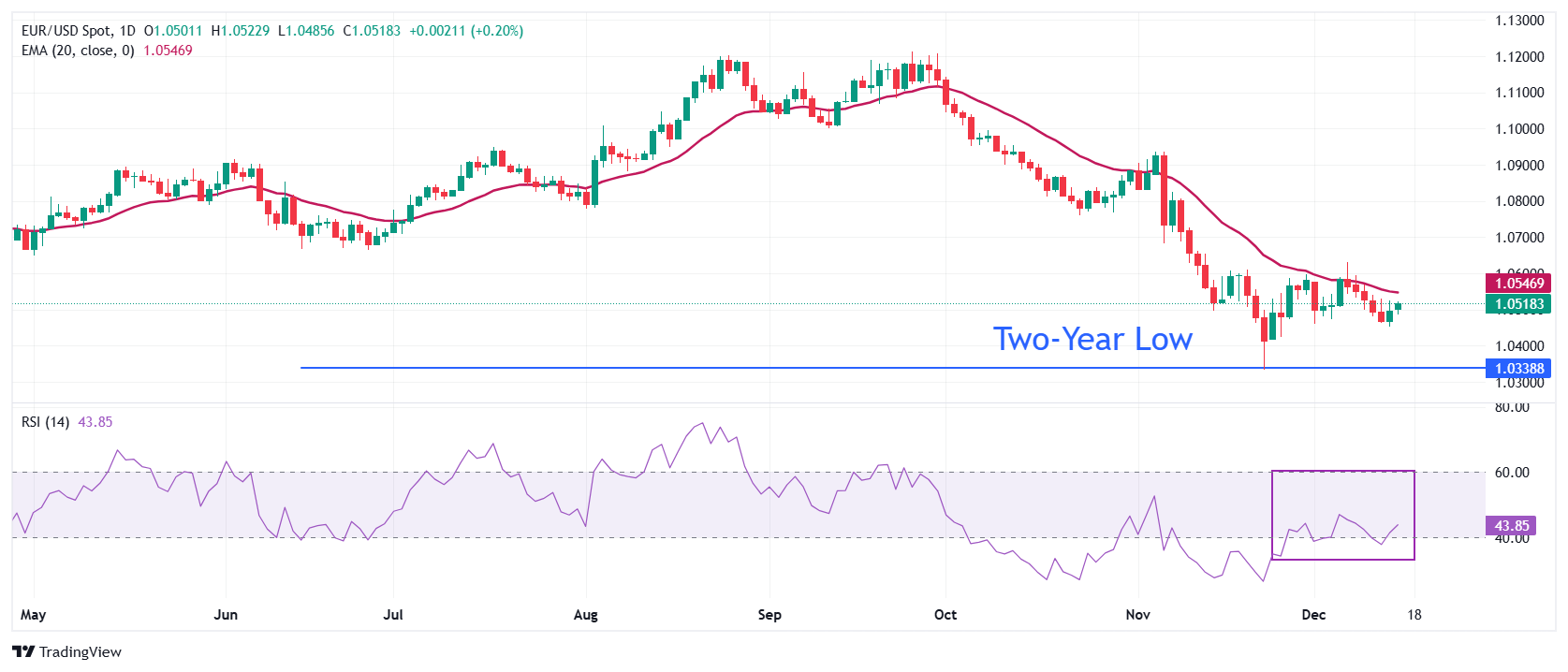
EUR/USD trades near the psychological figure of 1.0500 but continues to struggle around the three-day resistance near 1.0535. The major currency pair remains below the 20-day Exponential Moving Average (EMA) around 1.0545, suggesting a bearish near-term trend.
The 14-day Relative Strength Index (RSI) revolves around 40.00. The bearish momentum should trigger if the RSI (14) falls below 40.00.
Looking down, the two-year low of 1.0330 will provide key support. Conversely, the 20-day EMA will be the key barrier for the Euro bulls.
ECB FAQs
The European Central Bank (ECB) in Frankfurt, Germany, is the reserve bank for the Eurozone. The ECB sets interest rates and manages monetary policy for the region. The ECB primary mandate is to maintain price stability, which means keeping inflation at around 2%. Its primary tool for achieving this is by raising or lowering interest rates. Relatively high interest rates will usually result in a stronger Euro and vice versa. The ECB Governing Council makes monetary policy decisions at meetings held eight times a year. Decisions are made by heads of the Eurozone national banks and six permanent members, including the President of the ECB, Christine Lagarde.
In extreme situations, the European Central Bank can enact a policy tool called Quantitative Easing. QE is the process by which the ECB prints Euros and uses them to buy assets – usually government or corporate bonds – from banks and other financial institutions. QE usually results in a weaker Euro. QE is a last resort when simply lowering interest rates is unlikely to achieve the objective of price stability. The ECB used it during the Great Financial Crisis in 2009-11, in 2015 when inflation remained stubbornly low, as well as during the covid pandemic.
Quantitative tightening (QT) is the reverse of QE. It is undertaken after QE when an economic recovery is underway and inflation starts rising. Whilst in QE the European Central Bank (ECB) purchases government and corporate bonds from financial institutions to provide them with liquidity, in QT the ECB stops buying more bonds, and stops reinvesting the principal maturing on the bonds it already holds. It is usually positive (or bullish) for the Euro.
Author

Sagar Dua
FXStreet
Sagar Dua is associated with the financial markets from his college days. Along with pursuing post-graduation in Commerce in 2014, he started his markets training with chart analysis.

















