|

EUR/USD drops below 1.1300 post-US CPI

  • The pair comes under further pressure below the 1.1300 handle.
  • The greenback pares losses and advance to 96.80/85 on CPI.
  • US Core CPI rose above estimates 2.2% YoY in January.

Further downside pressure is now hitting the single currency and is dragging EUR/USD to fresh lows in sub-1.1300 region.

EUR/USD weaker post-CPI

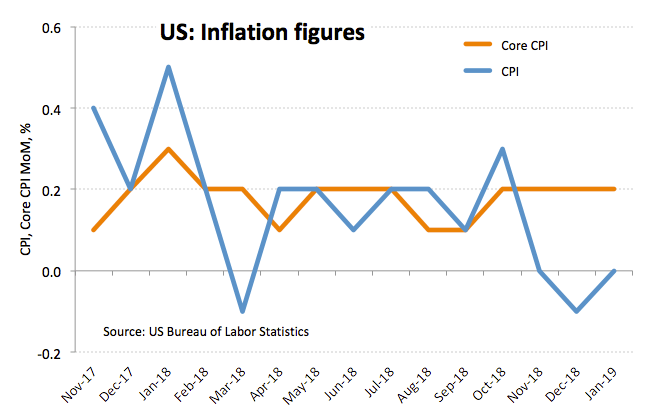
Spot lost extra momentum after US inflation figures came in above expectations during last month. In fact, consumer prices tracked by the headline CPI came in flat inter-month and rose 1.6% from a year earlier.

Additionally, consumer prices stripping food and energy costs rose at a monthly 0.2% and 2.2% over the last twelve months.

The pair is thus fading further the earlier spike to fresh tops in the 1.1330 region always on the back of rising hopes over a positive outcome from the ongoing US-China trade negotiations.

What to look for around EUR/USD

Both the ECB and European Commission have revised lower their projections for economic growth and inflation in the bloc, acknowledging at the same time that the ongoing slowdown could be longer than initially estimated. Additionally, political concerns remain well and sound following the recent Italy-France dispute with the ‘yellow-vests’ in centre stage ahead of the key EU parliamentary elections in May. Looking at the ECB, and following the current context, market participants seem to have pushed back the probable timing of the start of the tightening cycle by the central bank.

EUR/USD levels to watch

At the moment, the pair is losing 0.23% at 1.1298 and a break below 1.1257 (2019 low Feb.12) would target 1.1215 (2018 low Nov.12) en route to 1.1118 (monthly low Jun.20 2017). On the other hand, the next up barrier is located at 1.1356 (23.6% Fibo of the September-November drop) seconded by 1.1386 (55-day SMA) and finally 1.1416 (100-day SMA).
Author

Pablo Piovano

Born and bred in Argentina, Pablo has been carrying on with his passion for FX markets and trading since his first college years.


More from Pablo Piovano
Share:

Editor's Picks

EUR/USD stays defensive below 1.1900 as USD recovers

EUR/USD trades in negative territory for the third consecutive day, below 1.1900 in the European session on Thursday. A modest rebound in the US Dollar is weighing on the pair, despite an upbeat market mood. Traders keep an eye on the US weekly Initial Jobless Claims data for further trading impetus. 

GBP/USD holds above 1.3600 after UK data dump

\GBP/USD moves little while holding above 1.3600 in the European session on Thursday, following the release of the UK Q4 preliminary GDP, which showed a 0.1% growth against a 0.2% increase expected. The UK industrial sector activity deteriorated in Decembert, keeping the downward pressure intact on the Pound Sterling. 

Gold sticks to modest intraday losses as reduced March Fed rate cut bets underpin USD

Gold languishes near the lower end of its daily range heading into the European session on Thursday. The precious metal, however, lacks follow-through selling amid mixed cues and currently trades above the $5,050 level, well within striking distance of a nearly two-week low touched the previous day.

Cardano eyes short-term rebound as derivatives sentiment improves

Cardano (ADA) is trading at $0.257 at the time of writing on Thursday, after slipping more than 4% so far this week. Derivatives sentiment improves as ADA’s funding rates turn positive alongside rising long bets among traders.

A tale of two labour markets: Headline strength masks underlying weakness

Undoubtedly, yesterday’s delayed US January jobs report delivered a strong headline – one that surpassed most estimates. However, optimism quickly faded amid sobering benchmark revisions.

Sonic Labs’ vertical integration fuels recovery in S token

Sonic, previously Fantom (FTM), is extending its recovery trade at $0.048 at the time of writing, after rebounding by over 12% the previous day. The recovery thesis’ strengths lie in the optimism surrounding Sonic Labs’ Wednesday announcement to shift to a vertically integrated model, aimed at boosting S token utility.