EUR/USD accelerates its reversal on USD strength, dovish ECB rhetoric
- The Euro dips to fresh session lows below 1,1750 after ECB Centeno's dovish comments.
- Stronger-than-expected US jobless claims and manufacturing activity figures have underpinned the US Dollar's recovery.
- In Europe, France's growing political unrest increases pressure on the Euro.

EUR/USD is heading lower for the third day in a row, trading at 1.1765 at the time of writing on Friday, down from the four-year highs above 1.1900 hit earlier this week. Strong US macroeconomic data has provided additional support to the US Dollar, while in Europe, the political unrest in France and dovish comments by ECB's Centeno have added pressure on the Euro (EUR).
ECB Government Council member Mario Centeno affirmed earlier today that the bank can not tolerate inflation levels below the 2% target for too long and warned about downside risks to economic growth in Europe before anticipating that the next move will be a further rate cut.
In France, a new wave of anti-austerity protests is gathering strength, which is adding weight to the common currency. Hundreds of thousands of people gathered in France's main cities on Thursday to pressure French President Emmanuel Macron and the new Prime Minister, Sébastien Lecornu, to scrap plans to cut spending proposed by the previous Prime Minister, François Bayrou.
Meanwhile, the US Supreme Court said that it will decide on the legality of trade tariffs on November 5. This has been one of the leading measures of US President Donald Trump's second term and was put into question by a lower court ruling that the republican overstepped his authority by invoking a federal law meant for emergencies.
All in all, the US Dollar (USD) maintains a mild positive tone with a neutral market mood and the absence of key fundamental data in Europe or the US. However, upside attempts in the Greenback are likely to remain contained, with investors pricing in further Federal Reserve (Fed) monetary easing in the coming months.
Euro Price Today
The table below shows the percentage change of Euro (EUR) against listed major currencies today. Euro was the strongest against the British Pound.
| USD | EUR | GBP | JPY | CAD | AUD | NZD | CHF | |
|---|---|---|---|---|---|---|---|---|
| USD | 0.36% | 0.53% | 0.10% | 0.14% | 0.29% | 0.43% | 0.55% | |
| EUR | -0.36% | 0.19% | -0.31% | -0.22% | -0.10% | 0.07% | 0.19% | |
| GBP | -0.53% | -0.19% | -0.44% | -0.41% | -0.31% | -0.20% | -0.00% | |
| JPY | -0.10% | 0.31% | 0.44% | 0.02% | 0.32% | 0.39% | 0.30% | |
| CAD | -0.14% | 0.22% | 0.41% | -0.02% | 0.15% | 0.30% | 0.41% | |
| AUD | -0.29% | 0.10% | 0.31% | -0.32% | -0.15% | 0.17% | 0.34% | |
| NZD | -0.43% | -0.07% | 0.20% | -0.39% | -0.30% | -0.17% | 0.12% | |
| CHF | -0.55% | -0.19% | 0.00% | -0.30% | -0.41% | -0.34% | -0.12% |
The heat map shows percentage changes of major currencies against each other. The base currency is picked from the left column, while the quote currency is picked from the top row. For example, if you pick the Euro from the left column and move along the horizontal line to the US Dollar, the percentage change displayed in the box will represent EUR (base)/USD (quote).
Daily digest market movers: Strong data soothes investors and supports the US Dollar
- Weekly US Initial Jobless Claims dropped by 33,000 to 231,000 in the week of September 12, according to data released by the US Labor Department on Thursday. The numbers beat expectations of a softer decline to 240K from the previous 264K reading.
- Somewhat later, the Philly Fed Manufacturing Survey showed a larger-than-expected recovery of the sector's activity, with the index bouncing up to 23.2, its highest level since January, following a 0.3% contraction in August and also beating expectations of a 2.3 reading.
- These figures did not change the view that the Fed will be constrained to cut interest rates again in October, but have eased concerns about a sharp economic downturn, and provided additional support to the Greenback.
- Futures markets remain pricing in a 90% chance that the Fed will cut rates by another 25-basis-point (bps) month, and nearly 80% probability that the central bank will cut another quarter point in December. This feeling is likely to keep US Dollar rallies limited.
- On Thursday, ECB Vice President Luis de Guindos reiterated that the bank's monetary policy stance is "appropriate" at the moment but warned about the high economic uncertainty and affirmed that the monetary easing cycle may not be over yet in a dovish hint that added some pressure on the Euro.
Technical Analysis: EUR/USD key support is at the 1.1700 area
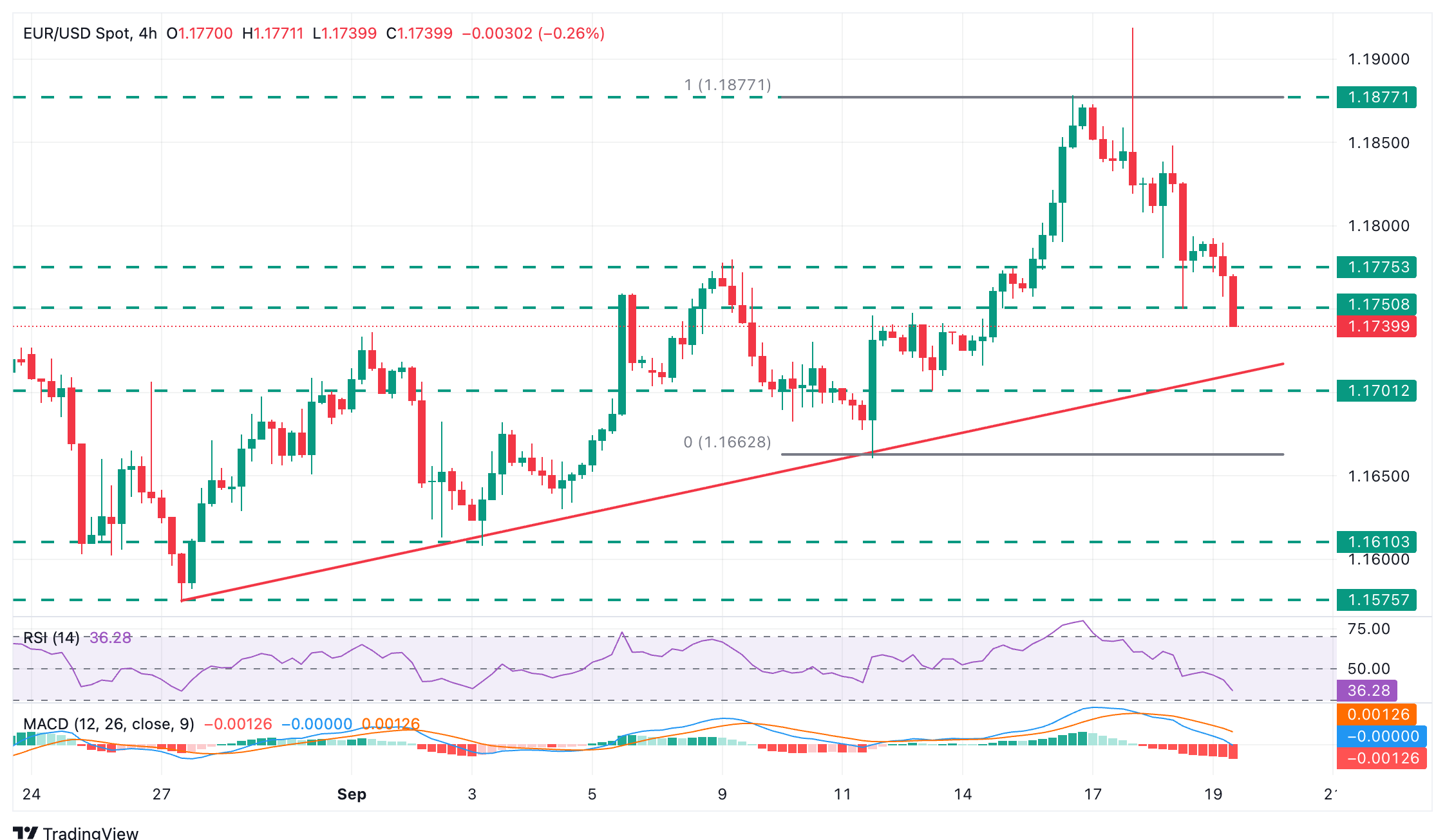
EUR/USD is accelerating its reversal from four-year highs, amid a stronger US Dollar. Technical indicators are showing an increasing bearish momentum, with the Relative Strength Index steady below the 50 level on the 4-hour chart, and with bears pushing the pair below the 1.1750-1.1760 support area, which held downside attempts on September 15 and 18.
The key support area for the broader bullish trend lies between the September 12 low at 1.1700 and the trendline support from late August lows, now around 1.1710. Further down, the next target is the September 11 low, near 1.1660. To the upside, the intra-day high is at 1.1790, ahead of Thursday's peak near 1.1850 and the September 16 high at 1.1878.
ECB FAQs
The European Central Bank (ECB) in Frankfurt, Germany, is the reserve bank for the Eurozone. The ECB sets interest rates and manages monetary policy for the region. The ECB primary mandate is to maintain price stability, which means keeping inflation at around 2%. Its primary tool for achieving this is by raising or lowering interest rates. Relatively high interest rates will usually result in a stronger Euro and vice versa. The ECB Governing Council makes monetary policy decisions at meetings held eight times a year. Decisions are made by heads of the Eurozone national banks and six permanent members, including the President of the ECB, Christine Lagarde.
In extreme situations, the European Central Bank can enact a policy tool called Quantitative Easing. QE is the process by which the ECB prints Euros and uses them to buy assets – usually government or corporate bonds – from banks and other financial institutions. QE usually results in a weaker Euro. QE is a last resort when simply lowering interest rates is unlikely to achieve the objective of price stability. The ECB used it during the Great Financial Crisis in 2009-11, in 2015 when inflation remained stubbornly low, as well as during the covid pandemic.
Quantitative tightening (QT) is the reverse of QE. It is undertaken after QE when an economic recovery is underway and inflation starts rising. Whilst in QE the European Central Bank (ECB) purchases government and corporate bonds from financial institutions to provide them with liquidity, in QT the ECB stops buying more bonds, and stops reinvesting the principal maturing on the bonds it already holds. It is usually positive (or bullish) for the Euro.
Author

Guillermo Alcala
FXStreet
Graduated in Communication Sciences at the Universidad del Pais Vasco and Universiteit van Amsterdam, Guillermo has been working as financial news editor and copywriter in diverse Forex-related firms, like FXStreet and Kantox.