EUR/USD declines as USD rebounds despite contradictory remarks from Trump-China
- EUR/USD falls to near 1.1350 as the US Dollar resumes recovery on increasing odds of de-escalation in the US-China trade war.
- Beijing is considering pausing additional tariffs on some goods from the US.
- ECB’s Holzmann warns about structural weakness in the Eurozone economy.

EUR/USD trades lower around 1.1350 during North American trading hours on Friday. The major currency pair weakens due to a recovery move in the US Dollar (USD) on hopes of an improvement in trade relations between the United States (US) and China.
The US Dollar Index (DXY), which tracks the Greenback’s value against six major currencies, resumes its upside recovery on Friday after correcting to near 99.20 the previous day. The USD Index rises to near 99.65 and aims to break above the weekly high around 100.00.
The confidence of financial market participants that the trade war between the world’s largest powerhouses could de-escalate has increased as China has signaled that it is considering suspending the 125% duty on imports of medical equipment and some industrial chemicals from the US, Bloomberg reported on Thursday.
This week, dialogues from the White House expressing optimism that Washington and Beijing could make a deal had stemmed hopes that the tariff war would not spiral further. On Tuesday, US President Donald Trump stated that “discussions with Beijing are going well” and added that he thinks “they will reach a deal”. During North American trading hours on Thursday, Trump also said in an interview with Time Magazine that Chinese President Xi Jinping had called him. “He’s called,” Trump said and added “I don’t think that’s a sign of weakness on his behalf.”
On the contrary, China has denied any discussions with the US. "China and the US are not having any consultation or negotiation on tariffs", a spokesperson from the Chinese embassy said on Friday, Reuters report. He added that the US should "stop creating confusion."
A spokesperson from Beijing also said on Thursday that there have not been any "economic and trade negotiations" with the US, according to Financial Times (FT). He added that the US needs to “completely cancel all unilateral tariff measures” if it wants trade talks.
On the monetary policy front, a chorus of policymakers has indicated that excessive uncertainty due to new economic policies by US President Trump could damage the economy. Minneapolis Fed Bank President Neel Kashkari warned on Thursday that the uncertainty posed by policies from the President could lead to “business lay-offs”. Kashkari ruled out the possibility that businesses have started cutting labor force but cautioned that some businesses indicate they are preparing for “possible job cuts if uncertainty continues”.
Daily digest market movers: EUR/USD drops, ECB dovish bets swell
- EUR/USD edges down due to USD’s strength. The Euro (EUR) is up against its major peers, except North American currencies, on Friday, even though European Central Bank (ECB) dovish bets are bloating due to growing concerns that the Eurozone inflation could undershoot the central bank’s target of 2%.
- On Thursday, ECB policymaker and Finnish central bank governor Olli Rehn warned about downside risks to inflation. "It is quite possible that the projections for medium-term inflation under the current circumstances may well be below the 2% target,” Rehn said at the sidelines of the spring meetings of the International Monetary Fund (IMF) and World Bank. Rehn expressed confidently that the current situations “justify an interest rate cut in June”.
- During European trading hours, ECB policymaker and Austria’s central bank governor Robert Holzmann has shown concerns over structural weakness in the continent. Holzmann expects that fears of economic shocks will remain intact despite the tariffs announced by Donald Trump being lowered. “I see economic scars even if tariffs are lowered,” Holzmann said. Such a scenario also paves the way for monetary policy easing.
- The next trigger for the Euro would be headlines from the White House and the European Union (EU) about potential trade relations between both sides of the Atlantic.
Euro PRICE Today
The table below shows the percentage change of Euro (EUR) against listed major currencies today. Euro was the strongest against the Japanese Yen.
| USD | EUR | GBP | JPY | CAD | AUD | NZD | CHF | |
|---|---|---|---|---|---|---|---|---|
| USD | 0.26% | 0.23% | 0.81% | 0.05% | 0.32% | 0.60% | 0.40% | |
| EUR | -0.26% | -0.04% | 0.56% | -0.23% | 0.05% | 0.35% | 0.12% | |
| GBP | -0.23% | 0.04% | 0.59% | -0.17% | 0.09% | 0.37% | 0.13% | |
| JPY | -0.81% | -0.56% | -0.59% | -0.75% | -0.51% | -0.24% | -0.46% | |
| CAD | -0.05% | 0.23% | 0.17% | 0.75% | 0.19% | 0.55% | 0.31% | |
| AUD | -0.32% | -0.05% | -0.09% | 0.51% | -0.19% | 0.29% | 0.05% | |
| NZD | -0.60% | -0.35% | -0.37% | 0.24% | -0.55% | -0.29% | -0.24% | |
| CHF | -0.40% | -0.12% | -0.13% | 0.46% | -0.31% | -0.05% | 0.24% |
The heat map shows percentage changes of major currencies against each other. The base currency is picked from the left column, while the quote currency is picked from the top row. For example, if you pick the Euro from the left column and move along the horizontal line to the US Dollar, the percentage change displayed in the box will represent EUR (base)/USD (quote).
Technical Analysis: EUR/USD holds key 20-week EMA
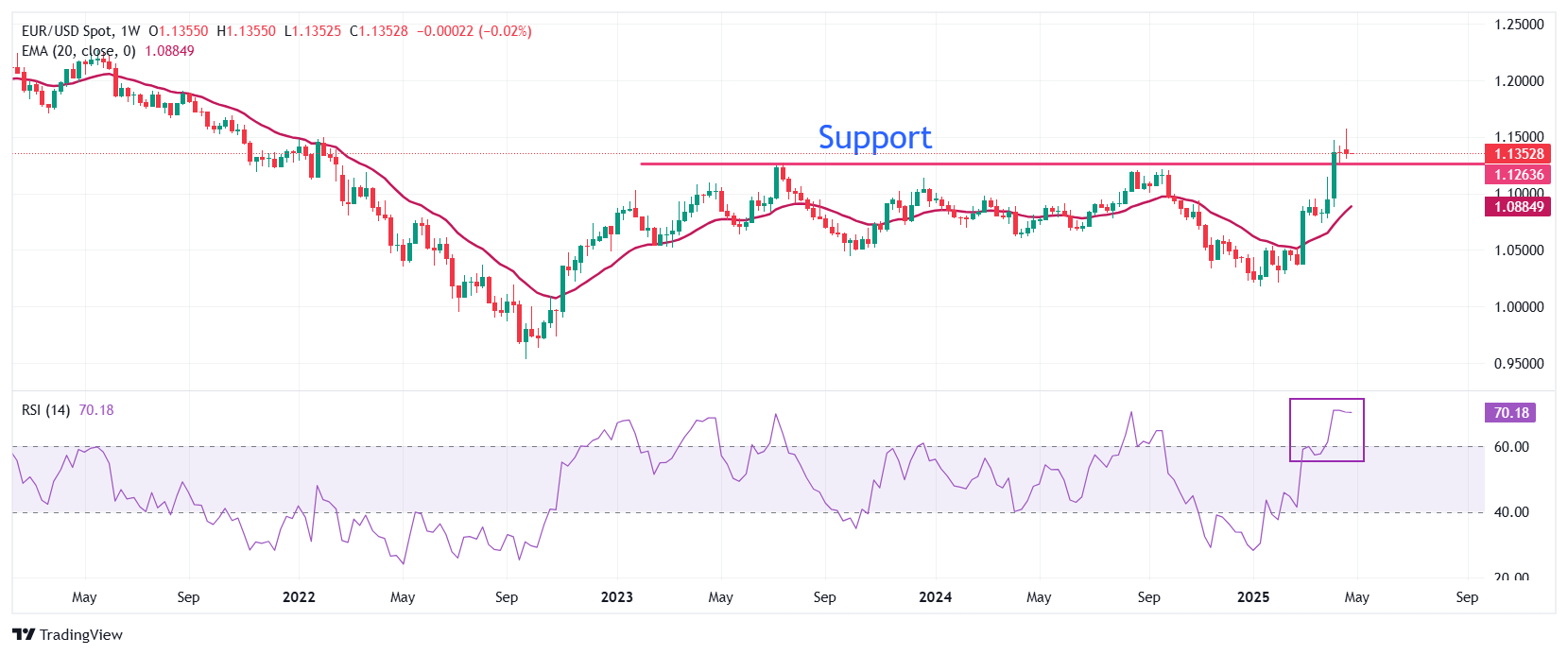
EUR/USD drops to near 1.1350 on Friday. However, the outlook of the major currency pair remains bullish as the 20-week Exponential Moving Average (EMA) is sloping higher around 1.0885.
The 14-week Relative Strength Index (RSI) climbs to near overbought levels above 70.00 in the weekly chart, which indicates a strong bullish momentum, but chances of some correction cannot be ruled out.
Looking up, the psychological level of 1.1500 will be the major resistance for the pair. Conversely, the July 2023 high of 1.1276 will be a key support for the Euro bulls.
US Dollar FAQs
The US Dollar (USD) is the official currency of the United States of America, and the ‘de facto’ currency of a significant number of other countries where it is found in circulation alongside local notes. It is the most heavily traded currency in the world, accounting for over 88% of all global foreign exchange turnover, or an average of $6.6 trillion in transactions per day, according to data from 2022. Following the second world war, the USD took over from the British Pound as the world’s reserve currency. For most of its history, the US Dollar was backed by Gold, until the Bretton Woods Agreement in 1971 when the Gold Standard went away.
The most important single factor impacting on the value of the US Dollar is monetary policy, which is shaped by the Federal Reserve (Fed). The Fed has two mandates: to achieve price stability (control inflation) and foster full employment. Its primary tool to achieve these two goals is by adjusting interest rates. When prices are rising too quickly and inflation is above the Fed’s 2% target, the Fed will raise rates, which helps the USD value. When inflation falls below 2% or the Unemployment Rate is too high, the Fed may lower interest rates, which weighs on the Greenback.
In extreme situations, the Federal Reserve can also print more Dollars and enact quantitative easing (QE). QE is the process by which the Fed substantially increases the flow of credit in a stuck financial system. It is a non-standard policy measure used when credit has dried up because banks will not lend to each other (out of the fear of counterparty default). It is a last resort when simply lowering interest rates is unlikely to achieve the necessary result. It was the Fed’s weapon of choice to combat the credit crunch that occurred during the Great Financial Crisis in 2008. It involves the Fed printing more Dollars and using them to buy US government bonds predominantly from financial institutions. QE usually leads to a weaker US Dollar.
Quantitative tightening (QT) is the reverse process whereby the Federal Reserve stops buying bonds from financial institutions and does not reinvest the principal from the bonds it holds maturing in new purchases. It is usually positive for the US Dollar.
BRANDED CONTENT
If you're looking for the best brokers to trade the EUR/USD pair, explore our selected options. Knowing each broker’s strengths will help you find the ideal fit for your trading strategy.
Author

Sagar Dua
FXStreet
Sagar Dua is associated with the financial markets from his college days. Along with pursuing post-graduation in Commerce in 2014, he started his markets training with chart analysis.