EUR/USD weakens as Fed supports restrictive monetary policy stance
- EUR/USD falls to near 1.0450 as the US Dollar rebounds after Fed officials guided that there is no need to make policy adjustments at least for now.
- ECB’s Nagel warned that President Trump’s tariffs will be more vulnerable for Germany.
- Investors await FOMC minutes, which will be released on Wednesday.

EUR/USD declines to near 1.0450 in Tuesday’s North American session after failing to hold above the psychological resistance of 1.0500 in the last two trading days. The major currency pair slumps due to some weakness in the Euro (EUR). The outlook for the shared currency is uncertain, as European Central Bank (ECB) policymaker and Bundesbank President Joachim Nagel has warned that United States (US) tariffs could weigh on the German economic outlook, which has already suffered from economic contraction for the last two years.
"Our strong export orientation makes us particularly vulnerable," Nagel said in his speech at the Speaker's Luncheon of the Union International Club on Monday. He added that the economic output in 2027 would be almost 1.5% lower than their prior forecast. Currently, the Bundesbank sees the German economy growing by 0.2% this year and 0.8% in 2026.
Fears of US tariffs on Germany escalated after US President Donald Trump announced during the weekend that he plans to impose tariffs on imported cars starting around April 2. According to data from OEC, the German economy exported $24.3 billion worth of cars to the US in 2023.
Meanwhile, firm expectations that the ECB will cut interest rates three times more this year have also capped the Euro’s upside. ECB dovish bets are based on growing risks of inflation undershooting the central bank’s target of 2%.
On the economic front, the Eurozone ZEW Economic Sentiment Index misses estimates by a mild margin. The sentiment data came in at 24.2 in February, against market expectations of 24.3. In January, the data was seen at 18.0.
US Dollar PRICE Today
The table below shows the percentage change of US Dollar (USD) against listed major currencies today. US Dollar was the strongest against the New Zealand Dollar.
| USD | EUR | GBP | JPY | CAD | AUD | NZD | CHF | |
|---|---|---|---|---|---|---|---|---|
| USD | 0.32% | 0.21% | 0.23% | 0.14% | 0.24% | 0.69% | 0.11% | |
| EUR | -0.32% | -0.11% | -0.08% | -0.18% | -0.08% | 0.37% | -0.21% | |
| GBP | -0.21% | 0.11% | 0.04% | -0.07% | 0.04% | 0.48% | -0.10% | |
| JPY | -0.23% | 0.08% | -0.04% | -0.11% | -0.01% | 0.42% | -0.14% | |
| CAD | -0.14% | 0.18% | 0.07% | 0.11% | 0.10% | 0.56% | -0.03% | |
| AUD | -0.24% | 0.08% | -0.04% | 0.00% | -0.10% | 0.44% | -0.15% | |
| NZD | -0.69% | -0.37% | -0.48% | -0.42% | -0.56% | -0.44% | -0.58% | |
| CHF | -0.11% | 0.21% | 0.10% | 0.14% | 0.03% | 0.15% | 0.58% |
The heat map shows percentage changes of major currencies against each other. The base currency is picked from the left column, while the quote currency is picked from the top row. For example, if you pick the US Dollar from the left column and move along the horizontal line to the Japanese Yen, the percentage change displayed in the box will represent USD (base)/JPY (quote).
Daily digest market movers: EUR/USD corrects as Trump's tariff fears weigh on German economic outlook
- The corrective move in the EUR/USD pair is also driven by a recovery move in the US Dollar (USD). The US Dollar Index (DXY), which tracks the Greenback’s value against six major currencies, rebounds after attracting bids near a two-month low and recovers to near 107.00 at the press time.
- The Greenback discovers buying interest as investors weigh in expectations that the Federal Reserve (Fed) will keep interest rates in the current range of 4.25%-4.50% for a longer period. On Monday, a slew of Fed officials stated that the monetary policy does not need to be adjusted in the current scenario.
- Fed Governor Michelle Bowman said in her prepared remarks at the American Bankers Association conference that she would like to gain “greater confidence” that progress in lowering inflation will “continue” as we consider making further adjustments. Bowman added that a steady interest rate stance for now also provides the opportunity to review further “indicators of economic activity“ and get further clarity on the “administration's policies and their effects on the economy."
- Meanwhile, Philadelphia Fed Bank President Patrick Harker said there are “reasons” enough to hold the “policy rate steady right now,” such as resilient economic growth, a balanced labor market, and still-elevated inflationary pressures. Harker didn’t commit to a timeframe but was optimistic that inflation would ease over time.
- For more cues about the monetary policy outlook, investors will focus on the Federal Open Market Committee (FOMC) minutes of the January policy meeting, which will be released on Wednesday. In the policy meeting, the Fed announced a pause in the monetary easing cycle, which started in September. Fed Chair Jerome Powell guided that monetary policy adjustments would be appropriate only when officials would see “real progress in inflation or at least some weakness in the labor market”.
Technical Analysis: EUR/USD falls back from 1.0500
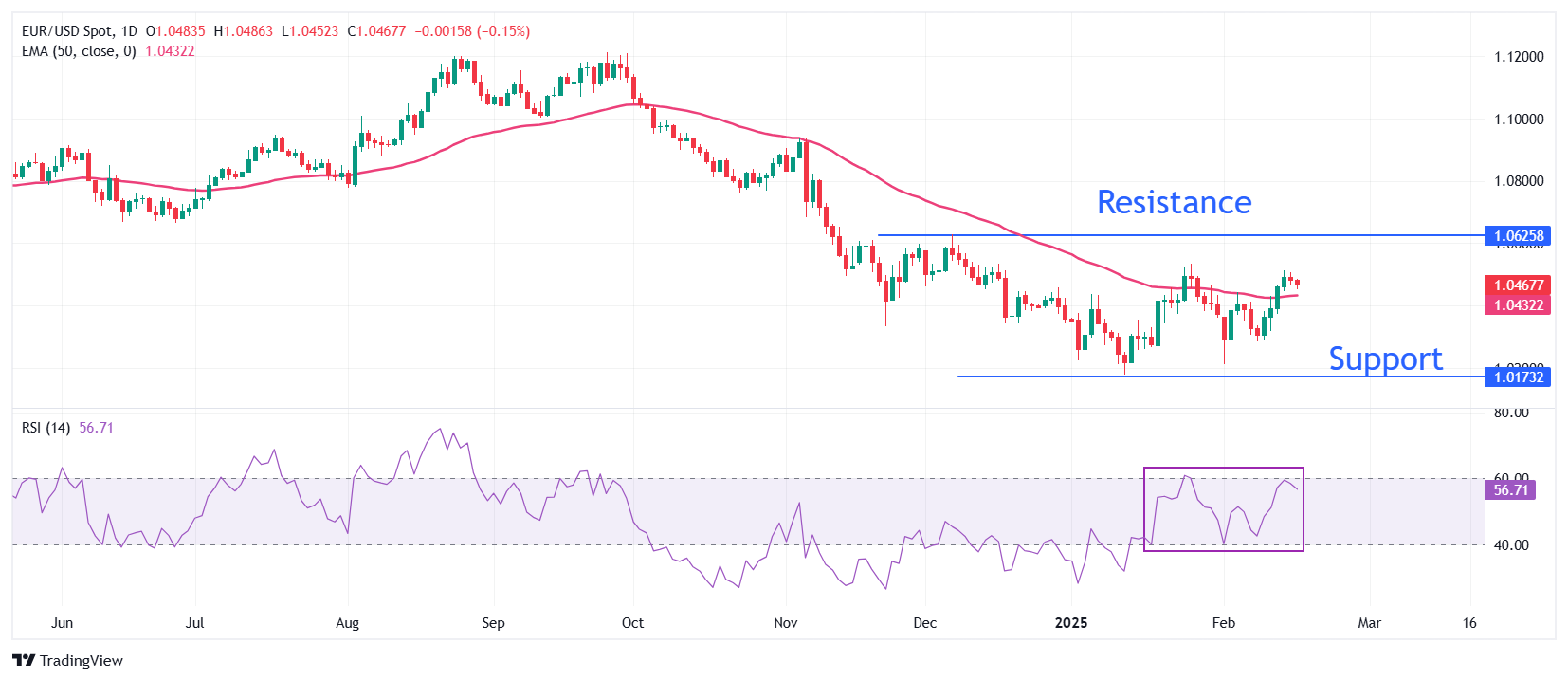
EUR/USD falls after facing resistance near the psychological hurdle of 1.0500. However, the outlook for the major currency pair is still bullish as it holds above the 50-day Exponential Moving Average (EMA), which stands at around 1.0430.
The 14-day Relative Strength Index (RSI) struggles to break above 60.00. A bullish momentum would activate if the RSI (14) manages to sustain above that level.
Looking down, the February 10 low of 1.0285 will act as the major support zone for the pair. Conversely, the December 6 high of 1.0630 will be the key barrier for the Euro bulls.
Author

Sagar Dua
FXStreet
Sagar Dua is associated with the financial markets from his college days. Along with pursuing post-graduation in Commerce in 2014, he started his markets training with chart analysis.