EUR/USD rebounds strongly as investors ignore Trump tariff fears
- EUR/USD bounces back above 1.0500 as the US Dollar falls back.
- Trump put proposes tariffs for Colombia on hold as the nation accepts Trump's terms.
- Investors will keenly focus on the Fed’s and the ECB’s policy meetings later this week.

EUR/USD resumes its upside journey and rebounds to near the six-week high of 1.0520 in Monday’s North American session. The major currency pair gains as the US Dollar (USD) surrenders its intraday gains that were inspired by fears of United States (US) President Donald Trump's tariffs on Colombia and turn negative. The US Dollar Index (DXY), which tracks the Greenback’s value against six major currencies, turns negative and slides to near 107.00.
On the weekend, Trump proposed 25% tariffs on its South American trading partner Colombia after the country refused to accept military flights carrying deportees from the US. However, the White House later reported that the Colombian government agreed to “Trump’s terms of accepting illegal immigrants,” and Trump’s proposed tariffs were “now on hold,” the Associated Press (AP) reported.
Meanwhile, the market sentiment is poised to remain cautious, with investors awaiting interest rate decisions from the Federal Reserve (Fed) and the European Central Bank (ECB) on Wednesday and Thursday, respectively.
According to the CME FedWatch tool, the Fed is certain to keep interest rates unchanged in the range of 4.25%-4.50%. Investors will pay close attention to Fed Chair Jerome Powell’s press conference to determine whether policymakers are comfortable with Trump’s call for immediate rate cuts.
On the US economic front, investors will focus this week on the Durable Goods Orders and the Personal Consumer Expenditure Price Index (PCE) data for December and the preliminary Q4 Gross Domestic Product (GDP) data.
US Dollar PRICE Today
The table below shows the percentage change of US Dollar (USD) against listed major currencies today. US Dollar was the strongest against the Australian Dollar.
| USD | EUR | GBP | JPY | CAD | AUD | NZD | CHF | |
|---|---|---|---|---|---|---|---|---|
| USD | -0.24% | -0.24% | -0.97% | -0.12% | 0.23% | 0.15% | -0.78% | |
| EUR | 0.24% | 0.08% | -0.57% | 0.26% | 0.48% | 0.51% | -0.43% | |
| GBP | 0.24% | -0.08% | -0.95% | 0.18% | 0.40% | 0.45% | -0.51% | |
| JPY | 0.97% | 0.57% | 0.95% | 0.86% | 1.35% | 1.33% | 0.31% | |
| CAD | 0.12% | -0.26% | -0.18% | -0.86% | 0.15% | 0.27% | -0.69% | |
| AUD | -0.23% | -0.48% | -0.40% | -1.35% | -0.15% | 0.07% | -0.86% | |
| NZD | -0.15% | -0.51% | -0.45% | -1.33% | -0.27% | -0.07% | -1.17% | |
| CHF | 0.78% | 0.43% | 0.51% | -0.31% | 0.69% | 0.86% | 1.17% |
The heat map shows percentage changes of major currencies against each other. The base currency is picked from the left column, while the quote currency is picked from the top row. For example, if you pick the US Dollar from the left column and move along the horizontal line to the Japanese Yen, the percentage change displayed in the box will represent USD (base)/JPY (quote).
Daily digest market movers: EUR/USD rebounds while trades await Fed-ECB policy decisions
- The recovery move in the EUR/USD pair is driven by a resumption in the downside move in the US Dollar. Meanwhile, the Euro (EUR) edges higher ahead of the ECB’s monetary policy decision. The ECB is widely anticipated to reduce its Deposit Facility rate by 25 basis points (bps) to 2.75%, with the Main Refinancing Operations Rate sliding to 2.9%. This would be the fourth interest rate cut by the ECB in a row.
- Traders are confident that the ECB will cut interest rates on Thursday, as Eurozone inflation has remained under control and growth prospects remain sluggish. Market participants will focus on ECB President Christine Lagarde’s press conference for fresh guidance on interest rates and how the central bank will counter the consequences of Trump’s tariffs on the Eurozone. Meanwhile, investors have also priced in three more interest rate cuts this year, coming in the remaining three meetings in the first half of the year.
- On the economic front, the German IFO Business Climate Index surprisingly accelerated to 85.1 in January from 84.7 in December, while it was expected to have dropped marginally to 84.6. In the same period, the Current Economic Assessment Index came in higher at 86.1, compared to 85.1 in December and the estimates of 85.4. Meanwhile, the IFO Expectations Index, which reflects firms’ expectations for the next six months, decelerated at a slower-than-expected pace to 84.2 from 84.4 in December. Economists expected the index to come in at 84.0.
- This week, investors will also focus on preliminary Eurozone Q4 GDP data, which will be released on Thursday. Economists expect the shared bloc to have grown by 1% compared to the same quarter last year. In the previous quarter, the economy expanded by 0.9%.
Technical Analysis: EUR/USD aims to sustain above 50-day EMA
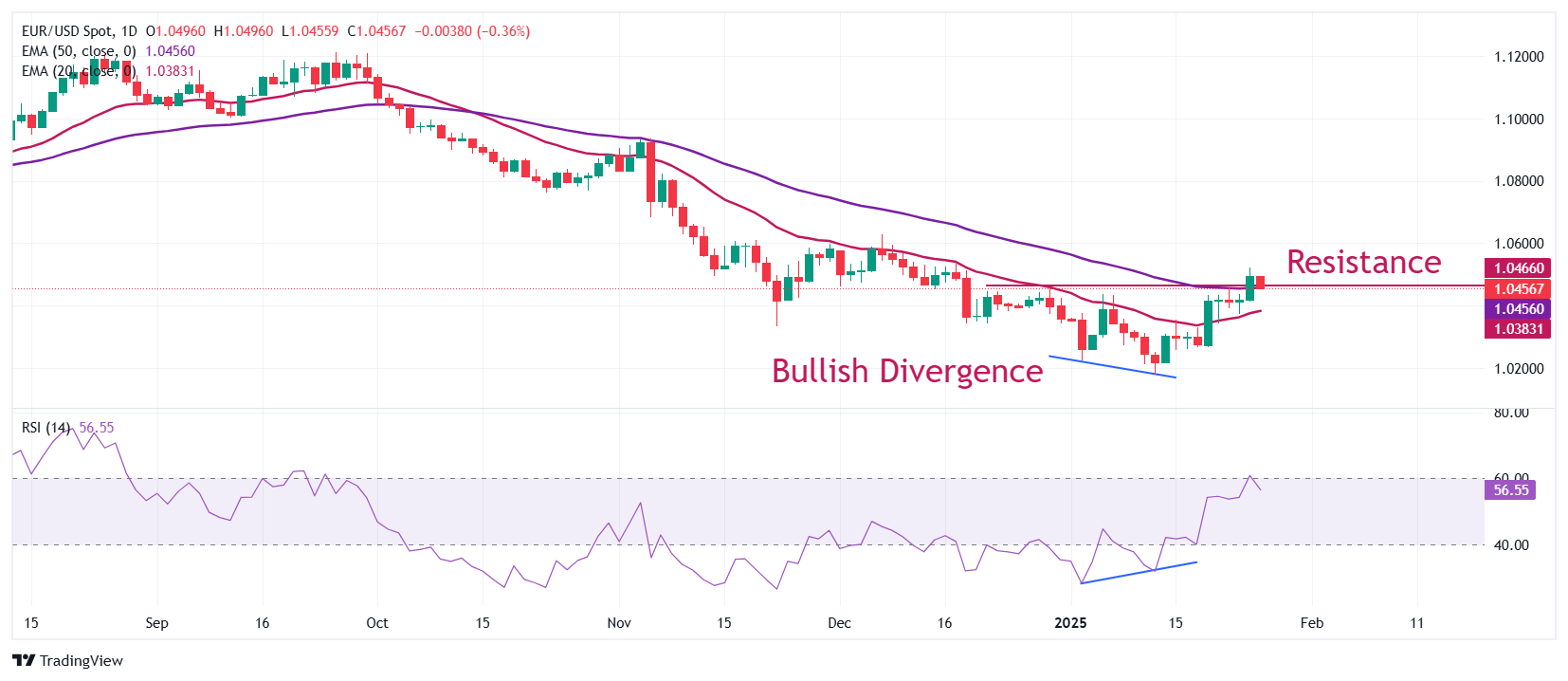
EUR/USD falls to near 1.0450 on Monday after posting a fresh monthly high near 1.0520 on Friday. The major currency pair wobbles around the 50-day Exponential Moving Average (EMA), which trades near 1.0460. The near-term outlook of the pair remains firm as it holds the 20-day EMA, which trades around 1.0383.
The pair entered a bullish reversal after breaking the January 6 high of 1.0437, which confirmed a divergence between the asset’s price and the 14-day Relative Strength Index (RSI). On January 13, the RSI formed a higher low, while the pair made lower lows.
Looking down, the January 20 low of 1.0266 will be the key support zone for the pair. Conversely, the December 6 high of 1.0630 will be the key barrier for the Euro bulls.
Economic Indicator
Fed Interest Rate Decision
The Federal Reserve (Fed) deliberates on monetary policy and makes a decision on interest rates at eight pre-scheduled meetings per year. It has two mandates: to keep inflation at 2%, and to maintain full employment. Its main tool for achieving this is by setting interest rates – both at which it lends to banks and banks lend to each other. If it decides to hike rates, the US Dollar (USD) tends to strengthen as it attracts more foreign capital inflows. If it cuts rates, it tends to weaken the USD as capital drains out to countries offering higher returns. If rates are left unchanged, attention turns to the tone of the Federal Open Market Committee (FOMC) statement, and whether it is hawkish (expectant of higher future interest rates), or dovish (expectant of lower future rates).
Read more.Next release: Wed Jan 29, 2025 19:00
Frequency: Irregular
Consensus: 4.5%
Previous: 4.5%
Source: Federal Reserve
Author

Sagar Dua
FXStreet
Sagar Dua is associated with the financial markets from his college days. Along with pursuing post-graduation in Commerce in 2014, he started his markets training with chart analysis.