EUR/USD continues to drift in technical consolidation range near 1.0900
- Euro rose on upbeat EU PMIs, fell after US PMIs beat expectations.
- ECB rate call due during Thursday market session, Friday to wrap up with US PCE inflation.
- EUR/USD gets hampered by 200-hour SMA.

EUR/USD rose to a near-term high above 1.0930 on Wednesday after European Purchasing Managers’ Index (PMI) figures surprised to the upside on the manufacturing component, while a broad forecast beat for US PMI data soured market sentiment and sent the EUR/USD lower as investors second-guessed the day’s momentum and pulled back into the safe-haven US Dollar (USD), albeit slightly.
HCOB PMIs for the pan-European economy mixed on Wednesday as investors chose to focus on the PMI Manufacturing component which rose to 46.6 in January, above the forecast increase to 44.8 from December’s 44.4. The Services component of the PMI declined to 48.4 from the previous 48.8, entirely missing the forecast uptick into 49.0.
US: Flash PMIs surprise to the upside in January
The Euro (EUR) rallied against the USD after investors took upbeat manufacturing figures to heart despite the PMI still printing in contractionary territory below the 50.0 level, a barrier the EU Manufacturing PMI has not printed above in almost two years.
The US S&P Global PMIs broadly came in above expectations as the US economy continues to outperform forecast models. January’s Manufacturing PMI climbed to an 11-month high of 50.3, returning to growth territory above 50.0 for the second time in four months and easily clearing the forecast steady print at 47.9 in December.
The US Services PMI component also climbed above expectations, printing at 52.9 versus the forecast backslide from 51.4 to 51.0. With US PMIs cleanly beating the street, investors are getting knocked back once again from rate cut hopes as a firming US economy makes the Federal Reserve (Fed) less likely to panic and begin cutting rates earlier than expected. Market-wide bets of a March rate cut from the Fed are now below 40% according to the CME’s FedWatch tool, down from around 80% just a month ago.
ECB Preview: Forecasts from 12 major banks
Thursday brings another rate call and monetary policy statement from the European Central Bank (ECB), and markets will be keeping a close eye on the extend of the ECB’s hawkish or dovish stance after ECB policymarkers worked double duty in recent days to talk down market hopes for an early rate cut before the summer months.
The trading week will cap things off with another print of the US’ Personal Consumption Expenditure (PCE) Price Index on Friday, which is expected to tick upwards MoM in December from 0.1% to 0.2%, and the annualized figure is seen ticking down from 0.1% to 0.2%.
EUR/USD Technical Outlook
The EUR/USD saw a sharp rejection after climbing through the 200-hour Simple Moving Average (SMA) near 1.0895, peaking at a near-term intraday high above 1.0930 before getting forced back down and settling Wednesday near the familiar 1.0880 level.
The EUR/USD is trading into a heavy congestion zone between the 50-day and 200-day SMAs near 1.0925 and 1.0850 respectively, and the pair is set to continue grinding out near-term consolidation between the two key technical barriers.
EUR/USD Hourly Chart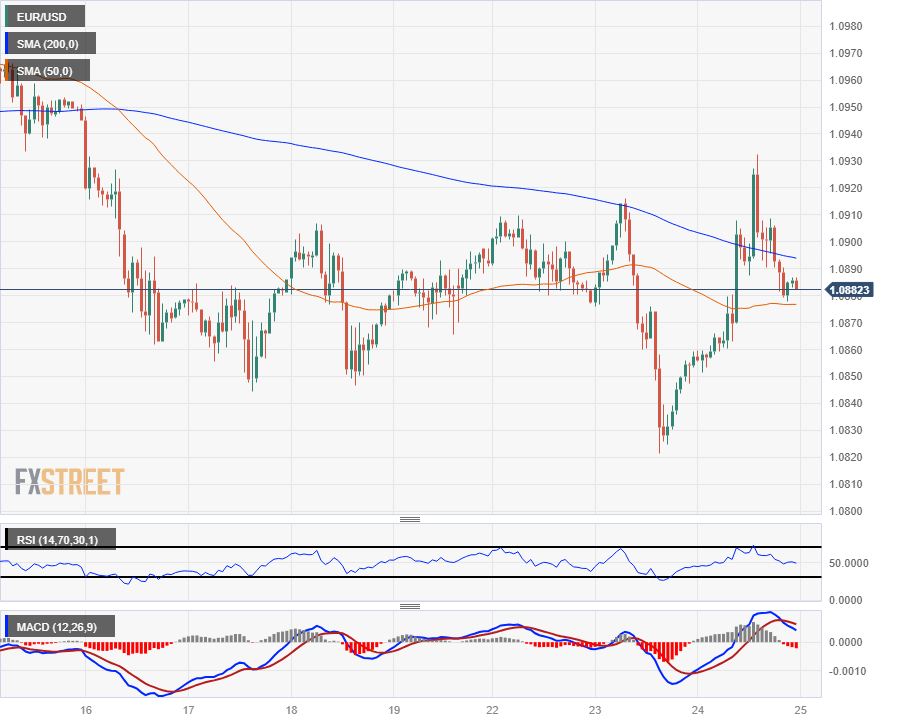
EUR/USD Daily Chart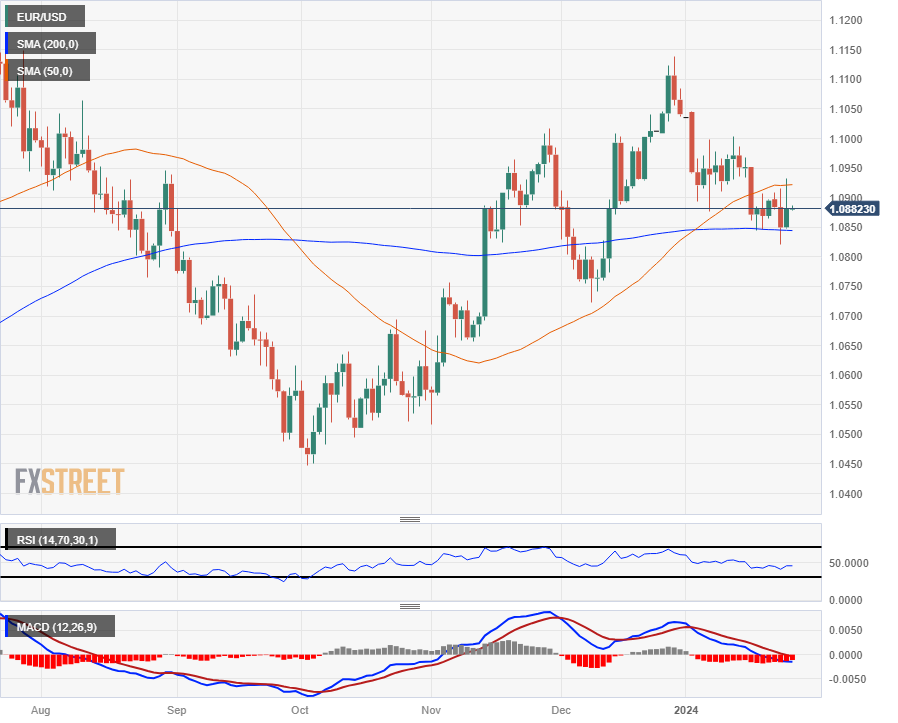
Author

Joshua Gibson
FXStreet
Joshua joins the FXStreet team as an Economics and Finance double major from Vancouver Island University with twelve years' experience as an independent trader focusing on technical analysis.