EUR/USD rallies remain limites amid France's political woes
- The Euro appreciates amid a softer US Dollar, but with upside attempts limited so far.
- Market concerns about political turmoil in France are weighing on the Euro.
- The US Dollar tumbled on Friday as US Nonfarm Payrolls data confirmed the labour market's deterioration.

The EUR/USD pair is ticking higher, trading near 1.1730 at the European session opening on Monday. The common currency is drawing support from a weak US Dollar after the poor US Nonfarm Payrolls (NFP) report seen on Friday, although a highly likely collapse of the French Government keeps Euro bulls in check.
NFP confirmed the deterioration of the US labour market, with its weakest growth since 2021 and a higher Unemployment Rate. The data practically confirmed market expectations of an interest rate cut at next week's Federal Reserve (Fed) meeting and brought the possibility of a 50 basis points cut back to the table. The US Dollar tumbled following the release.
The Euro, however, is seeing its own troubles on Monday, as France's Prime Minister Francoise Bayrou is facing a confidence vote, doomed to failure, later on the day. France's long-term yields are pulling back from last week's multi-year highs, but investors' concerns about political turmoil in the Euro area's second-largest economy pose a significant threat to the currency.
On the macroeconomic data front, the Eurozone Sentix revealed that investors' confidence deteriorated further, amid concerns of the economic impact of Trump's tariffs. Earlier in the day, German Industrial Production figures bounced up as expected, but the softer trade surplus dampened investors' enthusiasm.
Euro Price Today
The table below shows the percentage change of Euro (EUR) against listed major currencies today. Euro was the strongest against the US Dollar.
| USD | EUR | GBP | JPY | CAD | AUD | NZD | CHF | |
|---|---|---|---|---|---|---|---|---|
| USD | -0.11% | -0.10% | -0.30% | -0.15% | -0.49% | -0.58% | -0.33% | |
| EUR | 0.11% | -0.00% | -0.09% | -0.05% | -0.36% | -0.42% | -0.22% | |
| GBP | 0.10% | 0.00% | -0.18% | -0.05% | -0.36% | -0.43% | -0.21% | |
| JPY | 0.30% | 0.09% | 0.18% | 0.05% | -0.24% | -0.45% | -0.03% | |
| CAD | 0.15% | 0.05% | 0.05% | -0.05% | -0.24% | -0.37% | -0.18% | |
| AUD | 0.49% | 0.36% | 0.36% | 0.24% | 0.24% | -0.06% | 0.15% | |
| NZD | 0.58% | 0.42% | 0.43% | 0.45% | 0.37% | 0.06% | 0.21% | |
| CHF | 0.33% | 0.22% | 0.21% | 0.03% | 0.18% | -0.15% | -0.21% |
The heat map shows percentage changes of major currencies against each other. The base currency is picked from the left column, while the quote currency is picked from the top row. For example, if you pick the Euro from the left column and move along the horizontal line to the US Dollar, the percentage change displayed in the box will represent EUR (base)/USD (quote).
Daily digest market movers: Hopes of Fed rate cuts keep the US Dollar under pressure
- US Nonfarm Payrolls showed a mere 22K increase in August, well below the 75K expected. July's data was revised to 79K from the previously estimated 73K, but June's reading was revised down to -13K, the first net loss in employment since the pandemic era. Furthermore, the Unemployment Rate ticked up to 4.3%. All in all, the sort of data that confirms a Fed rate cut next week.
- Futures markets are fully pricing an interest rate cut after the Fed meeting on September 16-17, with chances of a 50 basis points cut increasing to 8% from 0% before the NFP release, according to data by the CME Group's FedWatch tool.
- The negative impact on the US Dollar, however, is being offset by the political crises in Japan and in France, which are weighing heavily on the Japanese Yen and the Euro, respectively.
- French Prime Minister Francoise Bayrou is facing a confidence vote on a set of harsh cuts on public spending, which the main opposition parties have already rejected. This will leave one of the Euro area's leading economies in a standstill, and likely bring back eurosceptic rhetoric by right and left-wing parties, hurting confidence in the currency.
- In Monday's economic calendar, the Sentix Investors' Confidence dropped to -9.2, its weakest reading since April, from -3.7 in August. The report reflects increasing concerns about the outlook of the exports-oriented industry on the back of the trade deal with the US
- Earlier on Monday, German Industrial Production bounced up 1.3% in July following a 0.1% contraction in June, in line with the market expectations. The impact of those figures, however, was offset by a narrower-than-expected trade surplus, at EUR 14.7 billion against market expectations of a EUR 15.4 billion figure. Both imports and exports fell unexpectedly in July, adding to the case of a weak economic outlook for the region's leading economy.
Technical Analysis: EUR/USD is at a key resistance in the 1.1740 area
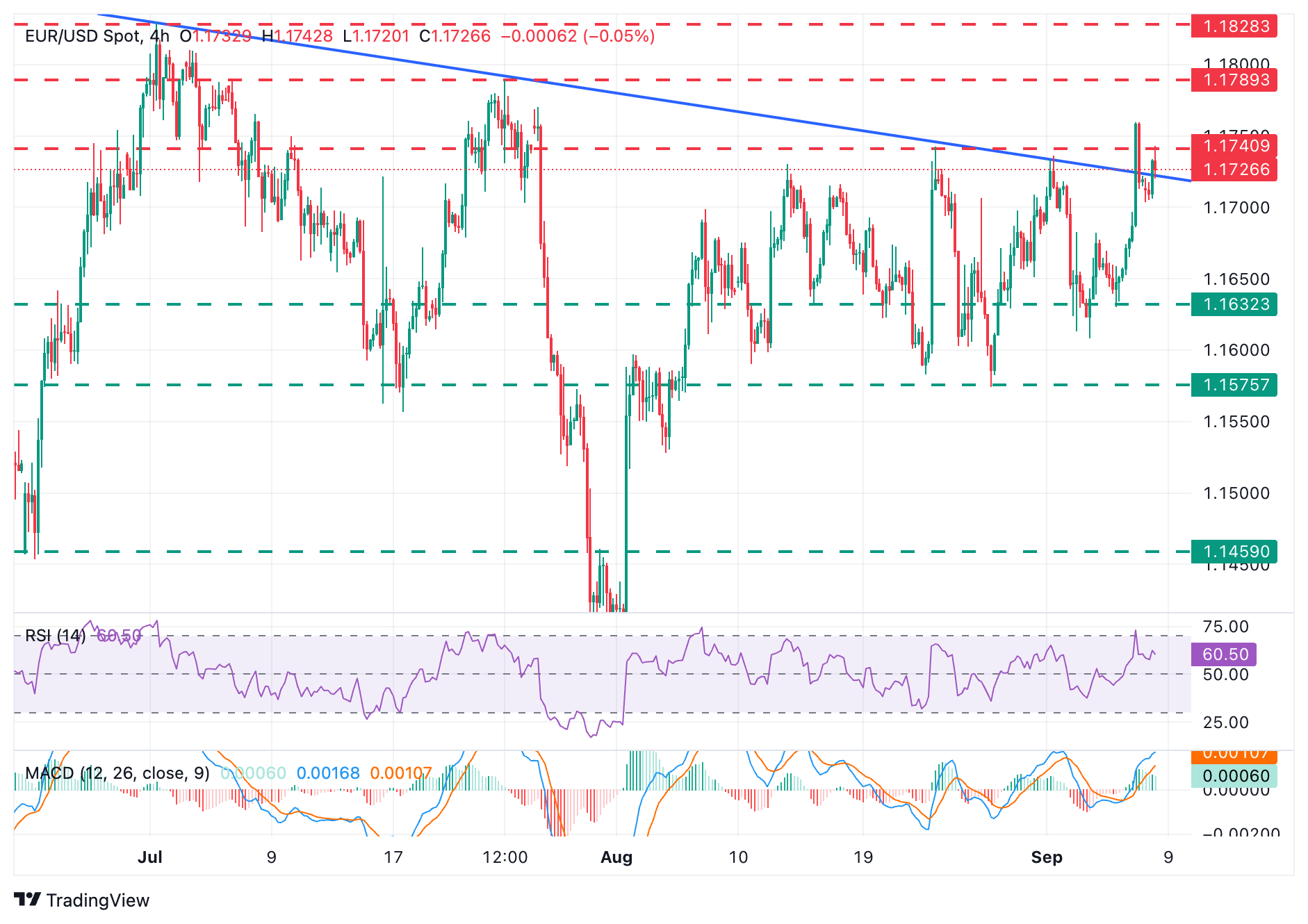
EUR/USD is showing an improved technical picture. The 4-hour RSI is within bullish territory at 59, and so is the MACD, but the resistance area between 1.1720 and 1.1740 might be a tough nut to crack.
The pair is now testing the trendline resistance from July 1 highs at 1.1830. Above here, the 1.1740 area, which broadly encloses the highs of August 13 and 22, and September 1, is likely to challenge bulls ahead of Friday's 1.1560 high.
Immediate support is at the intraday low, right above the 1.1700 round number. Further down, the September 4 low, at the 1.1630 area, might cap downside attempts ahead of the zone between 1.1575 and 1.1590, which held bears on August 11, 22, and 27.
Euro FAQs
The Euro is the currency for the 19 European Union countries that belong to the Eurozone. It is the second most heavily traded currency in the world behind the US Dollar. In 2022, it accounted for 31% of all foreign exchange transactions, with an average daily turnover of over $2.2 trillion a day. EUR/USD is the most heavily traded currency pair in the world, accounting for an estimated 30% off all transactions, followed by EUR/JPY (4%), EUR/GBP (3%) and EUR/AUD (2%).
The European Central Bank (ECB) in Frankfurt, Germany, is the reserve bank for the Eurozone. The ECB sets interest rates and manages monetary policy. The ECB’s primary mandate is to maintain price stability, which means either controlling inflation or stimulating growth. Its primary tool is the raising or lowering of interest rates. Relatively high interest rates – or the expectation of higher rates – will usually benefit the Euro and vice versa. The ECB Governing Council makes monetary policy decisions at meetings held eight times a year. Decisions are made by heads of the Eurozone national banks and six permanent members, including the President of the ECB, Christine Lagarde.
Eurozone inflation data, measured by the Harmonized Index of Consumer Prices (HICP), is an important econometric for the Euro. If inflation rises more than expected, especially if above the ECB’s 2% target, it obliges the ECB to raise interest rates to bring it back under control. Relatively high interest rates compared to its counterparts will usually benefit the Euro, as it makes the region more attractive as a place for global investors to park their money.
Data releases gauge the health of the economy and can impact on the Euro. Indicators such as GDP, Manufacturing and Services PMIs, employment, and consumer sentiment surveys can all influence the direction of the single currency. A strong economy is good for the Euro. Not only does it attract more foreign investment but it may encourage the ECB to put up interest rates, which will directly strengthen the Euro. Otherwise, if economic data is weak, the Euro is likely to fall. Economic data for the four largest economies in the euro area (Germany, France, Italy and Spain) are especially significant, as they account for 75% of the Eurozone’s economy.
Another significant data release for the Euro is the Trade Balance. This indicator measures the difference between what a country earns from its exports and what it spends on imports over a given period. If a country produces highly sought after exports then its currency will gain in value purely from the extra demand created from foreign buyers seeking to purchase these goods. Therefore, a positive net Trade Balance strengthens a currency and vice versa for a negative balance.
Author

Guillermo Alcala
FXStreet
Graduated in Communication Sciences at the Universidad del Pais Vasco and Universiteit van Amsterdam, Guillermo has been working as financial news editor and copywriter in diverse Forex-related firms, like FXStreet and Kantox.