EUR/USD gains as Powell lacks confidence in US job growth momentum
- EUR/USD holds gains in a tight range above 1.0800 due to multiple tailwinds.
- Fed Powell’s caution on the US labor market pushes the US Dollar on the backfoot.
- The Euro gains as the far right’s defeat eases upside risks to widening French financial crisis.

EUR/USD turns sideways around 1.0800 in Wednesday’s American session after a modest corrective move from an almost four-week high of 1.0850. The major currency pair shifts to the sidelines as investors await the United States (US) Consumer Price Index (CPI) data for June, which will be published on Thursday.
Economists expect that core inflation, which excludes volatile food and energy items, grew steadily by 0.2% and 3.4% on a monthly and annual basis, respectively, in June. Annual headline inflation is estimated to have decelerated to 3.1% from May’s reading of 3.3%, while the monthly figure is expected to have grown by 0.1% after remaining unchanged previously.
The inflation data will provide cues as to whether current expectations that the Federal Reserve (Fed) will start reducing interest rates from the September meeting are appropriate.
Meanwhile, Fed Chair Jerome Powell signaled in his commentaries at the semi-annual Congressional testimony on Tuesday that rate cuts are not appropriate until policymakers gain significant confidence that inflation is on course to return to the desired rate of 2%.
However, Powell warned about easing US economic strength as the labor market loses momentum. Powell said "Labor market conditions have cooled considerably compared to where they were two years ago," and added that the US “is no longer an overheated economy.”
Daily digest market movers: EUR/USD rises as Far Right fails to gain majority
- EUR/USD holds onto gains above 1.0800, inspired by a weak US Dollar (USD) and a decent recovery in the Euro, as the Marine Le Pen-led far-right National Rally fails to gain an absolute majority in French elections. The US Dollar Index (DXY), which tracks the Greenback’s value against six major currencies, faces pressure to extend recovery above 105.20.
- The far-right misses an outright majority despite leading in the first round, resulting in diminished fears of a widening French financial crisis. However, uncertainty about fiscal adjustments and the distribution of ministries remains high as the economy will be administered by a coalition government. Economists expect French President Emmanuel Macron's centrist alliance will join hands with the left wing, also known as the New Popular Front, led by Jean-Luc Mélenchon.
- Meanwhile, sliding expectations of subsequent rate cuts by the European Central Bank (ECB) keep the Euro on the front foot. ECB policymakers continue to refrain from committing to a pre-defined rate-cut path, with fears that an aggressive policy expansionary stance could reverse the disinflation process.
- On Tuesday, ECB governing council member and Governor of the Bank of Italy Fabio Panetta said the central bank could gradually reduce interest rates without any hiatus to slowing inflationary pressures. Panetta added that policy tightening done in the past is still impacting demand, output, and inflation.
Technical Analysis: EUR/USD trades inside Symmetrical Triangle formation
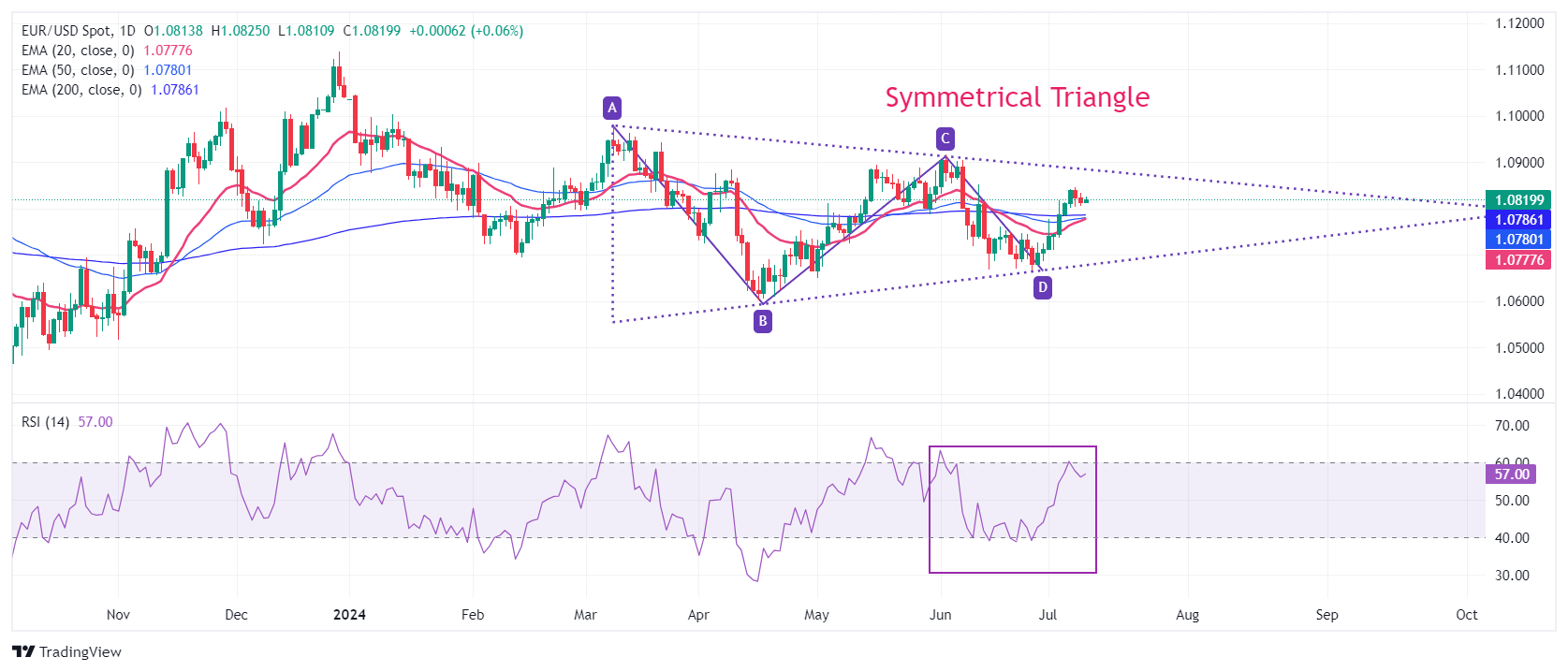
EUR/USD trades in a tight range slightly above the round-level support of 1.0800 as investors stay on the sidelines ahead of the US CPI report for June. The major currency pair stabilizes above the 20-day and 50-day Exponential Moving Averages (EMAs), which trade around 1.0750 and 1.0770, respectively. The overall trend of the shared currency pair has also strengthened as it has jumped above the 200-day EMA, which trades around 1.0800.
A Symmetrical Triangle formation on the daily timeframe exhibits a sharp volatility contraction, which indicates low volume and narrow ticks.
The 14-day Relative Strength Index (RSI) reaches 60.00. Should the bullish momentum be triggered if it breaks above 60.00?
Economic Indicator
Consumer Price Index (YoY)
Inflationary or deflationary tendencies are measured by periodically summing the prices of a basket of representative goods and services and presenting the data as The Consumer Price Index (CPI). CPI data is compiled on a monthly basis and released by the US Department of Labor Statistics. The YoY reading compares the prices of goods in the reference month to the same month a year earlier.The CPI is a key indicator to measure inflation and changes in purchasing trends. Generally speaking, a high reading is seen as bullish for the US Dollar (USD), while a low reading is seen as bearish.
Read more.Next release: Thu Jul 11, 2024 12:30
Frequency: Monthly
Consensus: 3.1%
Previous: 3.3%
Source: US Bureau of Labor Statistics
The US Federal Reserve has a dual mandate of maintaining price stability and maximum employment. According to such mandate, inflation should be at around 2% YoY and has become the weakest pillar of the central bank’s directive ever since the world suffered a pandemic, which extends to these days. Price pressures keep rising amid supply-chain issues and bottlenecks, with the Consumer Price Index (CPI) hanging at multi-decade highs. The Fed has already taken measures to tame inflation and is expected to maintain an aggressive stance in the foreseeable future.
Author

Sagar Dua
FXStreet
Sagar Dua is associated with the financial markets from his college days. Along with pursuing post-graduation in Commerce in 2014, he started his markets training with chart analysis.















