EUR/USD climbs towards 1.0765 four-week highs but fails to reclaim the 50-DMA, retraces to 1.0730s
- The shared currency is about to finish the week with 1.66%.
- US Core PCE rose by 4.9% YoY, lower than March’s 5.1% reading; will the Fed diminish the speed of rate hikes?
- EUR/USD Price Forecast: Its long-term bias remains bearish, but a rally towards 1.0800 in the near term is on the cards.

The EUR/USD reached a fresh four-week high, around 1.0765, but in the last hour, retreated some 30 pips, as the New York session wanes, on an upbeat trading session, courtesy of positive US data. At 1.0735, the EUR/USD is set to record weekly gains of 1.66% amidst a week full of ECB officials’ hawkish commentary and mixed US economic data.
US inflation eases some, and further ECB hawkish commentary lifts the EUR/USD
On Friday, the US Commerce Department unveiled inflation figures for the country. The Fed’s favorite gauge, the Core PCE for April, increased by 4.9% YoY, aligned with forecasts but lower than the March reading. That easied investors’ worries regarding an aggressive US central bank, with some of its members, like St. Louis Fed President James Bullard, expecting rates to finish in the 3.25-3.50% range.
In fact, during the week, Atlanta’s Fed President Raphael Bostic, usually a hawk, commented that once the Fed is done with 50 bps increases in the June and July meeting, it might pause as they assess the economy’s reaction.
In the meantime, the EUR/USD jumped on the release, towards 1.0750, though retraced the move, dipping towards 1.0700. However, in the middle of the North American session, the EUR/USD recovered some ground and settled above April’s 2020 lows of 1.0727.
Meanwhile, during the European session, the Bundesbank President and ECB member Joachim Nagel said that he believes the first-rate raise move should come in July, with more to follow in the second half of 2022. He added that inflation would not fall overnight, and it could take some time.
Next week, the Eurozone macroeconomic docket will feature Headline Inflation for Germany and the Euro area. Both headline figures are expected to rise to new highs, but core EU inflation is foreseen to fall to 3.4%. Another event triggering EUR/USD traders’ reaction would be the EU Council Meeting.
On the US front, the docket will reveal the May ISM Manufacturing and the Business related PMIs, Fed speakers, and employment data on the US front.
EUR/USD Price Forecast: Technical outlook
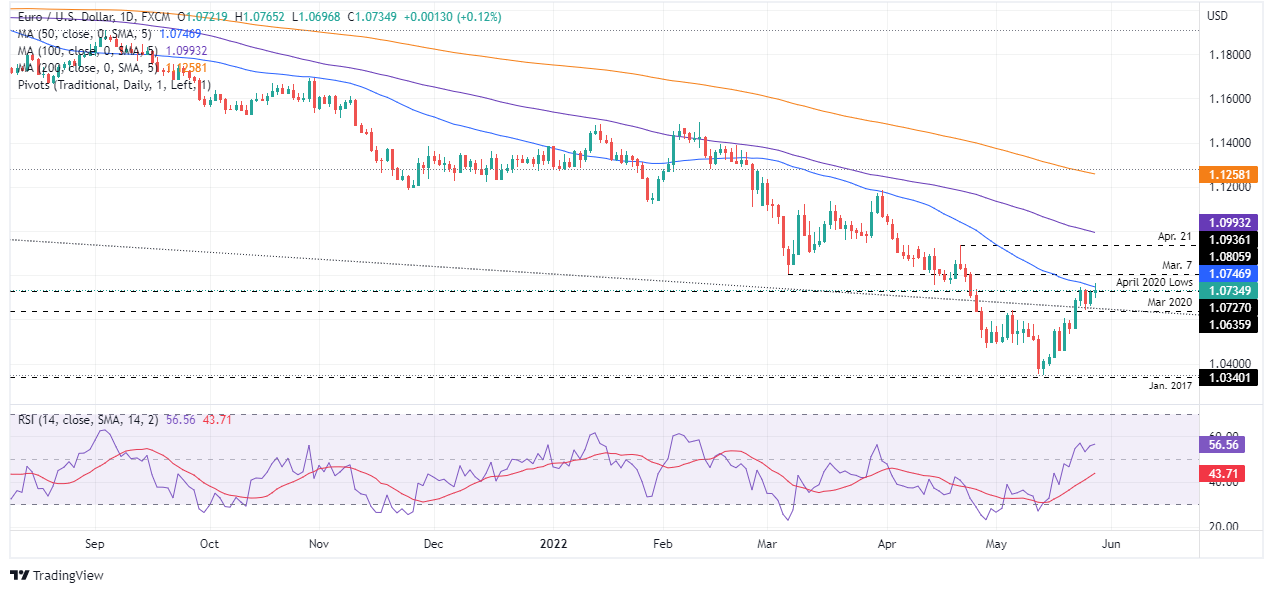
The EUR/USD advanced in the day and pierced the 50-day moving average (DMA) at 1.0746, pushing towards 1.0765 (new weekly highs). However, EUR/USD bulls’ failure to sustain the rally dragged spot prices below the abovementioned. However, they could remain hopeful as the Relative Strength Index (RSI) at 56 persists in bullish territory, aiming higher.
That said, the EUR/USD’s first resistance would be the 50-DMA. A break above would expose the March 7 low-turned-resistance at 1.0805, followed by April’s 21 high at 1.0936.
Author

Christian Borjon Valencia
FXStreet
Markets analyst, news editor, and trading instructor with over 14 years of experience across FX, commodities, US equity indices, and global macro markets.