EUR/USD declines as US Dollar strengthens after strong US PMI data
- EUR/USD slides below 1.1300 as the flash Eurozone PMI data surprisingly contracted, and the US business activity expanded in May.
- US President Trump warns that Russia could avoid ending the war in Ukraine.
- ECB’s Nagel is hopeful of an EU-US trade deal.

EUR/USD is down 0.4% to near 1.1280 during North American trading hours on Thursday. The major currency pair slides as the US Dollar (USD) attracts bids after the release of the upbeat preliminary United States (US) S&P Global PMI data for May. The report showed that the Composite PMI expanded at a faster pace to 52.1 from 50.6 in April. A significant increase in the Composite PMI came from growth in activities in both the manufacturing and the services sectors.
Both Manufacturing and the Service PMI grew at a faster pace to 52.3. The report showed that prices paid for inputs, new business, and inventory levels rose at a robust pace in the manufacturing sector. Higher import prices forced suppliers to pass through tariff-related costs. Such a scenario would allow Federal Reserve (Fed) officials to maintain a "wait and see" approach on the monetary policy outlook.
During early North American trading hours, Fed Governor Christopher Waller stated in an interview with Fox Business that "tariffs will cause a one-time increase in prices". Waller guided that the Fed could be in a position to "cut in the later part of the year, if tariffs settle down".
Earlier in the day, the US Dollar underperformed amid fears of a widening US fiscal crisis. During European trading hours, the House of Representatives passed US President Donald Trump’s new tax bill narrowly and advanced it to the Senate, where it needed a simple majority for passage.
According to the nonpartisan Congressional Budget Office, Trump’s tax-cut bill would increase the US debt by $3.8 trillion over the decade, which is currently $36.2 trillion. On Friday, Moody’s downgraded the US Sovereign Credit rating to Aa1 from Aaa, citing concerns over large debt, which led to a sharp increase in borrowing costs for the administration.
Daily digest market movers: EUR/USD drops amid uncertainty over Russia-Ukraine tensions
- The downside move in the EUR/USD pair is mainly driven by the Euro's (EUR) underperformance after the release of the surprisingly weak preliminary Eurozone HCOB Purchasing Managers’ Index (PMI) data for May. The report showed that the Composite PMI fell to 49.5 from 50.4 in April, suggesting that the overall business activity declined. A figure below the 50.0 threshold is seen as a contraction in business activities.
- According to the PMI report, activities in the services sector contracted unexpectedly for the first time since November 2024, while the Manufacturing PMI contracted at a slower-than-expected pace. Signs of business activity contraction are unfavorable for the Euro.
- Additionally, uncertainty over the outcome of the Russia-Ukraine ceasefire talks in Vatican City has also weighed on the Euro. On Wednesday, United States (US) President Donald Trump ruled out hopes of a ceasefire after stating in a private conference call with European leaders that Russian leader Vladimir Putin isn’t ready to end the war because he thinks he is winning, the Wall Street Journal (WSJ) reported. Diminishing hopes of a truce between Russia and Ukraine could keep the Euro on the backfoot.
- There is a notable shift in US President Trump’s stance on war in Ukraine from what he stated in a post on Truth.Social earlier this week, that both nations have agreed to immediate truce talks, and expressed confidence that both countries will focus on ending the war in Ukraine. However, Trump didn’t provide a timeframe for truce talks.
- Another reason behind the pressure on the Euro is the firm expectation that the European Central Bank (ECB) will cut interest rates again in the June policy meeting. ECB officials have signaled the need for further monetary policy expansion to offset downside risks to Eurozone inflation. "In order to be able to keep inflation at the target of 2%, [the ECB] may have to come below the natural rate in the range of 1.5% to 2%, ECB Governing Council member and Governor of the Bank of Portugal Mario Centeno said on Wednesday.
- On the global front, Bundesbank’s President Joachim Nagel has expressed confidence over progress in trade talks with the US, stating that Washington and Brussels have acknowledged that trade conflicts have no winners, on German Television at the sidelines of the G7 meeting in Canada, Reuters reported. "I also believe that the US side now understands some things better, and I am a little more confident than I perhaps was a few days ago,” Nagel said.
Euro PRICE Today
The table below shows the percentage change of Euro (EUR) against listed major currencies today. Euro was the weakest against the Japanese Yen.
| USD | EUR | GBP | JPY | CAD | AUD | NZD | CHF | |
|---|---|---|---|---|---|---|---|---|
| USD | 0.34% | 0.09% | -0.06% | 0.17% | 0.26% | 0.56% | 0.28% | |
| EUR | -0.34% | -0.25% | -0.39% | -0.17% | -0.08% | 0.22% | -0.07% | |
| GBP | -0.09% | 0.25% | -0.17% | 0.08% | 0.17% | 0.46% | 0.18% | |
| JPY | 0.06% | 0.39% | 0.17% | 0.21% | 0.33% | 0.59% | 0.31% | |
| CAD | -0.17% | 0.17% | -0.08% | -0.21% | 0.11% | 0.39% | 0.10% | |
| AUD | -0.26% | 0.08% | -0.17% | -0.33% | -0.11% | 0.29% | -0.01% | |
| NZD | -0.56% | -0.22% | -0.46% | -0.59% | -0.39% | -0.29% | -0.29% | |
| CHF | -0.28% | 0.07% | -0.18% | -0.31% | -0.10% | 0.00% | 0.29% |
The heat map shows percentage changes of major currencies against each other. The base currency is picked from the left column, while the quote currency is picked from the top row. For example, if you pick the Euro from the left column and move along the horizontal line to the US Dollar, the percentage change displayed in the box will represent EUR (base)/USD (quote).
Technical Analysis: EUR/USD skids below 1.1300
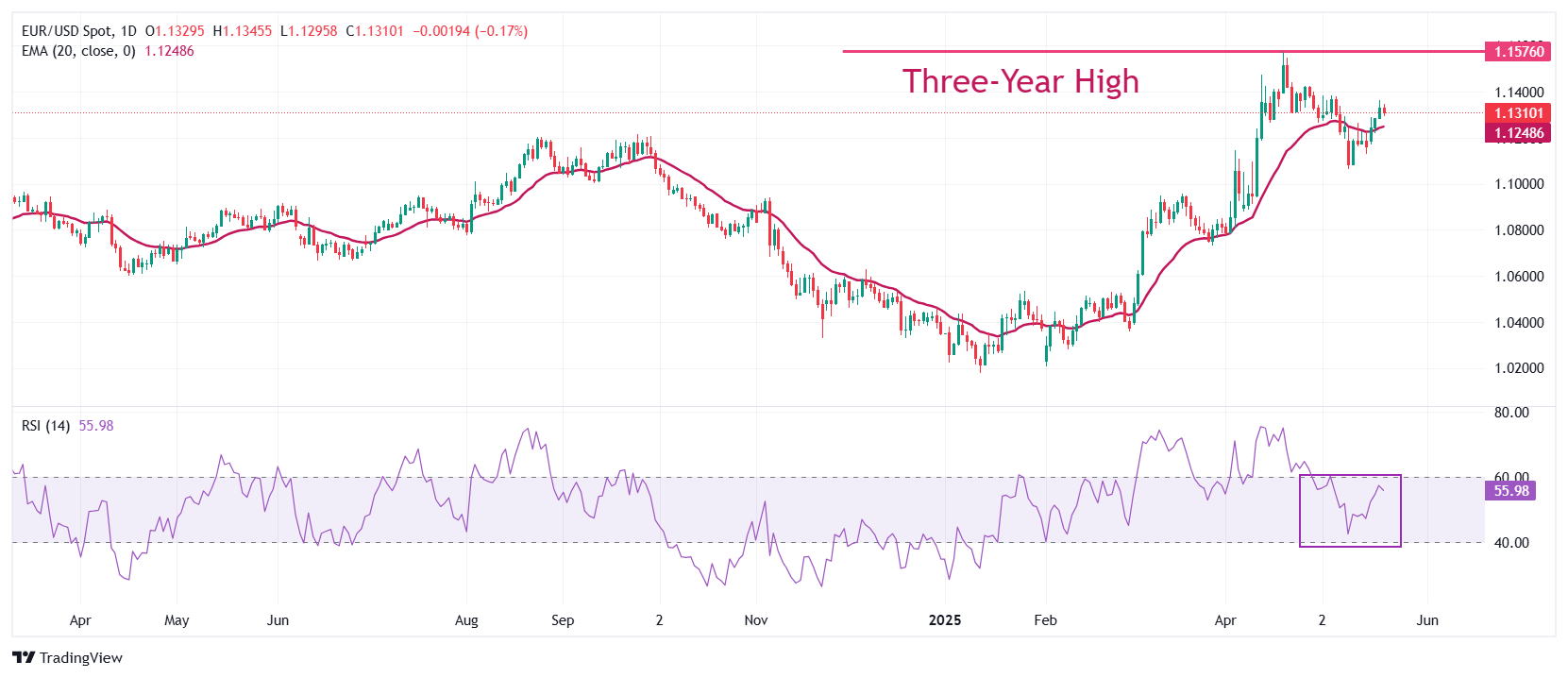
EUR/USD falls below 1.1300 on Thursday. However, the near-term outlook of the pair is bullish as it holds the 20-day Exponential Moving Average (EMA), which is around 1.1240.
The 14-period Relative Strength Index (RSI) oscillates inside the 40.00-60.00 range, suggesting indecisiveness among traders.
Looking up, the April 28 high of 1.1425 will be the major resistance for the pair. Conversely, the psychological level of 1.1000 will be a key support for the Euro bulls.
Economic Indicator
S&P Global Composite PMI
The S&P Global Composite Purchasing Managers Index (PMI), released on a monthly basis, is a leading indicator gauging US private-business activity in the manufacturing and services sector. The data is derived from surveys to senior executives. Each response is weighted according to the size of the company and its contribution to total manufacturing or services output accounted for by the sub-sector to which that company belongs. Survey responses reflect the change, if any, in the current month compared to the previous month and can anticipate changing trends in official data series such as Gross Domestic Product (GDP), industrial production, employment and inflation. The index varies between 0 and 100, with levels of 50.0 signaling no change over the previous month. A reading above 50 indicates that the private economy is generally expanding, a bullish sign for the US Dollar (USD). Meanwhile, a reading below 50 signals that activity is generally declining, which is seen as bearish for USD.
Read more.Last release: Thu May 22, 2025 13:45 (Prel)
Frequency: Monthly
Actual: 52.1
Consensus: -
Previous: 50.6
Source: S&P Global
Author

Sagar Dua
FXStreet
Sagar Dua is associated with the financial markets from his college days. Along with pursuing post-graduation in Commerce in 2014, he started his markets training with chart analysis.