EUR/USD slumps as US Dollar extends recovery after US Manufacturing PMI data
- EUR/USD slides below 1.1330 as the USD Index breaks above the key level of 100.00.
- The US Dollar gains sharply after the release of the US ISM Manufacturing PMI data.
- ECB officials have warned that risks to inflation are skewed to the downside.

EUR/USD falls sharply to near 1.1285 during North American trading hours on Thursday. The major currency pair declines as the US Dollar Index (DXY), which tracks the Greenback’s value against six major peers, extends its two-day recovery above the psychological level of 100.00.
The US Dollar (USD) attracts bids after the release of the United States (US) ISM Manufacturing Purchasing Managers' Index (PMI) data for April. The Manufacturing PMI landed at 48.7, higher than estimates of 48.0 but lower than the March reading of 49.0. The data indicates that activities in the manufacturing sector continues to decline faster than the pace seen in March but at a slower than expectations. A PMI reading below 50.0 is taken as contraction in business activity.
Meanwhile, prices for inputs remain elevated, with sub index Priced Paid expanding at a faster pace to 69.8 from the prior release of 69.4. The factory data clearly shows that burden of additional tariffs announced by US President Donald Trump on the so-called “Liberation Day”.
On Wednesday, the US Q1 Gross Domestic Product (GDP) data also showed that the economy declined by 0.3% on an annualized basis. This is the first time in three years that the US has faced an economic contraction in a quarter.
Analysts at Morgan Stanley stated that the current GDP data “doesn’t fully reflect the real impact of new economic policies” by US President Trump as firms frontloaded imports from their foreign suppliers to avoid higher tariffs, but warned of a “slower labor growth, a surge in inflation and a sharp slowdown in retail spending”.
Meanwhile, the uncertainty over US-China trade relations could dampen the US Dollar's recovery. The comments from White House officials have indicated that the US-China trade war will not be resolved in the near term. US Trade Representative Jamieson Greer stated in an interview with Fox News on Wednesday that trade discussions with Beijing have not been initiated yet since the imposition of reciprocal tariffs, the South China Morning Post (SCMP) reported. Greer clarified that no official discussions with Beijing are “underway”.
Daily digest market movers: EUR/USD weakens as US Dollar gains
- The downside move in the EUR/USD pair is also driven by slight selling pressure in the Euro (EUR) amid firming expectations that the European Central Bank (ECB) will cut interest rates in the June policy meeting. Traders have become increasingly confident that the ECB will reduce its Deposit Facility rate by 25 basis points (bps) to 2% as many officials have warned about downside risks to Eurozone inflation.
- ECB officials have expressed concerns that Eurozone inflation could undershoot the central bank’s target of 2%. Policymakers believe that growth will be hit badly by the fallout of tariffs by US President Trump and that its impact will be “net disinflationary” for the continent.
- For fresh cues on inflation, investors await the preliminary Eurozone Harmonized Index of Consumer Prices (HICP) data for April, which will be released on Friday. According to the estimates, the headline HICP rose at a moderate pace of 2.1% on year, slightly lower than the 2.2% increase seen in March. In the same period, the core HICP, which excludes volatile components like food, energy, alcohol, and tobacco, is expected to have grown at a faster pace of 2.5% compared to the prior reading of 2.4%.
- Ahead of the Eurozone HICP, the inflation data from its major member states have indicated that price pressures cooled down in Germany and France but remained stable in Spain and Italy.
- Meanwhile, flash Eurozone Q1 GDP came in stronger-than-expected on both a quarterly and annual basis. Eurostat reported that the economy grew by 0.4% quarter-on-quarter, higher than what economists had expected and the previous reading of 0.2%. However, the Q1 GDP data doesn’t yet reflect the impact of tariffs by US President Trump on automobiles.
Euro PRICE Today
The table below shows the percentage change of Euro (EUR) against listed major currencies today. Euro was the strongest against the Japanese Yen.
| USD | EUR | GBP | JPY | CAD | AUD | NZD | CHF | |
|---|---|---|---|---|---|---|---|---|
| USD | 0.39% | 0.26% | 1.48% | 0.11% | 0.45% | 0.48% | 0.65% | |
| EUR | -0.39% | -0.12% | 1.11% | -0.31% | 0.05% | 0.09% | 0.24% | |
| GBP | -0.26% | 0.12% | 1.22% | -0.16% | 0.17% | 0.22% | 0.37% | |
| JPY | -1.48% | -1.11% | -1.22% | -1.38% | -1.02% | -1.05% | -0.91% | |
| CAD | -0.11% | 0.31% | 0.16% | 1.38% | 0.36% | 0.37% | 0.54% | |
| AUD | -0.45% | -0.05% | -0.17% | 1.02% | -0.36% | 0.04% | 0.20% | |
| NZD | -0.48% | -0.09% | -0.22% | 1.05% | -0.37% | -0.04% | 0.16% | |
| CHF | -0.65% | -0.24% | -0.37% | 0.91% | -0.54% | -0.20% | -0.16% |
The heat map shows percentage changes of major currencies against each other. The base currency is picked from the left column, while the quote currency is picked from the top row. For example, if you pick the Euro from the left column and move along the horizontal line to the US Dollar, the percentage change displayed in the box will represent EUR (base)/USD (quote).
Technical Analysis: EUR/USD falls below 1.1300
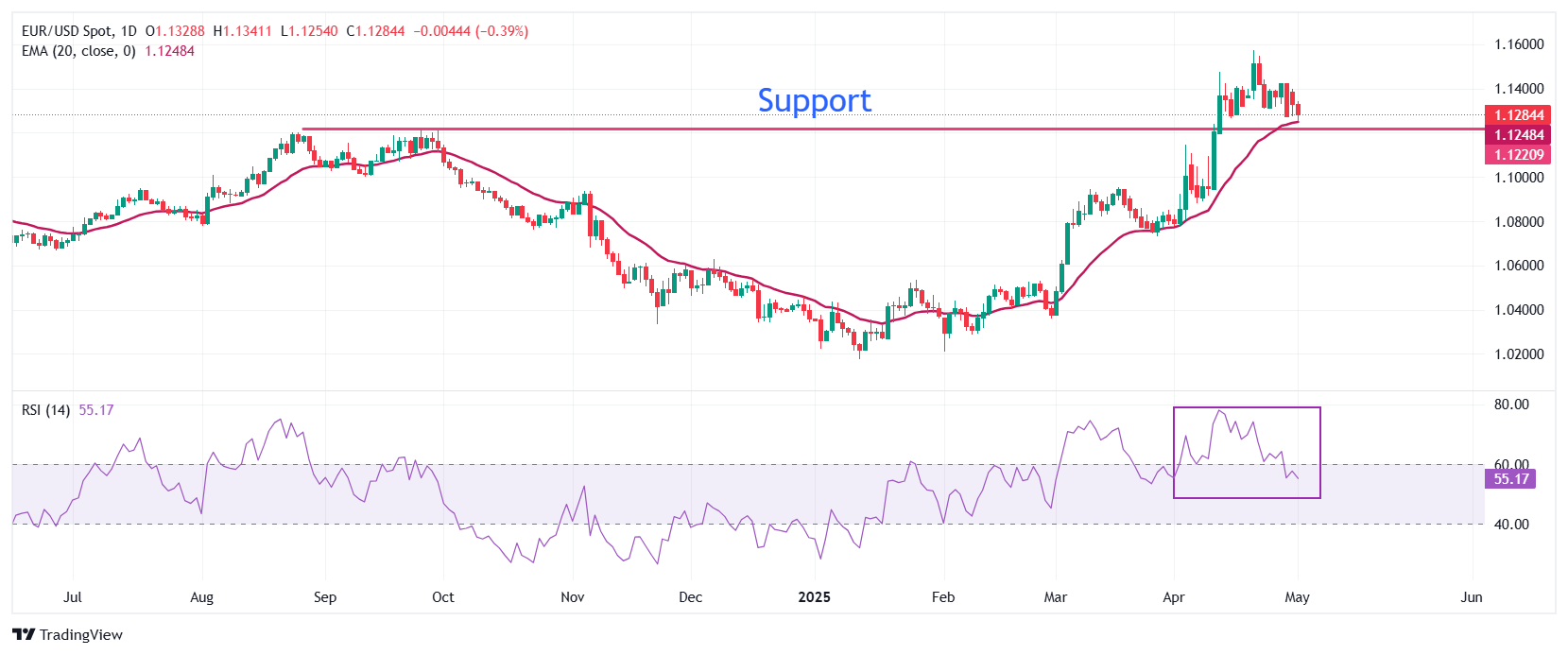
EUR/USD slips below the key level of 1.1300 in Thursday’s North American session. The pair slides to near the 20-day Exponential Moving Average (EMA), which trades around 1.1250.
The 14-day Relative Strength Index (RSI) falls inside the 40.00-60.00 range, indicating that the bullish momentum is concluded for now. However, the upside bias still prevails.
Looking up, the psychological level of 1.1500 will be the major resistance for the pair. Conversely, the 25 September high of 1.1214 will be a key support for the Euro bulls.
BRANDED CONTENT
Finding the right broker for trading EUR/USD is crucial, and we've identified the top choices for this major currency pair. Read about their unique features to make an informed decision.
Author

Sagar Dua
FXStreet
Sagar Dua is associated with the financial markets from his college days. Along with pursuing post-graduation in Commerce in 2014, he started his markets training with chart analysis.