EUR/USD falls below 1.0900 after release of US macro data
- EUR/USD declines on Thursday after the release of US macroeconomic data.
- US factory gate prices rose more than expected in February indicating inflationary pressures.
- Retails Sales rose but failed to meet estimates, Initial Jobless Claims declined.
- In Europe, ECB speakers line up with the potential for commetns regarding interest-rate policy.

EUR/USD weakens to below the key 1.0900 handle on Thursday after the release of US macroeconomic data indicates continued inflationary pressures in the economy.
US Factory gate inflation rose more than expected in February whilst Retail Sales data increased but failed to hit estimates. US Initial Jobless Claims undershot expectations and also came out a little lower than previously. Overall the data painted a picture of a resilient economy.
The data has toned expectations of when the Federal Reserve (Fed) will start cutting interest rates – a key driver for the US Dollar (USD). It now seems even more likely policymakers will want to keep interest rates higher for longer untill they see inflation push lower.
In Europe, meanwhile, a string of rate-setters from the European Central Bank (ECB) are scheduled to speak with their comments likely to shed light on when the central bank will decide to start cutting its interest rates – a key driver for the Euro (EUR).
EUR/USD Daily digest market movers: US data and Euro-speak
According to data released by the US Bureau of Labor Statistics on Thursday, Producer Price Index ex Food and Energy (Core PPI) rose by 2.0% in February, not the 1.9% forecast, and the same as the previous 2.0% in January.
Monthly Core PPI showed a 0.3% increase in prices, which beat the 0.2% rise expected but was still lower than the 0.5% from the previous month.
The headline Producer Price Index (PPI) rose 1.6% in February, which was well above the 1.1% YoY gain expected and the 1% in January. MoM PPI rose 0.6% versus the 0.3% forecast – the same as the 0.3% previous.
US Retail Sales registered a 0.6% rise MoM rather than the 0.8% rise forecast, but still above the 0.8% decline in January.
US Initial Jobless Claims for the week of March 8 came out at 209K when a 218 K result had been forecast, yet this was lower than the 210K previously.
ECB speakers shed light on whether interest rates will fall in April or June
Dovish talk from ECB Governing Council (GC) big-hitter Francois Villeroy de Galhau on Monday suggested he was leaning in favor of April for a first interest-rate cut by the Frankfurt-based bank.
On Wednesday, Bank of Austria Governor and ECB Governing Council member Robert Holzmann, however, said he thought the bank was more likely to cut in June. The President of the ECB, Christine Lagarde, also said June was the time the ECB would review its policy on rates.
Early Thursday ECB Governing Council member Yannis Stournaras backed the case for an early rate cut. Stournaras added that he doesn't buy the argument that the ECB cannot cut rates before the Fed and that four rate cuts in 2024 seem reasonable.
Also on Thursday, ECB Governing Council member Klaas Knot said he believes the ECB will start cutting interest rates in June.
Bank of Spain Governor and ECB Governing Council member Pablo Hernandez de Cos is still to speak at an event in Madrid at 17:00, according to Forexlive.com. He is followed by Vice-President of the ECB Luis de Guindos, at 18:00 GMT.
If more members appear to gravitate to June, which is the base case, it could have a slightly positive impact on the Euro and EUR/USD. If the De Galhau camp gains momentum, EUR/USD could weaken.
Technical Analysis: EUR/USD continues correction lower
EUR/USD is correcting steeply on Thursday, continuing the the pullback from the 1.0981 March 8 high.
The correction has picked up momentum on Thursday suggesting a risk the short-term uptrend could be reversing.
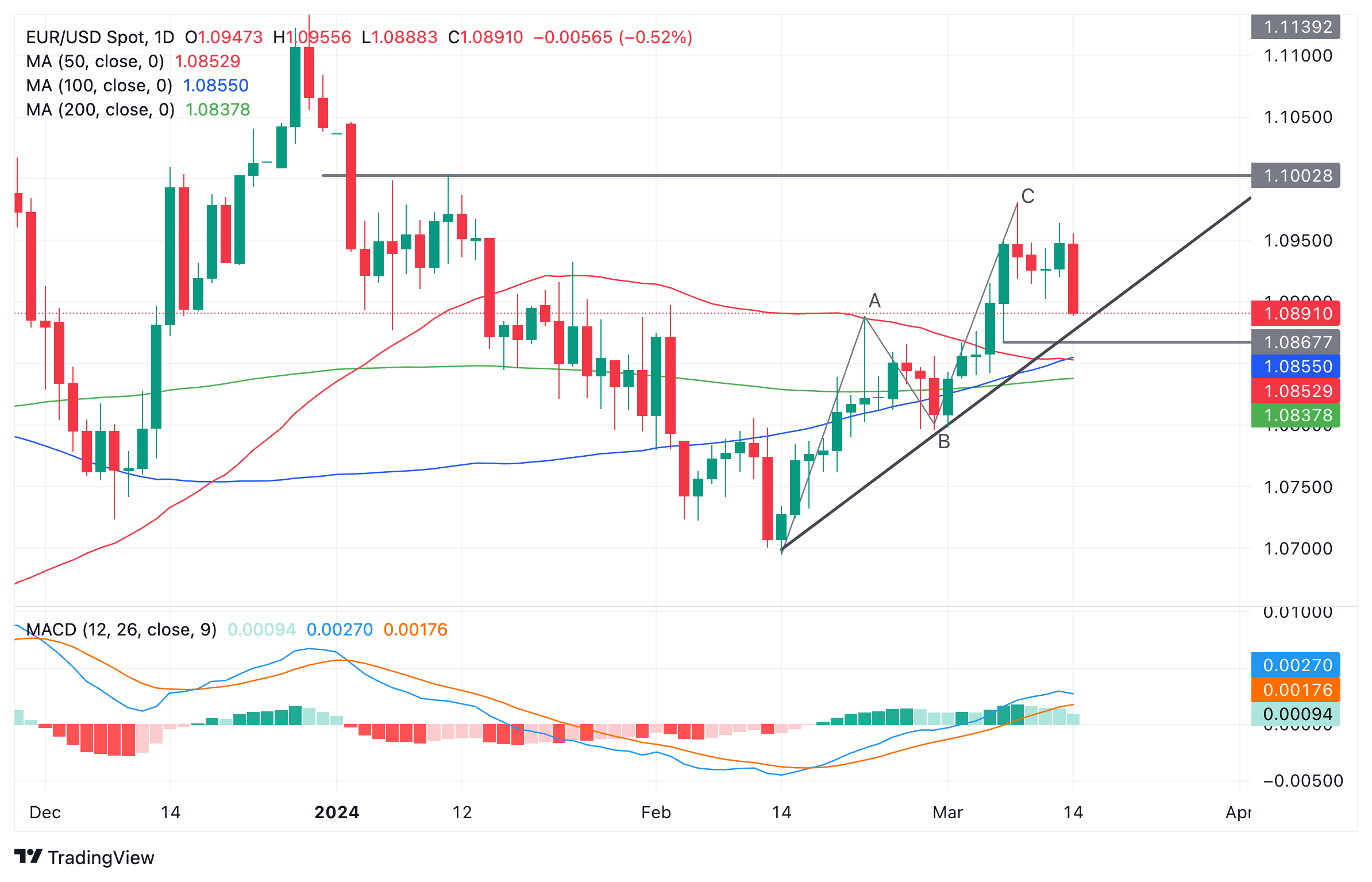
Euro vs US Dollar: Daily chart
Price has now reached a key support level between 1.0898 (February 2 high) and the top of the Measured Move’s A wave at 1.0888.
A break below 1.0867 would be critical and add credence to the case for a trend reversal rather then pullback, with bears taking more control.
Such a move could target support at 1.0795.
On the other hand, there is still a chance the pair could continue higher. A move above 1.0981 would provide confirmation of a higher high and an extension of the uptrend.
After that, tough resistance is expected at the 1.1000 psychological level, which is likely to be the scene of a fierce battle between bulls and bears.
A decisive break above 1.1000, however, would open the gates to further gains towards the key resistance level at 1.1139, the December 2023 high.
By “decisive” it is meant a break characterized by a long green candle piercing clearly above the level and closing near its high, or three green bars in a row, breaching the level.
Inflation FAQs
Inflation measures the rise in the price of a representative basket of goods and services. Headline inflation is usually expressed as a percentage change on a month-on-month (MoM) and year-on-year (YoY) basis. Core inflation excludes more volatile elements such as food and fuel which can fluctuate because of geopolitical and seasonal factors. Core inflation is the figure economists focus on and is the level targeted by central banks, which are mandated to keep inflation at a manageable level, usually around 2%.
The Consumer Price Index (CPI) measures the change in prices of a basket of goods and services over a period of time. It is usually expressed as a percentage change on a month-on-month (MoM) and year-on-year (YoY) basis. Core CPI is the figure targeted by central banks as it excludes volatile food and fuel inputs. When Core CPI rises above 2% it usually results in higher interest rates and vice versa when it falls below 2%. Since higher interest rates are positive for a currency, higher inflation usually results in a stronger currency. The opposite is true when inflation falls.
Although it may seem counter-intuitive, high inflation in a country pushes up the value of its currency and vice versa for lower inflation. This is because the central bank will normally raise interest rates to combat the higher inflation, which attract more global capital inflows from investors looking for a lucrative place to park their money.
Formerly, Gold was the asset investors turned to in times of high inflation because it preserved its value, and whilst investors will often still buy Gold for its safe-haven properties in times of extreme market turmoil, this is not the case most of the time. This is because when inflation is high, central banks will put up interest rates to combat it. Higher interest rates are negative for Gold because they increase the opportunity-cost of holding Gold vis-a-vis an interest-bearing asset or placing the money in a cash deposit account. On the flipside, lower inflation tends to be positive for Gold as it brings interest rates down, making the bright metal a more viable investment alternative.
Author

Joaquin Monfort
FXStreet
Joaquin Monfort is a financial writer and analyst with over 10 years experience writing about financial markets and alt data. He holds a degree in Anthropology from London University and a Diploma in Technical analysis.