EUR/USD hovers near highs with US Durable Goods, Jobless Claims on tap
- The Euro stalls below 1.1600 after rallying from 1.1500 lows earlier this week.
- The ECB has warned about elevated risks to financial stability and high public debt.
- US Retail Sales and Producer Price Index fed hopes of Further Fed monetary easing in December.

EUR/USD holds gains on Wednesday, although it remains capped below the 1.1600 line, trading at 1.1575 at the time of writing. European Central Bank's (ECB) concerns about financial risks have dampened investors' appetite for risk, but US Dollar rallies remain limited heading into the release of US Durable Goods Orders and weekly Jobless Claims figures
US economic data released on Tuesday revealed a weaker-than-expected increase in Retail Sales in September, while the Producer Price Index continued to grow at a steady pace. The Consumer Confidence deteriorated, with households wary about higher costs and sluggish job prospects. These figures reinforced market expectations of immediate Fed interest rate cuts, adding pressure on the US Dollar.
Meanwhile, US and Ukrainian representatives continue working on the roadmap for a peace plan. US President Donald Trump affirmed on Tuesday that the original plan has been "fine-tuned with additional input from both sides" and that he will send special envoy Steve Witkoff to meet Russian President Vladimir Putin next week. This news and the positive reaction from Ukrainian President Volodymyr Zelensky have contributed to improving market sentiment and provided additional support to the Euro.
During Wednesday's European session, the European Central Bank released its Financial Stability Review, which contains specific warnings about the "elevated risks to financial stability in Europe" and reminds that the high public debt in some countries could strain bond markets. Later on, ECB board member Philip Lane, and the president Christine Lagarde are expected to meet the press.
Euro Price Today
The table below shows the percentage change of Euro (EUR) against listed major currencies today. Euro was the strongest against the Japanese Yen.
| USD | EUR | GBP | JPY | CAD | AUD | NZD | CHF | |
|---|---|---|---|---|---|---|---|---|
| USD | -0.09% | -0.11% | 0.19% | -0.16% | -0.55% | -1.11% | -0.17% | |
| EUR | 0.09% | -0.02% | 0.29% | -0.08% | -0.46% | -1.02% | -0.08% | |
| GBP | 0.11% | 0.02% | 0.31% | -0.05% | -0.43% | -1.00% | -0.06% | |
| JPY | -0.19% | -0.29% | -0.31% | -0.36% | -0.73% | -1.29% | -0.35% | |
| CAD | 0.16% | 0.08% | 0.05% | 0.36% | -0.39% | -0.96% | -0.01% | |
| AUD | 0.55% | 0.46% | 0.43% | 0.73% | 0.39% | -0.57% | 0.36% | |
| NZD | 1.11% | 1.02% | 1.00% | 1.29% | 0.96% | 0.57% | 0.95% | |
| CHF | 0.17% | 0.08% | 0.06% | 0.35% | 0.00% | -0.36% | -0.95% |
The heat map shows percentage changes of major currencies against each other. The base currency is picked from the left column, while the quote currency is picked from the top row. For example, if you pick the Euro from the left column and move along the horizontal line to the US Dollar, the percentage change displayed in the box will represent EUR (base)/USD (quote).
Risk appetite and growing Fed easing hopes are weighing on the US Dollar
- The Euro is dragging support from a weaker US Dollar, as recent US figures boosted expectations of Fed interest rate cuts in December, while hopes of a peace agreement between Russia and Ukraine are contributing to improving market sentiment. Lower US Treasury yields are weighing on the US Dollar Index, which has depreciated about 0.6% over the last three days.
- On Tuesday, US Retail Sales data showed that consumption grew 0.2% in September, undershooting expectations of a 0.4% increase, and following a 0.6% growth in August. Excluding automobiles, sales of all other products rose 0.3%, also below the 0.4% consensus, while August's reading was revised down to 0.6% from the previously estimated 0.7% increase.
- The US Producer Prices Index (PPI) grew 0.3% in September after a 0.1% contraction in August. Year-on-year producer inflation remained steady at 2.7%, in line with the market consensus. The core PPI, on the other hand, eased to a 2.6% yearly pace from 2.9% in August, beating expectations of a 2.7% reading.
- The US Conference Board's Consumer Confidence Index fell to a six-month lows of 88.7 in November from an upwardly revised 95.5 reading in October, completing a weakening picture of the US economic outlook and strengthening the case for further Fed monetary policy easing.
- A report by Reuters suggests that Kevin Hassett, the National Economic Council (NEC) Director, emerges as the best positioned to replace Jerome Powell as Fed Chair at the end of his term in May. Hasset has advocated for the need to cut interest rates to support economic growth and is expected to pursue a looser monetary policy. This news has added pressure on the US Dollar.
- On Wednesday, US Durable Goods Orders growth is expected to have slowed down to 0.3% in September, from 2.9% in August. Excluding transportation, orders are seen growing at a 0.2% pace, following a downwardly revised 0.3% in August.
- US Initial Jobless Claims are expected to increase to 225,000 from 220,000 in the week of November 21.
Technical Analysis: EUR/USD under growing bullish pressure near 1.1600
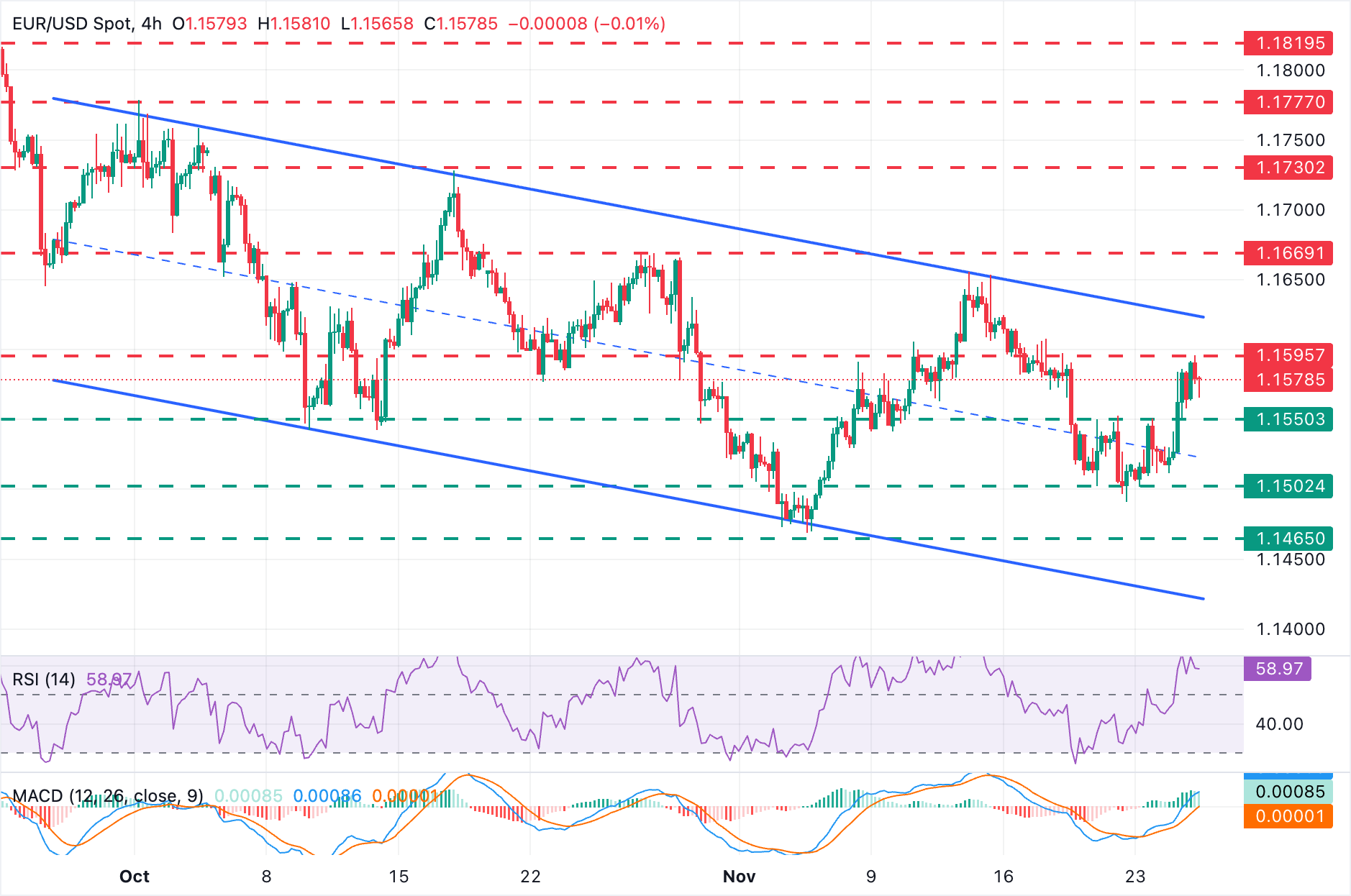
The EUR/USD bulls have taken control after breaching the 1.1550 resistance area and are testing the 1.1600 level, which, so far, remains in place. Technical indicators show an improving momentum. The 4-hour Relative Strength Index (RSI) is nearing oversold levels but not yet there, while the Moving Average Convergence Divergence (MACD) has crossed above the zero line, highlighting an improving bullish momentum.
Bulls remain capped below the mentioned resistance area above 1.1600 (November 18 and 19 highs). Further up, bulls are likely to be challenged at the top of a descending channel from the mid-October highs, which is now around 1.1625, ahead of the October 28 and 29 highs, near 1.1670.
On the downside, the previous resistance at 1.1550 (November 21 and 24 highs) is expected to provide support ahead of the 1.1500 psychological level. A bearish reaction below here would increase pressure towards the November 5 lows, near 1.1470, and the bottom of the descending channel from early October highs, now around 1.1425.
Economic Indicator
Durable Goods Orders
The Durable Goods Orders, released by the US Census Bureau, measures the cost of orders received by manufacturers for durable goods, which means goods planned to last for three years or more, such as motor vehicles and appliances. As those durable products often involve large investments they are sensitive to the US economic situation. The final figure shows the state of US production activity. Generally speaking, a high reading is bullish for the USD.
Read more.Next release: Wed Nov 26, 2025 13:30
Frequency: Monthly
Consensus: 0.3%
Previous: 2.9%
Source: US Census Bureau
Economic Indicator
Initial Jobless Claims
The Initial Jobless Claims released by the US Department of Labor is a measure of the number of people filing first-time claims for state unemployment insurance. A larger-than-expected number indicates weakness in the US labor market, reflects negatively on the US economy, and is negative for the US Dollar (USD). On the other hand, a decreasing number should be taken as bullish for the USD.
Read more.Next release: Wed Nov 26, 2025 13:30
Frequency: Weekly
Consensus: 225K
Previous: 220K
Source: US Department of Labor
Every Thursday, the US Department of Labor publishes the number of previous week’s initial claims for unemployment benefits in the US. Since this reading could be highly volatile, investors may pay closer attention to the four-week average. A downtrend is seen as a sign of an improving labour market and could have a positive impact on the USD’s performance against its rivals and vice versa.
Author

Guillermo Alcala
FXStreet
Graduated in Communication Sciences at the Universidad del Pais Vasco and Universiteit van Amsterdam, Guillermo has been working as financial news editor and copywriter in diverse Forex-related firms, like FXStreet and Kantox.















