EUR/JPY Price Forecast: Retreats further from yearly top; seems vulnerable below 172.00
- EUR/JPY attracts some follow-through sellers for the second straight day on Tuesday.
- The EUR remains depressed despite the US-EU trade deal and weighs on spot prices.
- The emergence of some JPY buying further contributes to the ongoing corrective slide.


The EUR/JPY cross extends the previous day's retracement slide from the vicinity of the 174.00 mark, or a fresh one-year high, and drifts lower for the second consecutive day on Tuesday. Spot prices drop to the 171.80 region during the Asian session and seem vulnerable to slide further.
The shared currency continues with its relative underperformance amid worries that the trade deal between the US and the European Union (EU) was unbalanced. Furthermore, the market anxiety heading into this week's key central bank event risks is seen benefiting the safe-haven Japanese Yen (JPY) and exerts some downward pressure on the EUR/JPY cross.
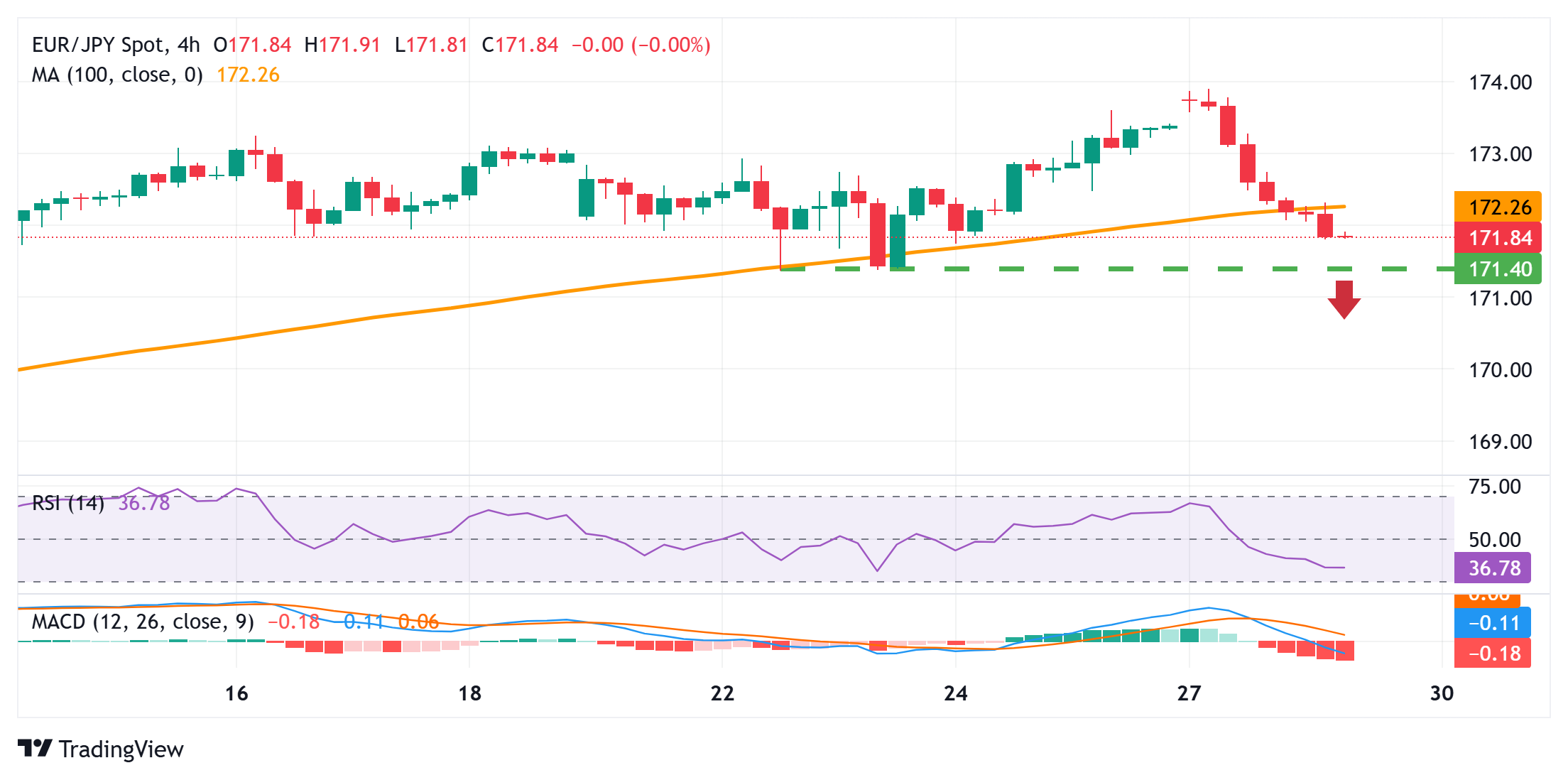
From a technical perspective, spot prices now seem to have found acceptance below the 100-period Simple Moving Average (SMA) on the 4-hour chart. Moreover, oscillators on the said chart have been gaining negative traction and are still far from being in the oversold zone. This, in turn, validates the near-term bearish outlook for the EUR/JPY cross.
Hence, a subsequent fall towards an intermediate support near the 171.60 region, en route to last week's swing low around the 171.35 area, looks like a distinct possibility. Some follow-through selling could make the EUR/JPY cross vulnerable to weaken further below the 171.00 round figure, towards testing the next relevant support near the 170.40 region.
On the flip side, any attempted recovery might now confront immediate resistance near the 172.25-172.30 zone ahead of the 172.65-172.70 area. A sustained strength beyond should allow the EUR/JPY cross to reclaim the 173.00 mark and climb further towards the 173.30-173.35 hurdle. The momentum could extend towards the 174.00 neighborhood, or the yearly top.
EUR/JPY 4-hour chart
Tariffs FAQs
Tariffs are customs duties levied on certain merchandise imports or a category of products. Tariffs are designed to help local producers and manufacturers be more competitive in the market by providing a price advantage over similar goods that can be imported. Tariffs are widely used as tools of protectionism, along with trade barriers and import quotas.
Although tariffs and taxes both generate government revenue to fund public goods and services, they have several distinctions. Tariffs are prepaid at the port of entry, while taxes are paid at the time of purchase. Taxes are imposed on individual taxpayers and businesses, while tariffs are paid by importers.
There are two schools of thought among economists regarding the usage of tariffs. While some argue that tariffs are necessary to protect domestic industries and address trade imbalances, others see them as a harmful tool that could potentially drive prices higher over the long term and lead to a damaging trade war by encouraging tit-for-tat tariffs.
During the run-up to the presidential election in November 2024, Donald Trump made it clear that he intends to use tariffs to support the US economy and American producers. In 2024, Mexico, China and Canada accounted for 42% of total US imports. In this period, Mexico stood out as the top exporter with $466.6 billion, according to the US Census Bureau. Hence, Trump wants to focus on these three nations when imposing tariffs. He also plans to use the revenue generated through tariffs to lower personal income taxes.
Author
Haresh Menghani
FXStreet
Haresh Menghani is a detail-oriented professional with 10+ years of extensive experience in analysing the global financial markets.

















