|

EUR/JPY Price Analysis: Ends the week bearishly, tumbles below 160.00

  • EUR/JPY records significant weekly losses, closing down by more than 2.20%.
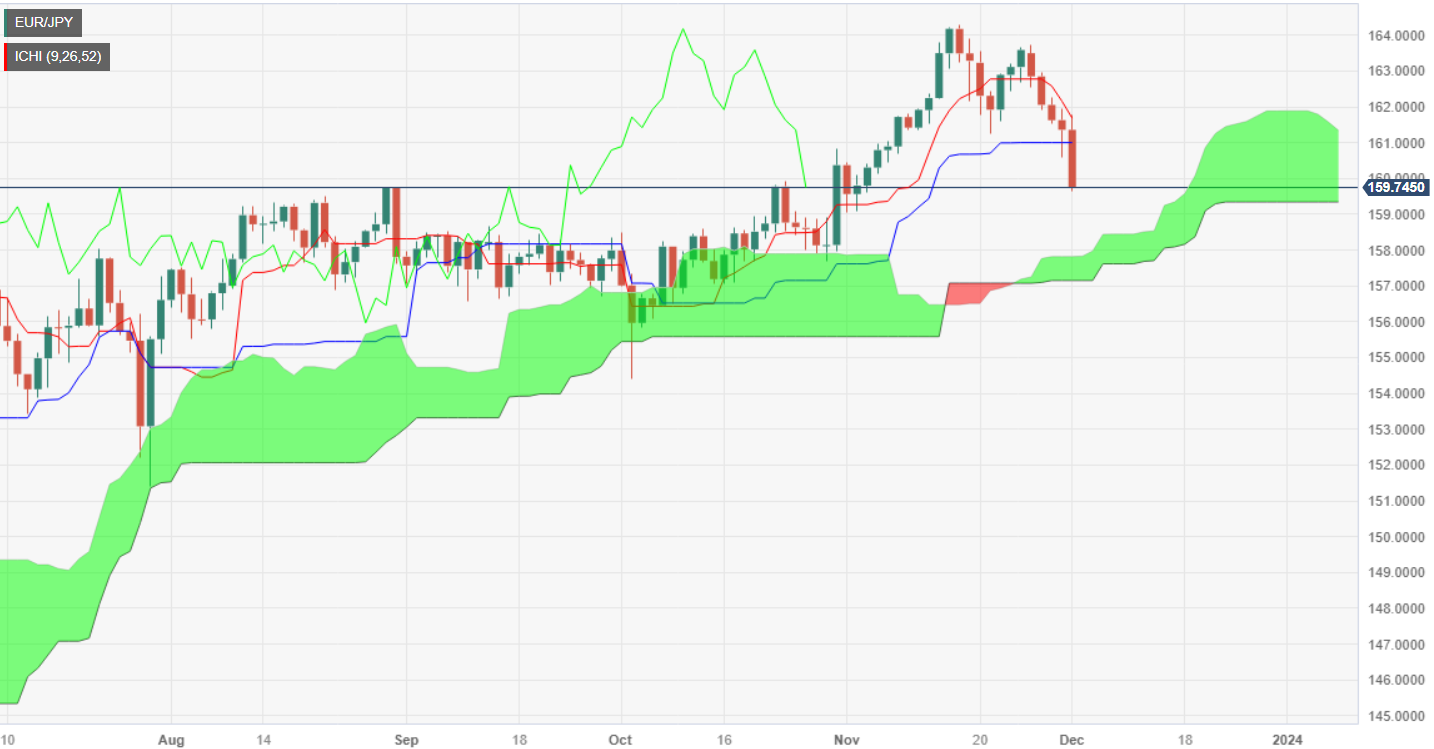
  • A key focus for traders is the Ichimoku Cloud support around the 158.00 level, which could accelerate the downtrend toward 154.00.
  • For a shift back to bullish resumption, EUR/JPY must reclaim the Kijun-Sen at 161.00 and surpass the recent cycle low at 161.24, with the Tenkan-Sen at 161.68 up next.

The EUR/JPY closed the week with a negative tone, down by 1% on Friday, for a total of more than 2.20% weekly losses, and shifts bearish after breaking key support levels on Friday. At the time of writing, the EUR/JPY exchanges hands at 159.73, following a fall of more than 160 pips from a daily high of 161.77.

The pair shifted bearish, though it’s pending breaching support at the Ichimoku Cloud (Kumo), at around the 158.00 area. Once the EUR/JPY extends its losses below that price level, sellers will target the October 3 swing low of 154.34, ahead of the July 28 low of 151.40

On the other hand, EUR/JPY needs to reclaim the Kijun-Sen at 161.00 before challenging the most recent cycle low at 161.24, the November 21 low. If those levels are surrendered, the next stop would e the Tenkan-sen at 161.68.

EUR/JPY Price Analysis – Daily Chart
EUR/JPY Technical Levels

EUR/JPY

Overview
Today last price159.7
Today Daily Change-1.66
Today Daily Change %-1.03
Today daily open161.36
 
Trends
Daily SMA20162.27
Daily SMA50159.75
Daily SMA100158.6
Daily SMA200153.6
 
Levels
Previous Daily High161.94
Previous Daily Low160.6
Previous Weekly High163.66
Previous Weekly Low161.25
Previous Monthly High164.31
Previous Monthly Low159.07
Daily Fibonacci 38.2%161.11
Daily Fibonacci 61.8%161.43
Daily Pivot Point S1160.66
Daily Pivot Point S2159.95
Daily Pivot Point S3159.31
Daily Pivot Point R1162
Daily Pivot Point R2162.65
Daily Pivot Point R3163.35

Author

Christian Borjon Valencia

Markets analyst, news editor, and trading instructor with over 14 years of experience across FX, commodities, US equity indices, and global macro markets.


More from Christian Borjon Valencia
Share:

Editor's Picks

AUD/USD meets support near 0.7000

AUD/USD fades Monday’s optimism and trades with decent losses in the low 0.7000s ahead of the opening bell in Asia. Indeed, spot fails to capitalise on the offered stance of the Greenback and the relatively easing tensions in the Middle East on Tuesday. In the meantime, the AUD is expected to follow the release of housing data in Oz and Chinese inflation figures, all due on Wednesday.

Japanese Yen steadies near recent lows as ceasefire, Japan intervention threats offset

USD/JPY trades around 160.15 on Tuesday, remaining close to its highest level since April 30 despite a broadly neutral intraday performance. The pair retains an underlying bullish bias, supported by expectations that US monetary policy will remain restrictive, although upside potential is being capped by the risk of intervention from Japanese authorities.

Gold dives to fresh two-month lows, aims to challenge $4,000

The selling pressure now gathers extra pace and sends Gold to new three-month lows near $4,230 per troy punce on Tuesday. That said, the yellow metal resumes its decline on the back of a recovery attempt in the US Dollar and the likelihood of a tighter-for-longer Fed this year.

Zcash Price Forecast: ZEC extends gains, targets $500 as retail demand and momentum strengthen
Zcash (ZEC) gains momentum and trades near $470 at the time of writing on Tuesday, shrugging off a broader risk-off mood primarily driven by geopolitical tensions in the Middle East and macroeconomic uncertainty. Retail activity remains relatively elevated, as reflected in the derivatives market.
Hotter US inflation numbers could further bolster Fed hike bets

Middle East tensions keep inflation risks elevated. Fed hike fully priced in by year end amid strong NFP report. US CPI data on Wednesday (12:30 GMT) to enter the spotlight. Further acceleration in inflation could drive the Dollar higher.

The US economy defies the rules: 100 days into the Oil shock and the recession signal is still missing

More than three months after the start of the Iran war and the resulting disruption to global energy markets, the US economy continues to display remarkable resilience. The conflict has triggered a sharp rise in Oil prices, reignited inflationary pressures and fueled widespread concerns about a potential economic slowdown.