EUR/GBP tests resistance ahead of G7 meeting, ECB and BoE guidance
- Euro awaits key catalysts as traders eye Tuesday’s G7 meeting, Germany’s PPI, ECB speeches, and Eurozone Consumer Confidence.
- EUR/GBP tests the 50 and 100-day SMA resistance zone with a breakout required to shift the bearish bias.
- Pound Sterling finds temporary support from renewed UK–EU cooperation.

The Euro (EUR) is strengthening against the British Pound Sterling (GBP) on Monday, as diverging drivers on both sides of the Channel shape market sentiment.
While the Euro remains resilient amid softer US Dollar flows and unchanged Eurozone inflation data, Sterling draws modest support from renewed UK–EU cooperation.
At the time of writing, EUR/GBP is trading near 0.8412, up 0.40% on the day and holding near the lower end of its recent consolidation range, as traders turn their attention to Tuesday’s packed calendar featuring the G7 finance meeting, central bank speeches, Germany’s inflation data, and Eurozone Consumer Confidence.
Eurozone inflation data fails to move EUR/GBP as traders look beyond the April print
On Monday, the Euro showed little reaction to the final April release of the Eurozone’s Core Harmonized Index of Consumer Prices (HICP), which came in line with analyst projections.
Both the Headline and Core figures were unchanged from March, reinforcing the view that underlying price pressures remain stable.
With the outcome largely priced in, the data offered no fresh catalyst to alter expectations for the European Central Bank (ECB), where policymakers are still anticipated to begin cutting rates in the second half of the year. As a result, the report had minimal impact on EUR/GBP positioning, with the pair continuing to trade within a well-defined range.
Sterling gains support from UK–EU cooperation, but the Euro outperforms
While recent UK–EU diplomacy provided Sterling with some fundamental support, Monday’s EUR/GBP price action appears to favor the Euro.
The Pound drew modest backing from the announcement of a renewed UK–EU cooperation framework, which includes expanded defense coordination and a shared agenda on trade and security, viewed as a stabilizing step for long-term UK–EU relations.
Additionally, anticipation of stronger UK inflation data on Wednesday is helping limit downside pressure on GBP. However, the Euro is outperforming on the day, supported by softer US Dollar flows and steady Eurozone inflation data, keeping EUR/GBP bid near the lower end of its recent range.
Traders brace for packed Tuesday calendar with G7 meeting, inflation data, and ECB, BoE guidance in focus
Focus now shifts to a high-impact Tuesday agenda that could shape the short-term direction of EUR/GBP. The two-day G7 Finance Ministers and Central Bank Governors’ Meeting begins in Banff, Canada, where global leaders are expected to discuss economic security, financial stability, and geopolitical risks.
Currency markets will be watching closely for any statements on trade imbalances or coordinated financial responses that could influence broader sentiment.
In Europe, Germany’s Producer Price Index (PPI) will provide an updated view of inflation at the producer level, feeding into expectations for broader Eurozone price trends.
The Euro may also react to scheduled speeches from ECB officials Cipollone and Knot, which could offer further clarity on the central bank’s policy stance amid persistent core inflation and subdued economic momentum.
In addition, the preliminary May Eurozone Consumer Confidence reading is due at 14:00 GMT, with forecasts pointing to a slight improvement to -16.0 from -16.7. A stronger-than-expected print could indicate stabilizing household sentiment and provide modest support to the Euro.
On the UK side, BoE Chief Economist Huw Pill is due to speak ahead of Wednesday’s key inflation reports.
His remarks may provide forward guidance on the Bank’s monetary outlook, with April’s Consumer Price Index (CPI) and Retail Price Index (RPI) figures expected to play a pivotal role in shaping near-term rate expectations.
EUR/GBP tests critical resistance as bearish bias holds near key technical zone
The EUR/GBP currency pair is currently hovering near a key confluence zone, where the 100-day Simple Moving Average (SMA) and the psychological support level of 0.8400 are providing immediate downside protection.
Just below, the May low at 0.8377 serves as the next key support to monitor, followed by the March swing low at 0.8315.
On the upside, resistance is reinforced by the 78.6% Fibonacci retracement level of the 2022 March–September rally at 0.84278, along with the 50-day SMA at 0.8468. A sustained break above this zone would be required to shift the short-term bias and expose the 38.2% retracement level of the 2015–2020 longer-term bull trend at 0.8519.
EUR/GBP daily chart
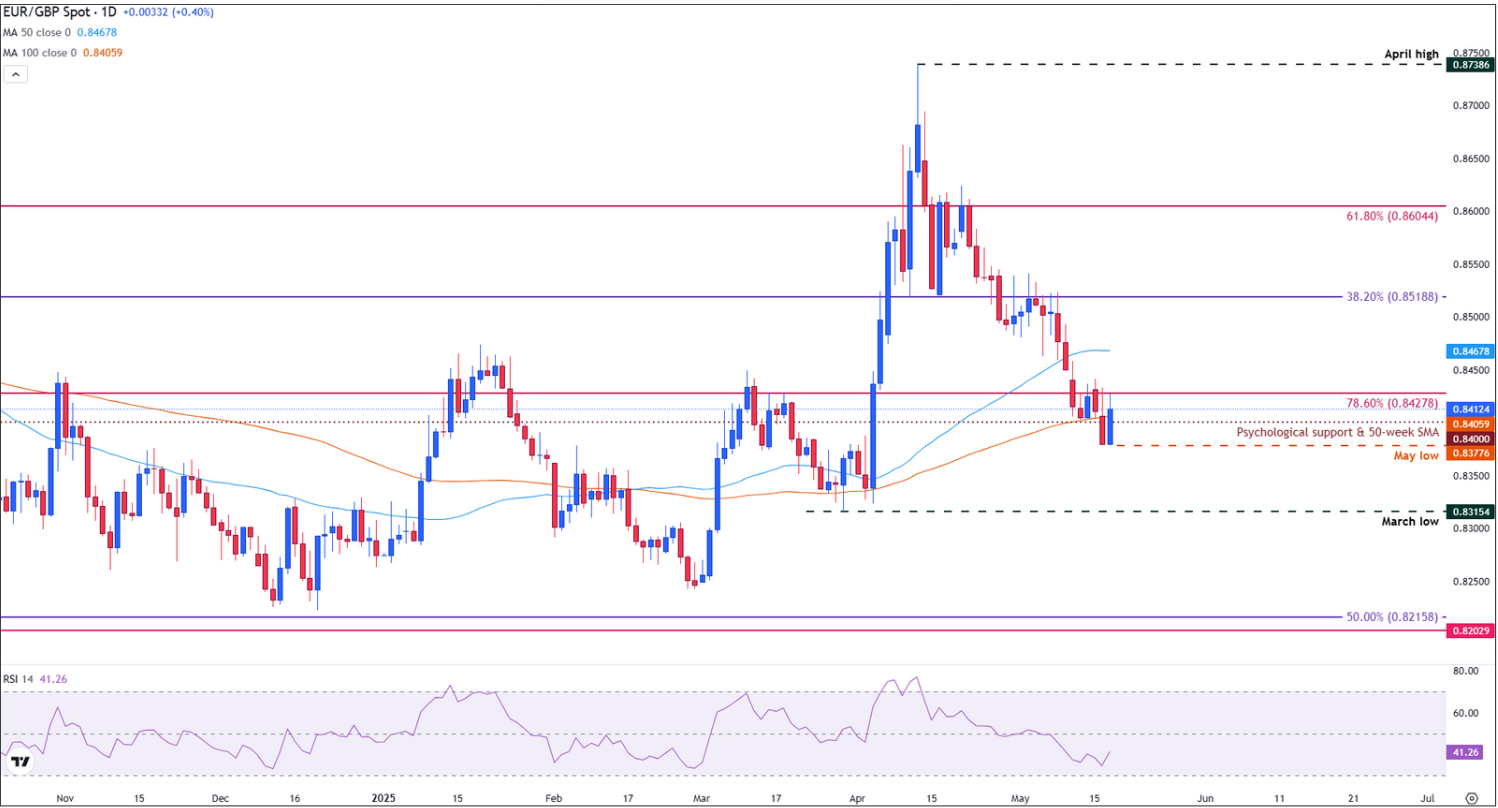
The Relative Strength Index (RSI) is currently at 41.26, indicating weak momentum and limited bullish conviction. As long as the pair remains capped below the 0.8430–0.8468 resistance band, the broader bias continues to favor sellers, particularly if upcoming UK inflation data and central bank commentary extend support to the Pound.
Euro FAQs
The Euro is the currency for the 19 European Union countries that belong to the Eurozone. It is the second most heavily traded currency in the world behind the US Dollar. In 2022, it accounted for 31% of all foreign exchange transactions, with an average daily turnover of over $2.2 trillion a day. EUR/USD is the most heavily traded currency pair in the world, accounting for an estimated 30% off all transactions, followed by EUR/JPY (4%), EUR/GBP (3%) and EUR/AUD (2%).
The European Central Bank (ECB) in Frankfurt, Germany, is the reserve bank for the Eurozone. The ECB sets interest rates and manages monetary policy. The ECB’s primary mandate is to maintain price stability, which means either controlling inflation or stimulating growth. Its primary tool is the raising or lowering of interest rates. Relatively high interest rates – or the expectation of higher rates – will usually benefit the Euro and vice versa. The ECB Governing Council makes monetary policy decisions at meetings held eight times a year. Decisions are made by heads of the Eurozone national banks and six permanent members, including the President of the ECB, Christine Lagarde.
Eurozone inflation data, measured by the Harmonized Index of Consumer Prices (HICP), is an important econometric for the Euro. If inflation rises more than expected, especially if above the ECB’s 2% target, it obliges the ECB to raise interest rates to bring it back under control. Relatively high interest rates compared to its counterparts will usually benefit the Euro, as it makes the region more attractive as a place for global investors to park their money.
Data releases gauge the health of the economy and can impact on the Euro. Indicators such as GDP, Manufacturing and Services PMIs, employment, and consumer sentiment surveys can all influence the direction of the single currency. A strong economy is good for the Euro. Not only does it attract more foreign investment but it may encourage the ECB to put up interest rates, which will directly strengthen the Euro. Otherwise, if economic data is weak, the Euro is likely to fall. Economic data for the four largest economies in the euro area (Germany, France, Italy and Spain) are especially significant, as they account for 75% of the Eurozone’s economy.
Another significant data release for the Euro is the Trade Balance. This indicator measures the difference between what a country earns from its exports and what it spends on imports over a given period. If a country produces highly sought after exports then its currency will gain in value purely from the extra demand created from foreign buyers seeking to purchase these goods. Therefore, a positive net Trade Balance strengthens a currency and vice versa for a negative balance.
Author

Tammy Da Costa, CFTe®
FXStreet
Tammy is an economist and market analyst with a deep passion for financial markets, particularly commodities and geopolitics.