|

EUR/GBP Price Analysis: Bounces off lower channel line and continues modest gains

  • EUR/GBP has rebounded after touching the lower channel line of its rising channel. 
  • The chart suggests a mild bullish bias as price slowly makes steps higher. 

EUR/GBP bounces off the lower channel line of its shallow rising channel and pushes higher. 

Price continues to respect the confines of the recovery channel which began at the August 30 lows. Little by little, it climbs higher, suggesting a new short-term uptrend is taking root. 

EUR/GBP 4-hour Chart 
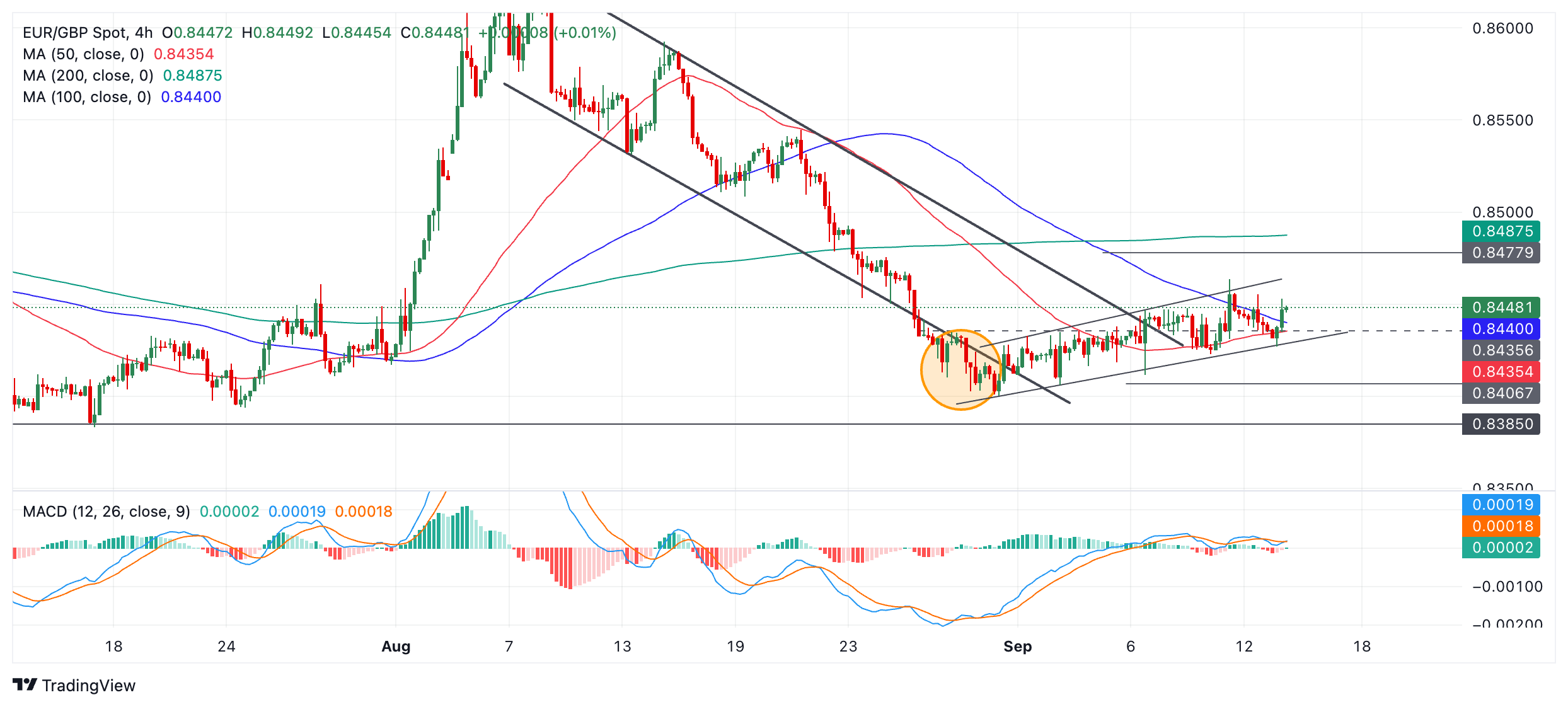
The Moving Average Convergence Divergence (MACD) momentum indicator stays above the zero line indicating a mild bullishness to price dynamics. 

A close above the 0.8464 high (September 11 high) would be required to confirm an upside breakout from the channel. Such a move would likely reach about 0.8477, the 0.618 Fibonacci (Fib) extension of the height of the channel extrapolated higher. 

Bullish signs now marginally outweigh bearish. For starters EUR/GBP keeps rising within a bullish channel, secondly it has now worked its way through the previous falling channel, and finally the exhaustion break during August (orange shaded circle) – when it accelerated to the downside – is a bullish reversal sign. 

The main bearish sign is the relative shallowness of the rising channel in comparison to the much steeper previous bear move. 

A close below 0.8423 (September 10 low) would pave the way for further weakness to a downside target at 0.8406, the 0.618 Fib extension lower.

Author

Joaquin Monfort

Joaquin Monfort is a financial writer and analyst with over 10 years experience writing about financial markets and alt data. He holds a degree in Anthropology from London University and a Diploma in Technical analysis.


More from Joaquin Monfort
Share:

Editor's Picks

AUD/USD defends 0.7000 ahead of RBA on Tuesday

AUD/USD is defending 0.7000 at the start of a new week, trading near its lowest level since August 4 amid a bullish US Dollar. US yields hold near multi-year highs amid inflation risks from higher oil prices and rising bets on an October Fed rate hike. This, along with the US-Iran standoff, continues to underpin the safe-haven buck and weigh on the pair ahead of Tuesday's RBA policy announcements.

USD/JPY climbs back toward 158.00 after BoJ minutes amid firm USD

USD/JPY finds dip-buyers and reverses part of Friday's slide driven by speculation that authorities will step in again to prop up the Japanese Yen. However, the BoJ's dovish Minutes cap the JPY. Meanwhile, the US Dollar regains traction as the US-Iran standoff supports crude oil prices, fueling inflation fears and reaffirming bets for an October Fed rate hike. This further supports the pair, driving it back toward 158.00.

Gold cracks $4,200 for the first time in eight weeks

Gold falls hard at the start of a new week, breaching $4,200 for the first time in eight weeks. Firming October Fed rate-hike bets, along with oil-driven inflation risks, keep US bond yields elevated near multi-year highs, helping the US Dollar regain positive traction amid persistent Iran risks. These factors weigh heavily on the bullion.

Bitcoin takes a breather, Ethereum faces pullback, XRP consolidates 
Bitcoin (BTC), Ethereum (ETH) and Ripple (XRP) take a breather at the start of the week on Monday after their recent gains last week. BTC pulls back, trading below $83,600 while ETH extends its losses, trading below $2,700, and XRP consolidates around $1.500. The price action of these top three cryptocurrencies suggests a mild pullback or consolidation as traders assess their next direction.
After the Trump Xi summit, markets are trading three clocks
The summit delivered time, not a deal. Trade, oil and chips now each run to a date, and the macro backdrop matters more than the pageantry. Markets wanted a deal and got a calendar date instead. Xi Jinping left Washington on Friday after tea at the White House and a tour of the National Archives.
Fed vs BoJ: Both hiked. The market only believes one of them – and the chart shows which

The Fed and the BoJ have just done something remarkably similar. Both central banks raised interest rates by 25 bps last week, both are confronting inflation risks, and both signal that future decisions will depend on incoming economic data.