EUR/GBP looking for a run above 0.8560 to close out Friday, UK data in the pipe for next week
- The EUR has moved higher on the week against the GBP as ther BoE turns dovish.
- Soft data for the Eurozone caps upside capacity.
- It's the Pound Sterling's ballgame to lose with data-heavy calendar due next week.

The EUR/GBP pair has moved higher for the week, with the Euro (EUR) gaining some ground against the Pound Sterling (GBP). A dovish Bank of England (BoE) has struck the GBP with bearish undertones, and despite beleaguered economic data for the broader European Union (EU) region, the Euro is the tug-of-war winner for this week.
The EUR started the week on the low end after Purchasing Manager Index (PMI) figures for the EU showed economic sentiment is declining for the continent. Later, Eurostat sales figures showed the retail space contracted by -1%, further capping upside potential for the Euro.
BoE hits dovish notes
On the United Kingdom (UK) side, the BoE’s Governor Andrew Bailey and members of the BoE’s Monetary Policy Committee (MPC) testified before the UK Parliament, speaking about inflation expectations and the overall economy.
Governor Bailey and his fellow MPC members struck a decidedly dovish tone, stating that the rate hike cycle for the BoE could very well be at the top, as well as expressing concerns that too much more action from the UK’s central bank could worsen the odds of achieving a “soft landing” for the domestic economy.
The softening stance from the BoE sent the GBP broadly lower for the week.
Next week: data-heavy UK
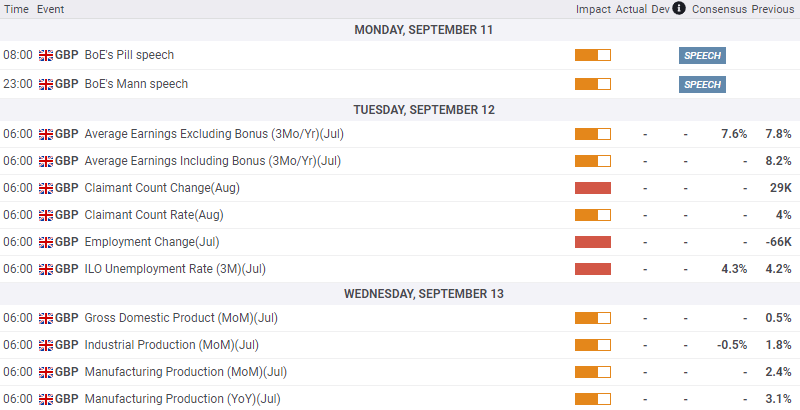
The economic calendar for the first half of next week is notably GBP-heavy, with very little meaningful releases from the EU side.
Monday sees appearances from the BoE’s chief economist Huw Pill and MPC member Catherine L. Mann. Tuesday brings UK unemployment figures and wages data, and Wednesday will bring UK manufacturing and Gross Domestic Product (GDP) data.
Wage growth, unemployment, and industrial data are all anticipated to slightly worsen.
UK economic calendar schedule, Monday - Wednesday. All times in GMT.
EUR/GBP technical outlook
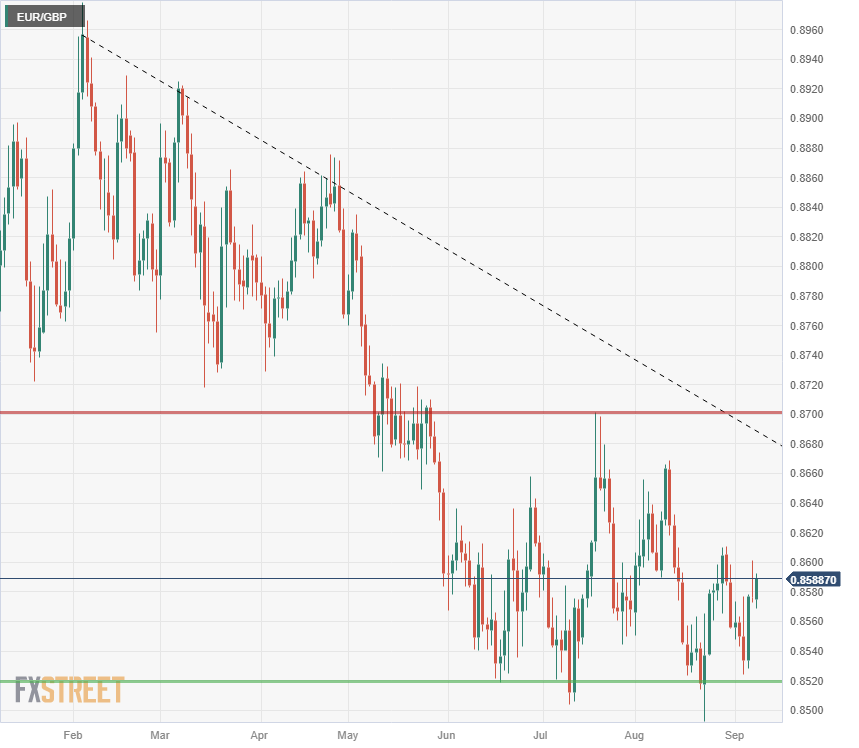
The Euro-Pound pair has consolidated since June, cycling in a rough range between 0.8660 and 0.8520. A high-side resistance zone sits above, between 0.8740 and 0.8720, while any significant downside breaks could see the floor give way beneath the 0.8500 major handle.
A break below 0.8500 would see the Euro trading into 13-month lows against the Sterling.
EUR/GBP Daily chart
Author

Joshua Gibson
FXStreet
Joshua joins the FXStreet team as an Economics and Finance double major from Vancouver Island University with twelve years' experience as an independent trader focusing on technical analysis.
















