|

Elliott Wave analysis: SPX targets recovery in three waves at least [Video]

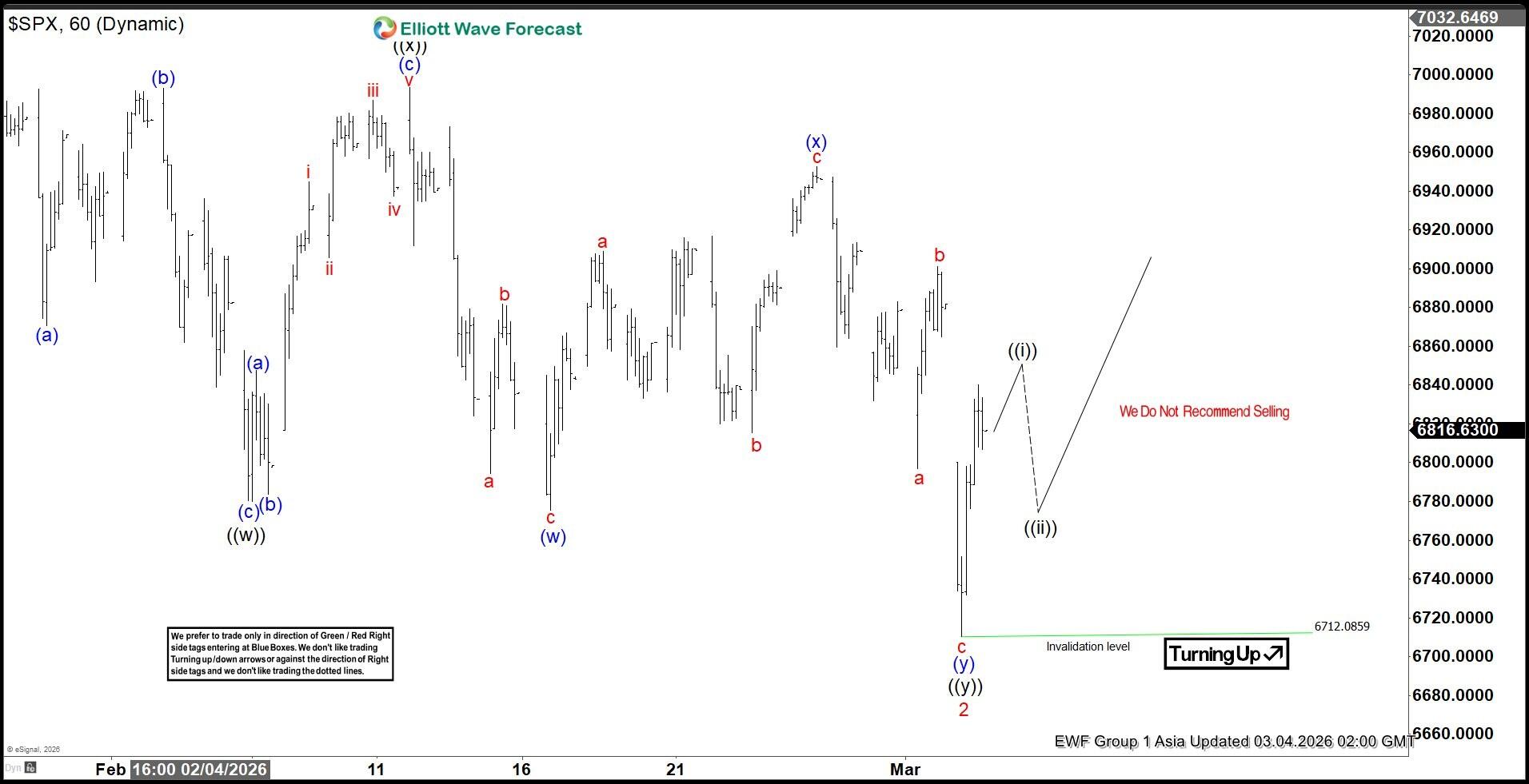
Short-term Elliott Wave analysis indicates that the rally to 7002.28 on January 28, 2026 marked the completion of wave 1. Following this advance, the market entered a corrective phase. The wave 2 pullback recently concluded at 6712, as illustrated in the one-hour chart. This decline corrected the cycle that began from the November 21, 2025 low, and its internal subdivisions unfolded in a double three structure, a common corrective pattern within Elliott Wave theory.

From the peak of wave 1, the first leg lower, wave ((w)), ended at 6780.13. A subsequent rally formed wave ((x)), which terminated at 6993.48. The final leg, wave ((y)), pushed lower and ended at 6712.08. This level aligns with the 100%–161.8% Fibonacci extension of wave ((w)), measured at 6629–6768, reinforcing its significance as a support zone.

With the correction complete, the Index has turned higher in wave 3. However, a decisive break above 7002.28 is required to fully confirm that the larger degree correction has ended. Until that level is exceeded, the possibility of a broader corrective structure remains. While the Index retains potential to extend toward new all-time highs, traders should remain cautious. The larger cycle from the April 2025 low is mature and could terminate at any time.

Therefore, strict risk management is essential when pursuing upside opportunities. In the near term, as long as the pivot at 6712.08 holds, expectations favor continued strength and further extension higher.

S&P 500 (SPX) 60-minute Elliott Wave chart
SP

SPX Elliott Wave [Video]

Youtube preview

Author

Elliott Wave Forecast Team

Elliott Wave Forecast Team

ElliottWave-Forecast.com

More from Elliott Wave Forecast Team
Share:

Editor's Picks

GBP/USD clings to small gains near 1.3450 after UK jobs data

GBP/USD trades in positive territory at around 1.3450 in the European session on Tuesday. The UK ILO Unemployment Rate remained at 4.9% in the three months to May, compared with expectations of 5%, but failed to provide any impetus to the British Pound's renewed uptick. Traders stay cautious amid US-Iran uncertainty and the UK political transition.

EUR/USD keeps range above 1.1400 after German ZEW

EUR/USD is keeping its range above 1.1400 in Tuesday's European session, as the US Dollar (USD) retreats following Monday's rebound. Nevertheless, the uncertainty around the US-Iran conflict limits the pair's upside. Meanwhile, the Euro (EUR) pays little heed to the strong German sentiment data, as traders await Thursday's European Central Bank policy announcements, which could drive the Euro's near-term valuation.

Gold extends recovery toward $4,100

Gold gains traction following Monday's choppy action and advances toward $4,100 on Tuesday. However, the uncertainty surrounding the conflict in the Middle East and growing expectations for a hawkish Federal Reserve policy outlook could make it difficult for the precious metal to gather bullish momentum in the near term.

Shiba Inu price extends gains as on-chain and derivatives metrics confirm bullish bias

Shiba Inu extends gains, trading above $0.0000042 after breaking above the descending trendline the previous day. Strengthening on-chain data and improving derivatives metrics support further gains for the meme coin. CryptoQuant’s exchange netflow chart below shows five consecutive days of net outflows since July 17.

Brent nears a critical crossroads as the global economy faces one too
Markets spent last Friday digesting a Reuters report that Iran has told the Houthis to stand ready to close Bab el-Mandeb if the US strikes Iranian power infrastructure — missiles and drones are reportedly already positioned near the strait, awaiting the order from IRGC officers in Yemen.
US Dollar mid-year outlook: Exceptional currency, exceptional risks?
The US Dollar enters the second half of 2026 in a markedly different position from a year ago. The King currency has recovered, reflecting persistent US inflation, changing expectations for Fed policy, geopolitical tensions and renewed demand for defensive assets.