Dow Jones Industrial Average recovers post-tariff shock
- The Dow Jones has gained over 660 points during the US session.
- Despite the gains, the Dow is still off of last week’s highs above 45,000.
- A temporary waive of tariffs on Mexico bolstered sentiment, but now EU tariffs loom.

The Dow Jones Industrial Average (DJIA) is caught in a lurch on Monday, falling below the 44,000 handle in the overnight session before recovering lost ground after headlines hit that US tariffs on Mexico may be delayed for up to a month as the two countries work out their differences. However, fresh threats of new tariffs on Europe further complicate investor sentiment to kick off the trading week.
United States (US) Federal Reserve (Fed) Bank of Atlanta President Raphael Bostic noted that he and the rest of the Federal Open Market Committee (FOMC) are willing to hold off even longer on interest rate adjustments. Tariffs are spiraling into a global trade war between the US and the majority of its trading allies, weighing heavily on stability and the inflation outlook.
US President Trump: I like the idea of tariffs on most countries
Mexico potentially scored a one-month delay on US tariffs, but details remain fuzzy and are dependent on how negotiations between the two sides evolve. Canada, China, and now the European Union remain on the block as countries that President Trump will punish by charging his own constituents excess fees for buying their goods.
The US ISM Purchasing Managers Index (PMI) recovered in January, climbing to 50.9 from 49.3, its highest point since late 2022. However, US economic signals are taking a hard backseat to geopolitical turmoil and trade war headlines. This is likely the last time that PMIs will have steady bullish prints for a while as the US trade taxes it is imposing on itself take hold and squeeze economic activity.
Dow Jones news
Despite a steep trim of the Dow Jones Industrial Average over the weekend, the major equity board is holding surprisingly steady in the aggregate, with about half of the index holding in the green for Monday. Apple (AAPL) and Nvidia (NVDA) are the biggest losers on the Dow, falling 3.4% and 2.8% respectively. Apple backslid to $228 per share, with Nvidia falling to a share price of $117. Both megacompanies are hugely exposed to trade tariffs, with the technology sector relying heavily on cross-border trade in order to manufacture and assemble their products.
Dow Jones price forecast
The Dow Jones Industrial Average is scrambling to dig in its heels at the 44,500 level, caught in whipsaw chop as equities go reeling. The Dow kicked off the trading week below the 44,000 handle, but investor sentiment is catching some bids on easing tariff headlines, keeping price action overall on the bullish side, though the Dow Jones remains caught on the low side of all-time highs above 45,000.
Dow Jones daily chart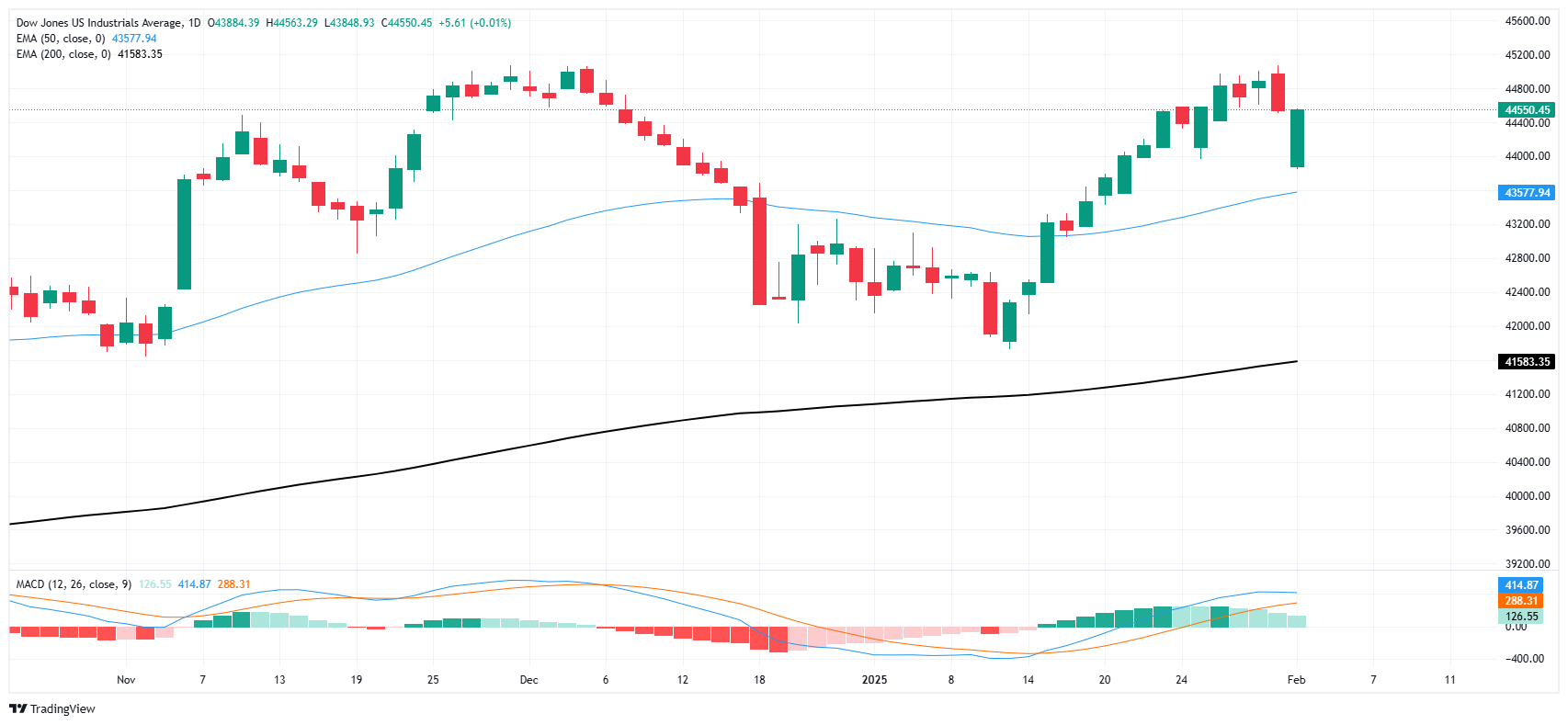
Dow Jones FAQs
The Dow Jones Industrial Average, one of the oldest stock market indices in the world, is compiled of the 30 most traded stocks in the US. The index is price-weighted rather than weighted by capitalization. It is calculated by summing the prices of the constituent stocks and dividing them by a factor, currently 0.152. The index was founded by Charles Dow, who also founded the Wall Street Journal. In later years it has been criticized for not being broadly representative enough because it only tracks 30 conglomerates, unlike broader indices such as the S&P 500.
Many different factors drive the Dow Jones Industrial Average (DJIA). The aggregate performance of the component companies revealed in quarterly company earnings reports is the main one. US and global macroeconomic data also contributes as it impacts on investor sentiment. The level of interest rates, set by the Federal Reserve (Fed), also influences the DJIA as it affects the cost of credit, on which many corporations are heavily reliant. Therefore, inflation can be a major driver as well as other metrics which impact the Fed decisions.
Dow Theory is a method for identifying the primary trend of the stock market developed by Charles Dow. A key step is to compare the direction of the Dow Jones Industrial Average (DJIA) and the Dow Jones Transportation Average (DJTA) and only follow trends where both are moving in the same direction. Volume is a confirmatory criteria. The theory uses elements of peak and trough analysis. Dow’s theory posits three trend phases: accumulation, when smart money starts buying or selling; public participation, when the wider public joins in; and distribution, when the smart money exits.
There are a number of ways to trade the DJIA. One is to use ETFs which allow investors to trade the DJIA as a single security, rather than having to buy shares in all 30 constituent companies. A leading example is the SPDR Dow Jones Industrial Average ETF (DIA). DJIA futures contracts enable traders to speculate on the future value of the index and Options provide the right, but not the obligation, to buy or sell the index at a predetermined price in the future. Mutual funds enable investors to buy a share of a diversified portfolio of DJIA stocks thus providing exposure to the overall index.
Author

Joshua Gibson
FXStreet
Joshua joins the FXStreet team as an Economics and Finance double major from Vancouver Island University with twelve years' experience as an independent trader focusing on technical analysis.