Dow Jones Industrial Average shrugs off Moody's Treasury downgrade
- The Dow Jones rose on Monday, tapping the 42,800 region.
- Moody’s downgraded US debt late last week, sparking a brief hesitation in investor sentiment.
- Fedspeakers are working double duty ahead of US PMI data later this week.

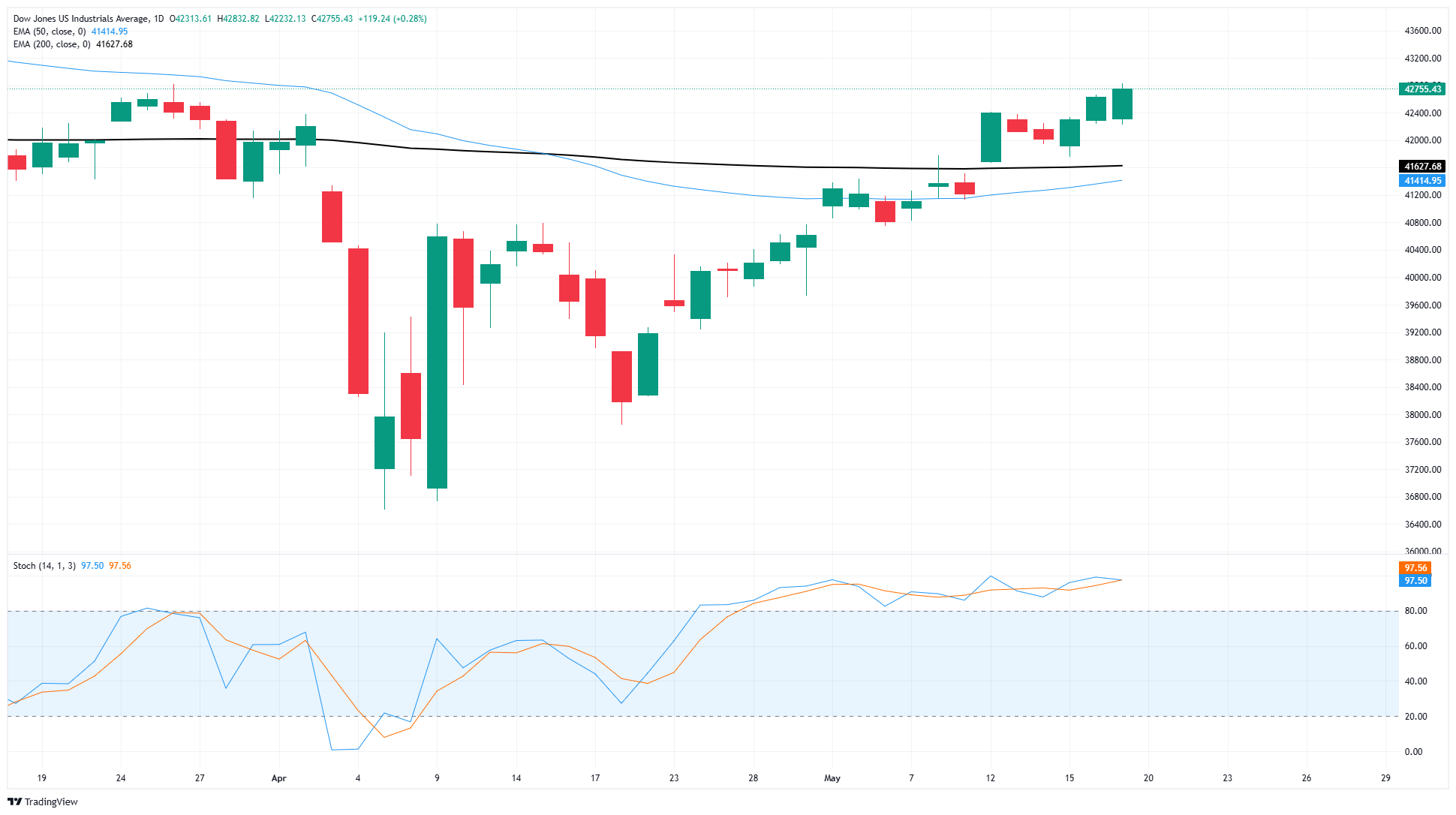
The Dow Jones Industrial Average (DJIA) gained ground to kick off the new trading week, touching 42,800 for the first time in eight weeks as markets continue to push equity markets back into the high end following this year’s tariff-fueled stock rout.
Moody’s ratings agency stripped the United States (US) of its last remaining AAA rating on its Treasuries last Friday, citing burgeoning US debt and government deficits that successive presidential administrations either refuse to, or are incapable of, bringing under control. Ratings agencies began stripping AAA status from US Treasuries in 2013, and it is the first time Moody’s has downgraded the US since 1913.
Investor sentiment wobbled at the headlines, but quickly recovered and shrugged off the hit to US creditworthiness: even with decaying investment quality, there are functionally no alternatives to Treasury-quality assets, especially when considering the sheer size of the US debt market, which towers over any other potential asset.
Still, not all is perfectly rosy in the Treasury markets: 30-year yields broke above 5% on Monday, and 10-year yields traded north of 4.5%. The last time 10-year yields rose this high, this fast, the Trump administration was forced to pivot away from and effectively cancel its “reciprocal tariff” plans in April.
Fed not in a rush to meet markets in the middle on rate cuts
Federal Reserve (Fed) speakers have hit the ground running this week in an attempt to temper market expectations for rate cuts. All Fed policymakers have been gently but firmly reminding investors that the US’s still-existing tariff and trade policies make it nearly impossible to forecast the domestic economy, and adjust policy rates as a result. The Fed is firmly entrenched in wait-and-see mode, no matter how much rate markets price in future rate cuts. Even though rate traders still hold out hope for a fresh rate-cutting cycle to kick off in 2025, when those rate cuts will begin continues to march further into the calendar. According to the CME’s FedWatch Tool, rate markets are now pricing in a first quarter-point rate trim in September, well back from the June expectations that were priced in less than a month ago.
The key economic data release this week will be S&P Global Purchasing Managers Index (PMI) figures for May. According to median market forecasts, both the manufacturing and services components of the PMI report are expected to decline slightly as tariffs take a bite out of business spending activity.
Read more stock news: UnitedHealth stock fills in the gap as market assesses the bottom is in
Dow Jones price forecast
The Dow Jones Industrial Average continues to march its way back up the charts. The major equity index has closed higher for four consecutive weeks, and is already on its way to a fifth bullish week after a determined start on Monday. The Dow Jones is pushing even further above the 200-day Exponential Moving Average (EMA) near 41,500, and is up nearly 17% from April’s tariff plunge that sent the DJIA down to 36,600.
Dow Jones daily chart
Economic Indicator
S&P Global Composite PMI
The S&P Global Composite Purchasing Managers Index (PMI), released on a monthly basis, is a leading indicator gauging US private-business activity in the manufacturing and services sector. The data is derived from surveys to senior executives. Each response is weighted according to the size of the company and its contribution to total manufacturing or services output accounted for by the sub-sector to which that company belongs. Survey responses reflect the change, if any, in the current month compared to the previous month and can anticipate changing trends in official data series such as Gross Domestic Product (GDP), industrial production, employment and inflation. The index varies between 0 and 100, with levels of 50.0 signaling no change over the previous month. A reading above 50 indicates that the private economy is generally expanding, a bullish sign for the US Dollar (USD). Meanwhile, a reading below 50 signals that activity is generally declining, which is seen as bearish for USD.
Read more.Next release: Thu May 22, 2025 13:45 (Prel)
Frequency: Monthly
Consensus: -
Previous: 50.6
Source: S&P Global
Author

Joshua Gibson
FXStreet
Joshua joins the FXStreet team as an Economics and Finance double major from Vancouver Island University with twelve years' experience as an independent trader focusing on technical analysis.