Dow Jones Industrial Average dips as US-Iran conflict rattles markets
- US equities sold off at the open but recovered sharply from session lows as investors digest the US-Israel military strikes on Iran over the weekend.
- Oil prices surge over 8% on fears of supply disruption through the Strait of Hormuz, lifting energy stocks while hammering airlines and travel names.
- Defense stocks rally hard with Lockheed Martin, Northrop Grumman, and RTX all posting strong gains on expectations of prolonged military spending.
- ISM Manufacturing PMI comes in at 52.4 for February, marking the second straight month of expansion.

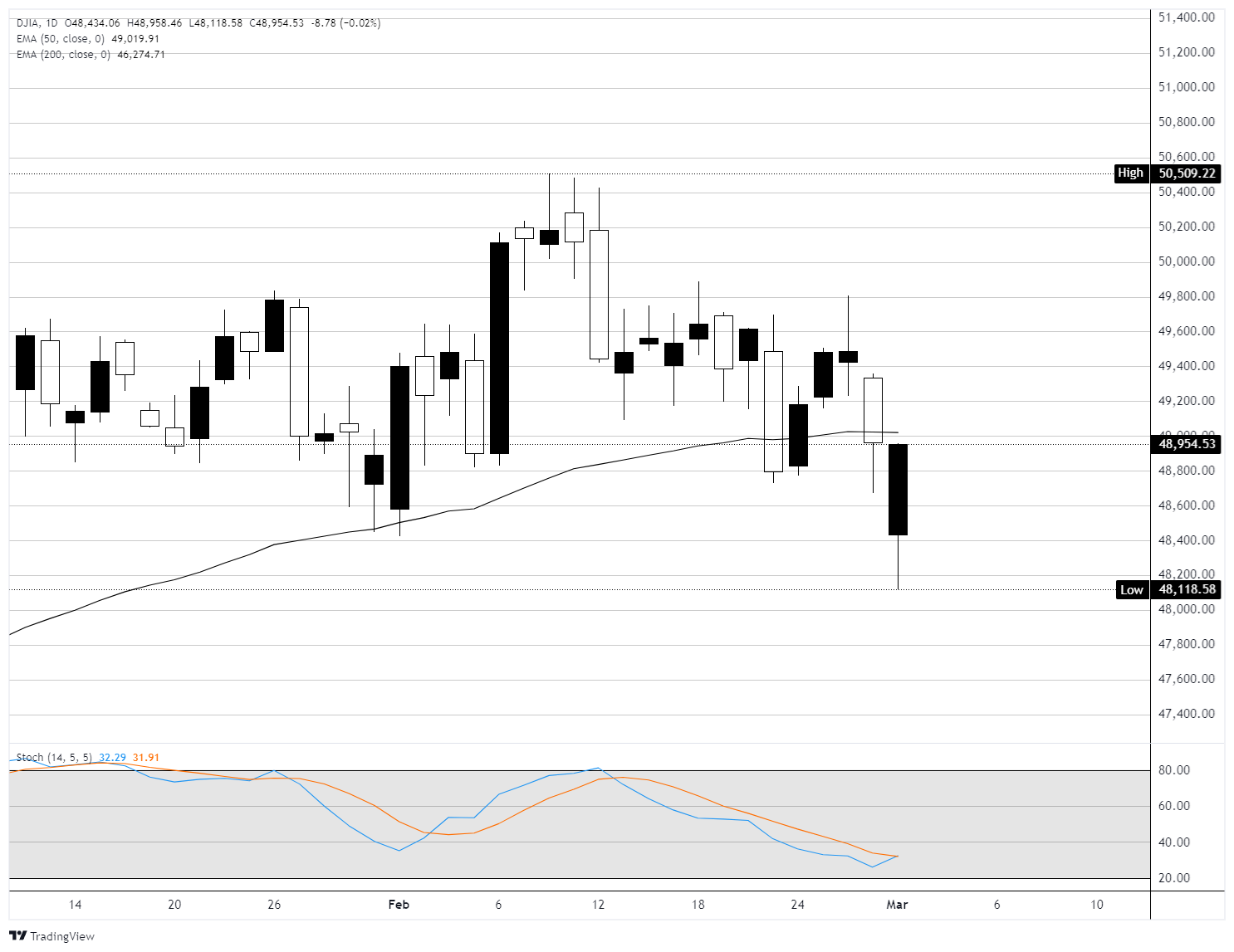
The Dow Jones Industrial Average is trading down around one-fifth of one percent at the time of writing on Monday. The S&P 500 is nearly flat, while the Nasdaq Composite has flipped green for the day. All three indexes have staged a significant recovery from their session lows: the Nasdaq was down as much as 1.6% earlier in the session, while the S&P 500 and Dow both pulled back around 1.2% at their worst.
Oil rips, Gold catches a bid, and the VIX spikes
The escalating US-Iran conflict is the dominant theme in markets on Monday. Over the weekend, the US and Israel launched coordinated strikes on Iran in an operation dubbed "Epic Fury," which killed Iran's Supreme Leader Ayatollah Ali Khamenei. Iran retaliated with strikes against US bases in the Middle East, killing three US service members. West Texas Intermediate (WTI) Crude is trading around $72 per barrel, up roughly 8% from Friday's close near $67. Brent Crude has hit a new 52-week high above $78. The surge reflects fears of supply disruption through the Strait of Hormuz, where container shipping giants have already suspended operations and rerouted vessels around Africa. Gold is catching a strong safe-haven bid, trading near $5,400 per ounce, up over 2% on the day. The CBOE Volatility Index (VIX) has surged about 19% to around 23.6, its highest level of 2026 so far, pushing above its long-run average around 20.
Defense stocks soar, airlines and travel names get crushed
It's a tale of two sectors. Defense names are flying, with Lockheed Martin (LMT) up over 3%, Northrop Grumman (NOC) gaining around 4%, and RTX (RTX) climbing a similar amount. Drone maker AeroVironment (AVAV) has jumped more than 10%. Investors are betting that the conflict translates directly into accelerated government defense spending. On the flip side, travel and airline stocks are getting hammered. United Airlines (UAL) is down over 5%, with American Airlines (AAL) and Delta Air Lines (DAL) falling a similar amount. Hotel chains Marriott International (MAR) and Hilton Worldwide (HLT) are both lower, while booking platforms Expedia (EXPE) and Booking Holdings (BKNG) are also seeing significant selling pressure as the conflict disrupts global tourism and cancels flights to Middle East destinations.
Energy producers rally on surging Oil prices
The Oil price spike is translating directly into gains for energy producers. Exxon Mobil (XOM) is up around 4%, Chevron (CVX) is gaining roughly 3%, and ConocoPhillips (COP) is advancing over 5%. Tanker stocks are also surging on expectations of longer shipping routes — Frontline (FRO) is up more than 5%, DHT Holdings (DHT) is gaining 7%, and International Seaways (INSW) is up 6%. The big question for markets from here is whether the surge in Oil prices translates into a fresh round of inflation concerns that complicates the Federal Reserve's (Fed) rate path. Rates markets are currently pricing in a roughly 96% probability that the Fed holds rates steady at 3.50-3.75% at its March meeting, and the spike in energy prices gives policymakers even less reason to cut anytime soon.
Nvidia bets big on photonics with $4 billion investment
In corporate news outside the geopolitical chaos, Nvidia (NVDA) announced it is investing $2 billion each in Lumentum Holdings (LITE) and Coherent (COHR) as part of multi-year strategic partnerships focused on advanced photonics technology for next-generation AI data centers. Both Lumentum and Coherent surged over 7% in premarket trading on the news, though gains have moderated through the session. Nvidia itself is trading lower on the day as part of the broader risk-off move, despite the investment being viewed positively for its AI infrastructure ambitions. Light-based photonics technology is increasingly seen as critical for scaling AI networks and reducing energy bottlenecks in data centers.
ISM Manufacturing PMI holds in expansion territory
On the data front, the Institute for Supply Management (ISM) Manufacturing Purchasing Managers Index (PMI) came in at 52.4 for February, slightly below January's 52.6 but still comfortably in expansion territory. It marks the second straight month of expansion for the manufacturing sector — only the third time in 40 months. New Orders came in at a healthy 55.8, down from 57.1 in January but still showing solid demand. The Prices Index and Supplier Deliveries sub-indexes are worth watching in the weeks ahead, particularly if the Oil price surge persists — higher input costs and potential shipping disruptions could start feeding through to the manufacturing sector and complicate the inflation picture heading into the second quarter.
Dow Jones daily chart
Dow Jones FAQs
The Dow Jones Industrial Average, one of the oldest stock market indices in the world, is compiled of the 30 most traded stocks in the US. The index is price-weighted rather than weighted by capitalization. It is calculated by summing the prices of the constituent stocks and dividing them by a factor, currently 0.152. The index was founded by Charles Dow, who also founded the Wall Street Journal. In later years it has been criticized for not being broadly representative enough because it only tracks 30 conglomerates, unlike broader indices such as the S&P 500.
Many different factors drive the Dow Jones Industrial Average (DJIA). The aggregate performance of the component companies revealed in quarterly company earnings reports is the main one. US and global macroeconomic data also contributes as it impacts on investor sentiment. The level of interest rates, set by the Federal Reserve (Fed), also influences the DJIA as it affects the cost of credit, on which many corporations are heavily reliant. Therefore, inflation can be a major driver as well as other metrics which impact the Fed decisions.
Dow Theory is a method for identifying the primary trend of the stock market developed by Charles Dow. A key step is to compare the direction of the Dow Jones Industrial Average (DJIA) and the Dow Jones Transportation Average (DJTA) and only follow trends where both are moving in the same direction. Volume is a confirmatory criteria. The theory uses elements of peak and trough analysis. Dow’s theory posits three trend phases: accumulation, when smart money starts buying or selling; public participation, when the wider public joins in; and distribution, when the smart money exits.
There are a number of ways to trade the DJIA. One is to use ETFs which allow investors to trade the DJIA as a single security, rather than having to buy shares in all 30 constituent companies. A leading example is the SPDR Dow Jones Industrial Average ETF (DIA). DJIA futures contracts enable traders to speculate on the future value of the index and Options provide the right, but not the obligation, to buy or sell the index at a predetermined price in the future. Mutual funds enable investors to buy a share of a diversified portfolio of DJIA stocks thus providing exposure to the overall index.
Author

Joshua Gibson
FXStreet
Joshua joins the FXStreet team as an Economics and Finance double major from Vancouver Island University with twelve years' experience as an independent trader focusing on technical analysis.